WASHINGTON—Douglas Parker, President Biden’s Occupational Safety and Health Administrator, is warning congressional Republicans against massive cuts—which GOP President Donald Trump proposes—in job safety and health enforcement and in the research that backs it up.
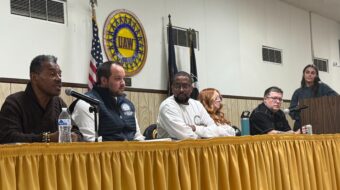
Parker raised those points at a House subcommittee hearing on job safety and health, called by the Republican-run House Workforce Protections Subcommittee. Unlike other hearings by that panel’s parent committee, Education and the Workforce, questions from both sides of the aisle lacked right-wing fireworks.
The future of job safety and health protections is in doubt. Republican witnesses before the panel, led by Pat Sughrue, health and safety director for Cianbro Corp. of Maine, speaking for the anti-union and anti-worker Associated Builders and Contractors, proposed looking forward to preventing hazards, rather than enforcement. Other witnesses sang that line, too, if less strongly.
Trump proposes a $50 million (13.5%) cut in enforcement money at OSHA for the fiscal year starting October 1 and a 36% cut in inspections nationwide, Parker testified on May 13. Trump would cut research on safety and health hazards, which workers and OSHA inspectors depend upon, by the National Institute for Occupational Safety and Health (NIOSH) by 75% in that fiscal year.
Trump, through multibillionaire Elon Musk and his so-called Department of Government Efficiency, wanted to completely kill NIOSH. But the Mine Workers and furloughed NIOSH workers led a mass protest in downtown D.C. against that elimination. It drew so much publicity that Congress retreated.
“Thankfully, through the efforts of the public, including leading voices from labor and management, this decision was reversed,” Parker said. “This non–partisan recognition of the critical role of a public institution in providing value to both workers and employers was a welcome departure from the current climate of divisiveness.” But in his budget for fiscal 2027, Trump is trying again.
Combining the money cut with only 700 federal OSHA inspectors, a smaller support staff, and a similar force of state OSHA inspectors—in those states, such as the home state of California, where the state handles job safety—would decimate deterrence, Parker said.
Killing NIOSH and OSHA would delight the corporate chieftains who hate job safety rules that cut into their profits. And OSHA and Mine Safety and Health Administration inspectors can’t write rules to enforce without NIOSH research beforehand on the hazards. The 75% NIOSH money cut eliminates all the research, said Parker.
Parker didn’t completely write off looking forward and trying to prevent hazards before deaths and accidents occur. But it must be done collaboratively and especially include workers, who bring on-the-job expertise about what works, what doesn’t, and what obstacles occur, he said.
“We should encourage innovation, research, and a scientific approach to improving outcomes for workers,” he said. But “health and safety strategies implemented by employers do not develop in a vacuum. While many employers deserve credit for their significant commitment to health and safety, It would be a mistake to think of emerging health and safety strategies as employer-developed.
“Strategies are grounded in years of experience and study of the nature of workplace hazards. They are grounded in the demands of organized labor to improve working conditions, and in labor-management agreements that have for years improved safety programs through worker participation, input, and negotiation.”
Those agreements are written into union contracts. What was written into OSHA’s rules under Biden and Parker was a required offer for someone to represent workers, or their heirs, at a disaster. Often, the “someone” is a union safety and health expert who “walks around” to represent workers, even non-union workers, as OSHA inspectors do their jobs.
The unionists often catch problems OSHA’s probers don’t. Trump wants to bump the unionists out of the walkarounds.
There are other problems with relying just on looking forward, Parker noted. One is the undercount of illnesses, particularly on-the-job injuries. Some of that underreporting, he noted, is due to corporate pressure on workers not to complain or call OSHA with injury reports.
More injury reports mean increases in workers’ comp premiums, data show, and that cuts into profits. Parker politely did not say that.
Another is that past records of injuries can help predict future outcomes. But that’s not true of illnesses, since many, like black lung disease, develop long afterward.
“For example, if an employer has a high number of ergonomic injuries and implements a new ergonomic program, the number of past injuries is a lagging indicator of future ergonomic injuries. In addition to being a lagging indicator, it has limited predictive value in determining how the new program will work,” Parker testified.
“However, it remains a critical benchmark for future performance. It is also a record of past outcomes, and represents worker suffering, lost income for the worker, and lost economic value” for the firm.
The top Democrat on the subcommittee, Rep. Ilhan Omar, DFL-Minn., emphasized many of the same points. She also honed in on Trump’s proposed cuts.
“NIOSH has lost many valuable experts to attrition, and we do not know whether the agency is being allowed to replace them. This is yet another example of how the Trump administration’s recklessness has come at the direct expense of protecting and prioritizing working Americans,” said Omar.
“OSHA and NIOSH are our best, longstanding tools to stop workplace harm. It is vital we fully fund and staff these agencies to identify and correct unsafe working conditions, because voluntary compliance programs or leading indicators alone will not be enough.”
And Omar singled out the dangers of high heat exposure, which affects construction and utility workers in urban areas, such as her Minneapolis district, as well as farm workers nationwide.
“The Trump administration’s weakened OSHA enforcement program on heat stress will leave workers vulnerable. And in turn, the workers who are able to seek medical care for heat stress will be entrusted to our nation’s hardworking health care workers, who still face serious risks of workplace violence, another danger the Trump administration has chosen to ignore,” Omar concluded.
We hope you appreciated this article. At People’s World, we believe news and information should be free and accessible to all, but we need your help. Our journalism is free of corporate influence and paywalls because we are totally reader-supported. Only you, our readers and supporters, make this possible. If you enjoy reading People’s World and the stories we bring you, please support our work by donating or becoming a monthly sustainer today. Thank you!
CONTRIBUTOR