WASHINGTON—With a July 1 deadline looming for the U.S., Mexico, and Canada to review, extend, rewrite, or junk their trade treaty, the USMCA, the labor-environmentalist BlueGreen Alliance demands stronger pro-worker safeguards in any replacement pact.
And they are pressuring Trump to make good on the criticisms he expressed regarding NAFTA and earlier trade agreements when he ran for the presidency the first time, and his repetition of pro-worker sentiments when he ran in 2024. He has been noted to repeatedly change positions on issues once he gets into office or into a place where he can make good on the promises.
During his first term and in both his 2016 and 2024 re-election bids, he denounced the original three-nation pact, NAFTA, as a sellout of U.S. workers. Now, only days before the new pact goes into effect, he has mentioned nothing about worker protections in the deal, preferring to focus on ballrooms and alleged vandalism at the reflecting pool in the nation’s capital.
Trump nevertheless kept up his criticism of the USMCA (U.S.-Canada-Mexico Agreement), and it helped him win key industrial Great Lakes states in 2024. His blasts at NAFTA helped him win those states in 2016. Now is the time for him to put up or shut up on the issue
Backers claimed the USMCA would benefit workers, despite the corporate exodus of factory jobs from the U.S. to Mexico. It didn’t. Corporate CEOs moved U.S. factories making everything from cars to cookies south of the border, leaving U.S. workers—many of them unionized—without jobs and Mexican workers with pay much lower than what the companies can afford.
“If corporations can cut costs by relocating where they can pay workers poverty wages, offer fewer protections, and exploit and pollute the environment without consequence, we will continue to see a ‘race-to-the-bottom’ trade regime. North America can and should set a global example for strong labor and environmental protections,” the BlueGreen Alliance declared.
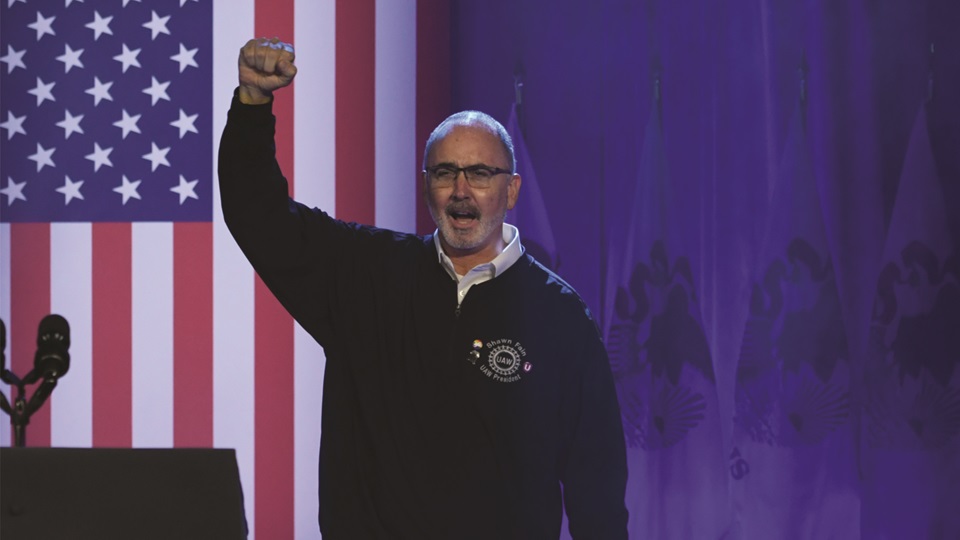
The Auto Workers, led by President Shawn Fain, particularly denounce the USMCA—and NAFTA before it—as continued sellouts of U.S. workers, by the Detroit 3 car companies interested only in exploiting Mexico’s low pay and lax environmental rules to enhance their profits
And earlier this year, UAW sent Trump’s United States Trade Representative, Jamieson Greer, a 29-page detailed analysis of how any replacement pact must fix NAFTA’s and the USMCA’s flaws—starting with equivalent pay for Mexican autoworkers and an even higher North American content standard for vehicles manufactured in the three nations.
UAW isn’t the only union critic. “Working people need both good jobs and a clean environment,” Steelworkers President Roxanne Brown said in late June when the BlueGreen Alliance sent Greer its own analysis of the USMCA and what should replace it.
One option the alliance strongly opposes is a straight 16-year extension of the USMCA, unchanged.
The alliance wants to ensure any new pact that amends or replaces the USMCA “delivers on both of these crucial objectives. That will only happen when we stop corporations from shifting jobs to Mexico just to exploit the low wages and lax environmental safeguards there,” Brown added.
That’s in line with the alliance’s overall platform, which has been consistent ever since the Steelworkers and the Sierra Club co-founded it 20 years ago.
“Our coalition works every day to develop common goals, navigate differences, and advocate collectively to end the exploitation of both workers and the environment. Nowhere has this been more necessary than on trade,” said Jason Walsh, the alliance’s executive director.
“Now is our time to fix USMCA to protect workers’ rights, encourage clean manufacturing, and raise labor and environmental standards across North America.”
The USMCA was an improvement over NAFTA, largely because the AFL-CIO and the former top trade and legislative representatives of the UAW and the Teamsters actually had a hand in writing it. It established minimum wage standards for Mexico, which the current government there has implemented. NAFTA was written behind closed doors by the corporate chiefs, with no labor input.
The USMCA also opened the way for independent, not pro-corporate or pro-government, unions south of the border, along with a stronger Mexican labor rights law, including planned enforcement with tougher penalties than in the U.S. The law is stronger; the enforcement is spotty.
And there should be a similar law, again with strong enforcement, for environmental standards in all three nations, the BlueGreen Alliance says.
Right now, the alliance contends, the USMCA still “prioritizes the enrichment of multinational corporations at the expense of working people and the planet.’ And it “still rewards companies for offshoring production, paying the lowest wages possible, and laying waste to the environment in the most vulnerable communities,” the alliance told Trump’s trade representative, Greer.
Among the key changes any new trade pact should include are:
- Extending its minimum North American content rules to all types of vehicles, including electric vehicles and autonomous (self-driving) vehicles, along with semiconductors, batteries, chips, critical materials, and software needed for cars, trucks, and SUVs.
- Closing a USMCA loophole that lets companies import components of cars—or anything else—from non-North American nations to Mexico, where they would be relabeled as “Mexican,” i.e., North American, and could enter the U.S. duty-free, to be assembled here.
The alliance noted 20% of the “made in Mexico” components in vehicles headed for the U.S. were actually made in China.
- Even including higher wages for Mexican autoworkers, the average factory wage in Mexico is still only $2.76 an hour. BlueGreen demands a new pact have a much higher minimum wage—and that it covers “core manufacturing workers” in all three countries.
That’s important to all U.S. workers. Just under half of all U.S. states, virtually all of them “red states” run by Republican regimes in the South, the Great Plains, and the Rocky Mountains, still use the federal minimum wage of $7.25 an hour, which hasn’t risen since 2009.
- The USMCA mandates “40% of a vehicle’s content must come from facilities where workers earn at least $16 an hour. “The provision should be strengthened to ensure manufacturers aren’t incentivized to offshore so they can pay workers less. Specifically, it should expand the $16/hour wage rules to other significant manufacturing sectors like aircraft and shipbuilding,” BlueGreen adds.
In their separate set of standards for a new trade pact, the Auto Workers want to increase North American content, too.
The alliance also wants to both strengthen the Labor Rapid Response Mechanism—U.S.-aided and funded enforcement of labor laws in Mexico—and establish an identical one for environmental violations.
The LRRM teams, often alerted by independent Mexican unions, their U.S. allies, or both, probe labor law violations at Mexican factories and enterprises and impose fines and other sanctions, including trade sanctions. That makes labor law violation penalties in Mexico tougher than they are in the U.S.
What the alliance letter omits, however, is that the U.S. enforcement money, joint inspectors, and training of the Mexicans all come from the U.S. Labor Department’s Bureau of International Labor Affairs, which both Trump and the GOP-majority on the House Appropriations Committee want to abolish. That panel helps decide what agencies actually get our taxpayer dollars.
We hope you appreciated this article. At People’s World, we believe news and information should be free and accessible to all, but we need your help. Our journalism is free of corporate influence and paywalls because we are totally reader-supported. Only you, our readers and supporters, make this possible. If you enjoy reading People’s World and the stories we bring you, please support our work by donating or becoming a monthly sustainer today. Thank you!
CONTRIBUTOR