DALLAS—Over two weekends in June, Bridge North Texas and the Black Faith Coalition brought together faith leaders, labor organizers, and community activists for a series of trainings and rallies aimed at building progressive people power and driving voter turnout among poor and low-wage Texans.
The effort kicked off on Saturday, June 6, at Friendship West Baptist Church—a historically African American congregation—with an info session and non-compliance training titled Organized People Change Everything. A second session followed the next day at the Communication Workers of America union hall in Dallas. Together, the trainings covered authoritarianism, fascism, civil disobedience, and strategies for progressive organizing.
Bridge North Texas seeks to unite faith communities, historically Black churches, labor unions, and civil rights organizations into a broad, independent coalition built for the long haul.
At the opening of the Saturday training, Bridge North Texas and Black Faith Coalition leader Edwin Robinson cited author Steve Phillips—whose books include How We Win the Civil War: Securing a Multiracial Democracy and Ending White Supremacy for Good and Brown is the New White: How the Demographic Revolution Has Created a New American Majority —as a major influence on the organization’s direction.
Presenter Tasneem Al-Michael offered a sobering framework for understanding the current political moment. Authoritarianism, he argued, is a system—not just a person—that relies on social, political, economic, and cultural institutions to sustain it. He traced its roots in the United States to a long history of racism and white supremacy, and warned that the country is now experiencing what he called an “authoritarian breakthrough”—a narrow window in which an authoritarian regime moves aggressively to consolidate power and dismantle the checks on it.

The following week, on June 9 and 10, Bridge North Texas hosted online nonviolence training sessions led by Vonnetta West and Curtis Johnson of the Martin Luther King Jr. Center for Nonviolent Social Change.
Drawing on Dr. King’s legacy, the presenters walked participants through the six principles of nonviolence—among them, that nonviolence is a way of life for courageous people, that it seeks to defeat injustice rather than people, and that it holds voluntary suffering for a just cause to be redemptive and transformative.
They also outlined six steps for nonviolent social change, moving from information gathering and education through personal commitment, negotiation, direct action, and ultimately reconciliation. The goal, they emphasized, is the “beloved community”—a society grounded in love and justice.
Bishop Barber brings the fire
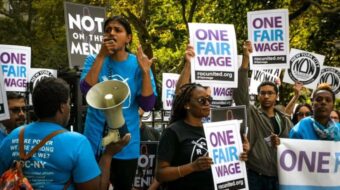
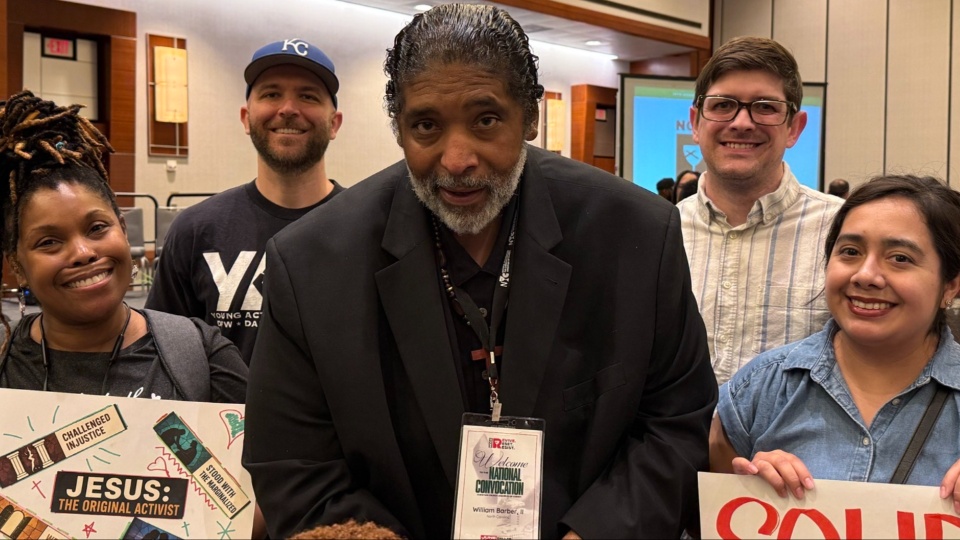
The series reached its emotional peak on Saturday, June 13, when Bishop William Barber II, co-chair of the Poor People’s Campaign, headlined a rally in Dallas alongside Bridge North Texas and the Black Faith Coalition.
Barber, whose thundering oratory blends scripture with political analysis, delivered an unsparing message: The progressive movement failed to do enough to stop Trump and the rise of what he called “neo-fascism”—and it needs to own that.
“All of this ain’t Trump’s fault,” he told the crowd. “Everyone of us got to say, ‘I’m part of this too, I didn’t do all I should’ve done.’ The church ain’t done all it should’ve done.
“Who let ’em in? And why did we only get excited after they destroyed the Voting Rights Act? The Voting Rights Act was attacked in 2013, we didn’t have one major march on Voting Rights, in 2014 and 2015, when they totally killed it, now everybody wants to march.”
He backed that charge with numbers. Trump won the 2024 presidential election by only two million votes, Barber noted, while 89 million Americans stayed home. In Texas alone, Trump’s margin was 1.6 million votes—but 2.5 million poor and low-wage voters never cast a ballot. Congressional control, he pointed out, came down to roughly 7,000 votes separating Hakeem Jeffries from Mike Johnson as Speaker.
“We think Trump won by this big mandate—No! We didn’t fight!” Barber said.
His prescription was a march to the polls this year and in every election—block by block, congregation by congregation. He challenged church leaders to stop running organizers out of their pews and start building political infrastructure within their own communities.
 “If you don’t have a political action committee in your congregation to know who voted, you ain’t serious,” he said. “You don’t leave a mega church and then tell everybody else what to do—you organize that mega church and then two miles around that church.”
Barber was equally pointed in rejecting both partisan loyalty and racial separatism as paths forward. He reminded the audience that nine Democrats joined Republicans in 2020 to block a living wage increase, and invoked Dr. King’s warning that the greatest fear of the wealthy oligarchy is the moment poor Black and white Americans unite into a single voting bloc powerful enough to reshape the nation’s economic architecture.
“The church always needs to stand up,” he emphasized, “not just right now. It’s not because we got a certain administration. It doesn’t matter the administration, Democrat or Republican.
“The moment that we are in is not white supremacy alone…. The moment we are in is neo-fascism and authoritarianism. And authoritarianism ain’t after just Black folk, it’s after everybody that’s poor and marginalized,” said Barber.
“Neo-fascism takes all of the economic systems and turns them to the greedy, by letting inflation run, cause that’s the way you pay back the friends that got you in office. Or let oil prices go up cause that’s how you pay back….”
Again emphasizing the need for multiracial unity, he said, “Neo-Black nationalism will not get us out of this. That’s what they want—the white folk over here, and the Black folk over there.”
He also drew a direct line between religious nationalism and money, arguing that Texas oil wealth funds much of the movement. “If you don’t understand that connection, you really don’t understand the battle that we are in.”
What comes next
The Black Faith Coalition is now moving from training to action. Under the banner of Freedom Summer 2.0, the coalition has announced a statewide series of organizing events: July 24–25 in Houston, August 21–22 in Austin, and September 18–19 in Dallas—all aimed at turning out the very voters Bishop Barber described: poor, low-wage, and largely absent from recent elections.
We hope you appreciated this article. At People’s World, we believe news and information should be free and accessible to all, but we need your help. Our journalism is free of corporate influence and paywalls because we are totally reader-supported. Only you, our readers and supporters, make this possible. If you enjoy reading People’s World and the stories we bring you, please support our work by donating or becoming a monthly sustainer today. Thank you!
CONTRIBUTOR