

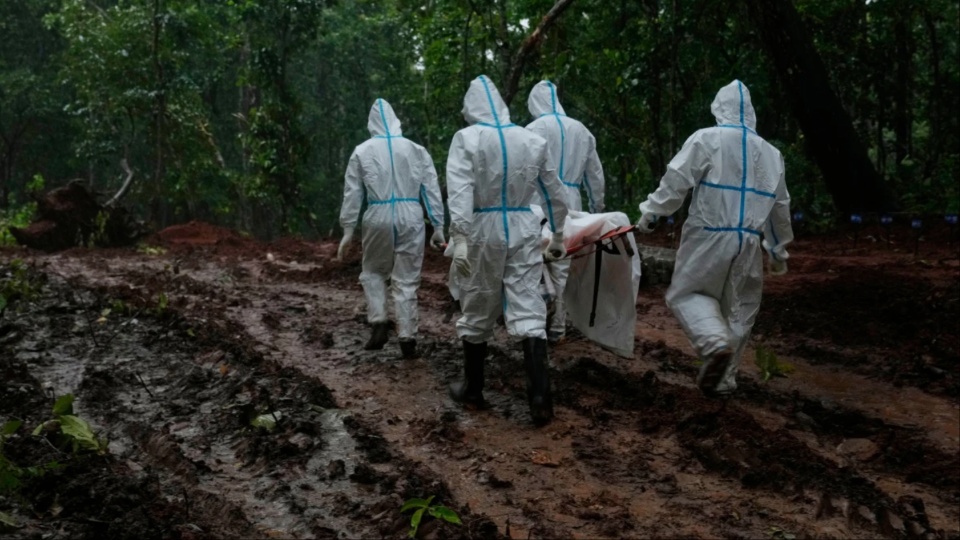
The speed at which a glacier can become a disaster was revealed high in the Himalayas last week, at an elevation of roughly 5,200 meters (17,000 feet), when a glacier near the China-Nepal border fractured, unleashing a cascade of rock and ice. But what began as an ice avalanche soon became a high-speed debris flow and then turned into a catastrophic mudslide.
By the time it reached Gyirong Port in China’s Xizang autonomous region, it was hurtling at roughly 180 kilometers (112 miles) per hour. The entire sequence from the initial collapse to the devastating arrival of the mudslide at Gyirong Port took only about seven minutes, leaving no time for prewarning and causing heavy casualties on both sides of the border.
Scientists have long warned that glaciers around the Qinghai-Tibet Plateau and the broader Himalayan region—the so-called “Third Pole” and the largest body of ice outside the Arctic and Antarctic—are becoming increasingly unstable as the planet warms.
Glaciers are extraordinarily sensitive to temperature changes, and human-induced warming has been the primary driver of widespread glacial retreat since the 1990s. This continued melting does not merely make glaciers smaller but also destabilizes them, markedly increasing the likelihood of ice, rock, and water moving together. As the climate warms, such glacial chain disasters are becoming more frequent, more widespread, and more destructive.
The glacier was, in this case, more a messenger than a culprit. The years from 2015 through 2025 were the 11 hottest on record. Global greenhouse-gas emissions reached a record high, while glaciers worldwide lost an estimated 408 billion metric tons of mass in 2025 alone—equivalent to filling five Olympic-sized swimming pools every second of the year. The Himalayas are among the regions that suffered the greatest losses.
Yet, when such disasters occur, responsibility is often discussed as though emissions were neatly confined within national borders. They are not.
A smartphone assembled in Asia does not become environmentally benign because its eventual buyer lives in California. National emissions inventories by country generally count pollution where production occurs, even if production serves consumption elsewhere. The result is a peculiar accounting system in which wealthy societies consume carbon-intensive goods while much of the associated pollution appears on somebody else’s ledger.
For instance, while the U.S.’ territorial energy-related carbon dioxide emissions reached roughly 4.9 billion metric tons in 2025, its consumption footprint is significantly higher, revealing the carbon cost of outsourcing production to other countries.
This matters because the climate crisis is fundamentally a question of cumulative emissions. The U.S. alone is responsible for roughly one-fifth of all cumulative carbon dioxide emissions since 1850, with the European Union accounting for about 12%. Taken together, developed nations have emitted 60 to 65% of all greenhouse gases while representing less than 15% of the world’s population.

The developed economies have benefited enormously from over two centuries of carbon-intensive industrialization. They therefore cannot plausibly present themselves as innocent bystanders when the consequences of their prosperity manifest in poorer and more vulnerable parts of the world.
Nor is climate finance charity. The principle of common but differentiated responsibilities recognizes a basic fact: Countries share a common interest in stabilizing the climate, but they do not share identical histories or capacities.
The Paris Agreement explicitly requires developed countries to provide funds and technological support to developing nations. The pledge made in 2009 to mobilize $100 billion annually by 2020 was met two years late. Even now, the new target of $300 billion per year by 2035 remains a fraction of the $2.4 trillion that United Nations experts estimate developing countries actually need every year.
This makes the upcoming COP31 meeting in Antalya, Turkiye, more than just another diplomatic gathering. It should be a test of whether climate promises can evolve into practical solidarity. The conference is expected to address climate finance, the transition away from fossil fuels, and measures for building climate-resilient societies.
Will wealthy countries provide developing countries the finance and technology needed not merely to reduce emissions but also to survive the consequences of warming that are already unfolding? The old answer—that everyone is responsible, therefore everyone is equally responsible—is morally convenient but scientifically inadequate. A glacier does not know where a factory is registered. Carbon dioxide does not carry a passport.
The mudslide along the China-Nepal border should therefore be seen as a warning from our warming planet. The question at COP31 is whether the world’s wealthiest economies will heed this warning and acknowledge that helping vulnerable countries confront the consequences is not generosity but part of the bill for a crisis from which they have benefited for generations.
We hope you appreciated this article. At People’s World, we believe news and information should be free and accessible to all, but we need your help. Our journalism is free of corporate influence and paywalls because we are totally reader-supported. Only you, our readers and supporters, make this possible. If you enjoy reading People’s World and the stories we bring you, please support our work by donating or becoming a monthly sustainer today. Thank you!
CONTRIBUTOR




MOST POPULAR TODAY

Warnings sound: Trump ready to stage what amounts to a full-fledged coup

Workers walk: Almost 100K California employees struck for a day

Grenada marks 40 years since the assassination of revolutionary leader Maurice Bishop


Cuba solidarity: HotHouse delegation to combine cultural exchange with humanitarian aid