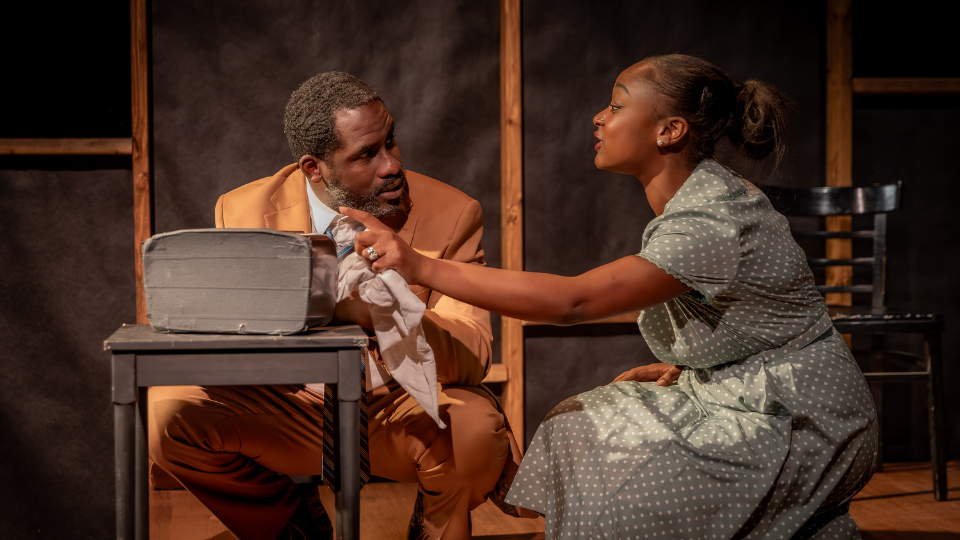
The Robey Theatre Company’s production of Leslie Lee’s circa 1983 Colored People’s Time, A History Play, recounts 100 years of African American life. Through a series of 13 vignettes presented more or less in chronological order, Lee traces the evolution of Black people from the 1850s to the 1950s, as they strive to survive and thrive in America.
The scenes are sandwiched between prologues and epilogues featuring a narrator who philosophically ruminates on the nature and passage of time, accentuated by the amplified ticking of a clock. The cast of nine performs on a mostly bare, two-level stage, intermittently enlivened by some projections, with different actors in each scene (the dramatis personae never appear together en masse onstage, except during the proverbial curtain call).
Along with tragedy and comedy, a “history play”—which recounts a historical narrative, such as Shakespeare’s dramatizations of the lives and reigns of monarchs, as in Richard III—is one of the three main genres of Western theatre. Having said that, Colored People’s Time definitely combines elements of both tragedy and comedy, as well as musicals, too. However, unlike the Bard of Avon, Lee’s storytelling does not focus on the high and mighty but rather on ordinary people, the rank and file who actually turn the wheel of history.
While outstanding Black leaders such as Joe Louis, Marcus Garvey, Martin Luther King, and Rosa Parks may be referenced as touchstones in various vignettes during the course of this almost two-and-a-half-hour production with one intermission, Lee rather democratically zooms in on everyday Black people, and the roles they play in the course of human events, and how those episodes impact them.
There are too many vignettes staged and actors staging them for me to recount them all, but here are the highlights. The action starts with a sketch that, according to the program, is entitled “Bell Da Ring” set in 1859, Mississippi. Four barefoot enslaved people surreptitiously meet, presumably, in the woods, far from the prying eyes of their enslaver. Untutored and perhaps illiterate, Sampson (Jah Shams) leads a rambling retelling of the Old Testament story about Jonah for acolytes. The antsy Issac (Philip Bell, his name especially appropriate here) is frightened that their slavers may discover them, yet his spirit has moved him to join them, along with Hannah (Enisha Brewster).
Although the would-be preacher man may veer off course and be corrected by Catherine (Autumn Renae), what’s significant in this recounting by people in bondage is that the Bible is interpreted in line with liberation theology’s understanding of the Good Book (which, given the current brouhaha between courageous Pope Leo XIV standing up for peace against the Trump regime, is especially timely).
Sort of launching a new Africanized church, the quartet gathers around a cauldron, which may be a reference to Macbeth or how, as alluded to above, the USA is a seething, boiling cauldron of hatred and racism. Two acapella songs enliven the sequence: Renae presciently sings that freedom is coming—John Brown’s abolitionist army struck Harpers Ferry the year this scene is set, and the Civil War that would lead to emancipation began two years later. Enisha Brewster sings a sonorous, lilting number.
The next vignette, “Buckra,” set in 1870 South Carolina, is interesting, yet misses an opportunity. What’s intriguing is that two formerly enslaved men, portrayed by James T. Lawson II and Kermit C. Burns, try to get by in the South performing “coon shows” in blackface. Although the subject of how blackface represented, or better yet, misrepresented African Americans, is indeed worthy of exploration, Lee missed the boat here, as this scene takes place during one of the most momentous eras in U.S. history for Black people: Reconstruction. It can be argued that, for about a decade, post-Civil War emancipated people, to some extent, experienced Black Power at the ballot box (at least for males), in legislatures, etc.
W.E.B. Du Bois subtitled his landmark 1935 tome Black Reconstruction, An Essay Toward a History of the Part Which Black Folk Played in the Attempt to Reconstruct Democracy in America… Despite this nonfiction chronicle, it’s interesting to note that American popular culture has largely neglected this rich, fruitful epoch with few exceptions, notably the 1979 TV movie Freedom Road starring Muhammad Ali as an ex-slave who becomes a legislator, directed by Czech transplant Jan Kadar, adapting the novel by Howard Fast—who, like Kadar and Du Bois, had been a Communist Party USA member.
In any case, it is a bitter fact of film history that the most prominent motion picture to depict Black Power during Reconstruction is arguably D.W. Griffith’s truly despicable 1915 The Birth of a Nation, although of course it does so with a viciously racist POV, dramatizing how Black voting rights and other advances triggered the creation of the KKK.
It’s disappointing that Leslie Lee has nothing better and more profound to say about this pivotal period in African American history other than to concentrate on minstrel shows.
The Great Migration of millions of Southern Black people to the supposedly greener pastures of the North takes center stage in several ensuing vignettes in Colored People’s Time, as in “…promise me something…” set in 1915, Richmond, Virginia. In “Blind John,” Bell drolly portrays a sightless musician trying to hop a ride on a train—is it the proverbial freedom train?
One part of the play poses the question: Was the promise of greater liberties and job opportunities in the North a reality or a chimera? The vignette takes place during a 1919 Chicago race riot. In it, the Jewish shopkeeper Berger (Darrell Philip), whose store is set aflame and looted, tries to save the life of a Black man wounded during the riot. When Dewit (Lawson II) derides him, Berger contends that as a Jew, he too has experienced bigotry, and insists: “Discrimination is discrimination, no matter who it is.” Presumably taped gunshots and chants of “We want justice!” are heard.
“Garvey’s taken over Harlem” takes place in 1926 during a parade in an Upper Manhattan apartment as a couple of lovers, Autumn Renae and uniformed Garveyite Kermit C. Burns, argue over the pros and cons of the back to Africa movement, the Universal Negro Improvement Association and Marcus Garvey, who was convicted of mail fraud (although his real “crime” was likely committing Black nationalism and Pan-Africanism; President Biden pardoned Garvey about a decade after Leslie Lee’s death).
In another scene that occurs in 1932 Harlem, the Great Depression is dramatized in “There’s something funny about you this mornin man,” wherein Nadine (Kimberly Bailey) rents out a bed by the hour for boarders to sleep in at her apartment. Trying to get some sleep, the wannabe poet Riggins (Burns) grouses: “It’s a Depression, and I got a right to be depressed.” The 1938 Detroit-set “Unemployed Worker” also delves into the effect the Depression had on African Americans.
“Joe Louis done made me want to dance” is on a much lighter note and illustrates Leslie Lee’s playwriting style that focuses on what Sly Stone called “Everyday People”— instead of on the high muckety-mucks. The 1938 rematch between “the Brown Bomber” and boxer Max Schmeling for the heavyweight title is the backdrop for this humorous scene. In the foreground are two couples who have gathered at the Kansas City home of Jah Shams and Autumn Renae to listen together to the fight being broadcast over a radio that has seen better days. The sequence cleverly, wittily dramatizes how the sheer excellence of Black athletics has been a source of ethnic pride. In addition to being Caucasian, Schmeling was also German, and the bouts between him and Louis also became a focal point of pre-war anti-Hitler sentiment, as the Nazis were extreme white supremacists.
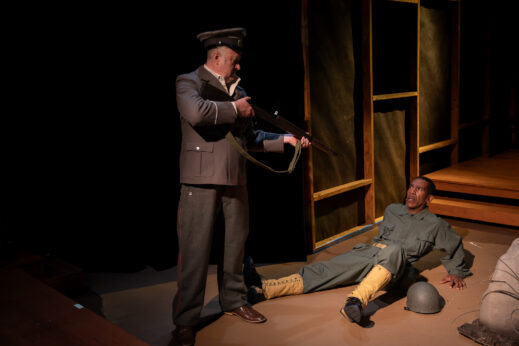
World War II continues to play an outsized role in Colored People’s Time, as it did in Black history. Singer/composer Cydney Wayne Davis performs rousing versions of WWII era hits, including the Andrews Sisters’ “The Boogie Woogie Bugle Boy” and “I’ll Be Seeing You.” The vignette “Yes, that is what they call you in America” is probably the play’s politically sharpest vignette, as Gus, a Black G.I. (Lawson II), gets the drop on a German officer—in a bit of canny casting, Klaus is played by Philip, who in a previous sketch had portrayed the Jewish character Berger.
Klaus befuddles Gus, reminding the Black soldier who is a proud part of the “Red Ball Express” trucking convoy that supplied American troops as they marched from Normandy to Germany, that upon returning home, Gus will have to fight another war against domestic racists. As a German, Klaus knows that the Nazis learned much about white supremacy and apartheid from Southern segregationists.
Lee saves the best for last in Colored People’s Time’s final and finest vignette, which takes place about a hundred years after this history play began in pre-Civil War Mississippi. The world-historical Montgomery Bus Boycott that shook America is the setting of the grand finale, but instead of depicting Rev. King or Rosa Parks (who are mentioned in passing), Lee again zooms in on those ordinary people who, when the chips are down, can do such extraordinary things.
Addie (Kimberly Bailey) and CJ (Jah Shams) are dog tired, and their feet hurt. Why? Because for more than a year, they have steadfastly been doing their part in supporting the bus boycott in Alabama in order to desegregate public transport. So, instead of riding the bus to work and so on, Addie and CJ have been walking to and from everywhere in Montgomery. They lament that if Black people were birds, “…The white folks [would] find a way to Jim Crow the air,” which is the name of this segment.
Contrary to the program for the play, which I believe erroneously sets this sketch in the year 1954, the last scene likely is meant to occur on December 20, 1956. Without divulging a plot spoiler, let’s just say that on that day, Addie, CJ, Black America, and all justice-loving people got one of the most wonderful Christmas gifts in the entire annals of the United States. The joy Bailey and CJ erupt with and express is contagious, evoking and encapsulating the pursuit of happiness that has so often been denied to what Stokely Carmichael called “the Africans in America.” In their outburst of sheer delirium, CJ and Addie use two words that, after seeing this beautiful play, may never mean the same things to you again: “Unconstitutional” and “sprawling.” For this bravura sequence alone, Bailey and Shams are award-worthy.
Director Ben Guillory, who is the Producing Artistic Director and co-founder of the Robey Theatre with Danny Glover (who has a producer credit for this production), expertly and artistically helms his ensemble and moves this play, about a century in the life of a people, along flowingly. You could call Lee’s history play “A Sprawling Saga.” How fitting that it is being revived by the Robey Theatre, which is named after one of the greatest entertainers and civil rights activists, Paul Robeson.
Colored People’s Time is a must-see for theatergoers interested in African American themes, historical subject matter, gifted writing, direction, and acting.
The Robey Theatre Company presents Colored People’s Time, A History Play on Thursdays, Fridays, and Saturdays at 8:00 p.m. and Sundays at 3:00 p.m. through May 17 at the Los Angeles Theatre Center, Theatre 4, 514 S. Spring Street, Los Angeles, CA 90013. For info and tickets, call (213)489-0994 or visit here.
We hope you appreciated this article. At People’s World, we believe news and information should be free and accessible to all, but we need your help. Our journalism is free of corporate influence and paywalls because we are totally reader-supported. Only you, our readers and supporters, make this possible. If you enjoy reading People’s World and the stories we bring you, please support our work by donating or becoming a monthly sustainer today. Thank you!
CONTRIBUTOR