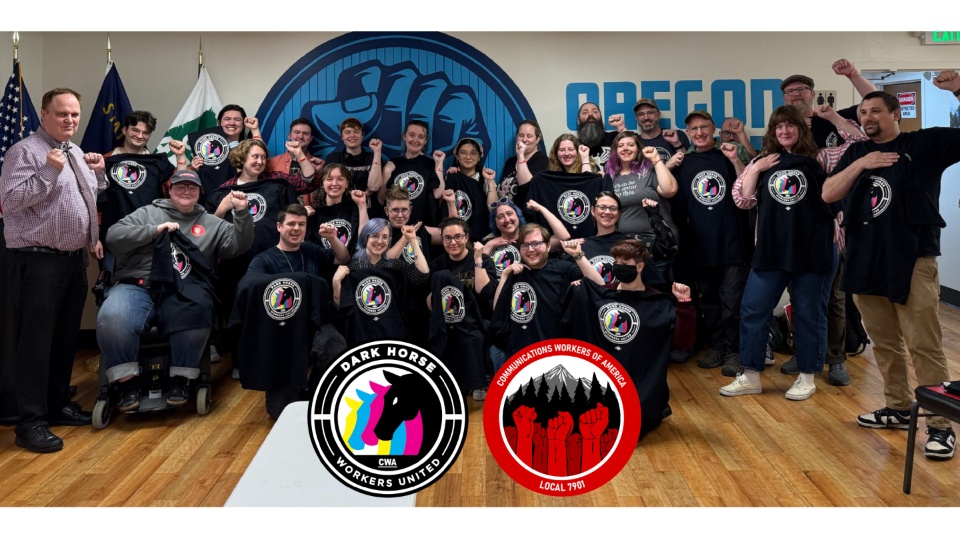
On May 27, 2026, workers at Dark Horse Comics announced the formation of Dark Horse Workers United in partnership with Communications Workers of America Local 7901. Last week, People’s World secured an exclusive interview with one of the workers to get the full scoop on the situation for workers at the comic book publishing company.
But first, a little bit of background information for those not familiar with CWA and Dark Horse:
CWA formed in 1938 to represent telephone operators, but today its membership covers a broad range of occupations. The Association of Flight Attendants, The NewsGuild; National Association of Broadcast Employees and Technicians; Printing, Publishing, and Media Workers; and United Videogame Workers are just a few of the unions that exist under the CWA umbrella.
The labor group helped establish the Alphabet Workers Union in 2021, which represents Google and other Alphabet company workers, and most recently it helped launch United Wizards of the Coast, composed of board game and card game workers.

Dark Horse Comics was founded in 1986, and for 40 years its office has operated out of Milwaukie, Oregon, just southeast of Portland. In the early days of the company, Dark Horse gained a reputation for working with small or new creators who were often outside the mainstream. Many of these artists retained creative control over their intellectual property, which is unusual in the comics industry. Some of Dark Horse’s most successful titles are Hellboy, Sin City, Usagi Yojimbo, and Umbrella Academy.
After its initial success, Dark Horse branched out into licensed comics, like Alien and Star Wars, and has even produced a few Hollywood adaptations of its most popular stories. As the company grew larger, it entered the toy and merchandise market and additionally began publishing deluxe edition manga titles, such as Berserk and Trigun.
As fun as it might sound to work at a comic book company, all is not well at Dark Horse. Things have been especially tumultuous since 2020, when the company was rocked by a sexual harassment scandal involving editor Scott Allie. In 2021, Dark Horse was sold to Swedish company Embracer Group, which oversees a staggering 53 different video game and publishing studios.
Multiple rounds of layoffs took employees by surprise in 2024, and the Dark Horse digital app was shuttered in early 2025. Even more recently, founder and CEO Mike Richardson was “let go” in early March, which will be followed by the imminent closure of all physical Dark Horse storefronts.

It’s clearly going to take more than a new interim CEO to get the company back on track, and nobody understands this better than the workers. In order to face these challenges, the employees have formed Dark Horse Workers United. Below is a conversation People’s World had with one of the union’s members, who wishes to remain anonymous.
People’s World: So, starting with the question everyone is wondering: What’s it like working at a comic book company?
Anonymous: I mean, my first instinct is to say that it’s awesome, because my coworkers are awesome. I get to read comic books all day, I get my name put in the credits; there’s a lot of good reasons to love my job.
On the other hand, I am underpaid, and I would argue, undervalued, but I think a lot of people that work in the arts feel this way. And there’s a reason for that. Publishing and video game development, and the creative fields in general, have a nickname, and that’s “prestige fields.” Basically, what this refers to is that everybody wants to work in one of these jobs because of the reasons I just stated.
When you work in a prestige field, it’s competitive, and corporate leadership will use this against workers, saying things like, “You’re lucky to have this job, if you don’t like it, just leave,” because if you leave, they’ll find a replacement for you within a week, and that person will probably be underpaid and just as talented as you….
The prestige fields basically have a “passion tax”—if you want to work one of these jobs, you’re chronically underpaid and undervalued. Do you want me to keep going? I could go on a whole rant here.”
No, but a couple more questions…. What specific changes are you asking for as a union?
Since we haven’t entered the bargaining stage yet, we don’t have a specific list of demands, and that’s because our demands will be decided democratically, by the entire bargaining unit. But what I can legally tell you is our vision for the future, and how that was put together in light of some of the issues we’ve faced in the past.
We were told over and over that the founder’s voice was the only one that mattered. That’s why we put democracy as the first principle, because we all deserve a say in what happens to us and the company.

Diversity is our second principle. We have a very diverse team at Dark Horse, and we want our titles and licenses to reflect that. We also have a very diverse audience, and we want to create spaces that make them feel respected and interested in our work, especially in light of the current political climate.
Equity is next, because we understand that the bargaining unit’s individual needs stem from a long history of systemic inequality.
Obviously, solidarity is on the list, as it should be for all unions and all people. You can only accomplish something at this scale with everyone’s involvement. There’s power in numbers, and we’re building worker power.
And our last principle is transparency, and I think this one also stemmed from the recent history at Dark Horse. We’ve had multiple rounds of layoffs in the last couple years, change of leadership, cutting of projects—all without the employees having prior knowledge. There’s been a subtle climate of trauma among the employees that has grown bigger and bigger, and we want that to end.
When we form a union under CWA, Dark Horse will have to include us in critical decisions going forward.
What are the next steps for Dark Horse Workers United, and how can the public support you?
Now that we’ve sent in our request for voluntary recognition—and simultaneously our petition with the NLRB—we will wait a week to see if leadership recognizes our union voluntarily, which would be amazing. If they don’t, we will move forward with an election through the NLRB within the next four to six weeks.
During that time, however, Dark Horse and our parent company, Embracer Group, will likely carry out a union-busting campaign. We are prepared for this; we’ve done a lot of training against union-busting tactics.
But it’s still kind of scary—and just for the readers, union-busting lawyers make thousands of dollars per hour just to tell us not to form a union. Which is kind of funny, because they literally could just pay us more. But this isn’t really just about money, it’s about power.

And even though I would love to be making more money, what we’re doing by forming this union is about changing the fundamental power structure of our workplace, and simultaneously the creative industry in general. We’re making history right now.
As for what people can do, it’s just solidarity. It’s what’s most important inside Dark Horse and outside. If you share our social media posts, our press releases, read about it, comment on it, tell your friends. Hopefully we’ll have some swag to hand out, we might do some rallies in downtown Milwaukie.
The most important thing to understand is that we are Dark Horse, not Jay Komas, not Embracer Group, or any other leadership that might take their place. If you support the founding principles of Dark Horse, you really support us, the employees that work here.
This and other recent labor struggles have yielded encouraging results. Image Comics and Seven Seas Publishing are two other comics companies where workers have won labor victories. The art and media industries suffer the same kind of exploitation as every other, but what sets it apart is the raw passion of the fans—they’re not your normal customer.
Anyone with a story to tell can make their voice heard through comic books, films, and video games. So many of these stories have affected people on the deepest level; they broaden perspectives, teach moral lessons, criticize and analyze the world around us. But as long as profit remains the primary motive of the art and culture industries, the art itself will suffer.
Creative industry workers, as well as fans, are tired of having their passion exploited. Now they are standing together to demand change. If you’d like to keep an eye on the union’s progress or show your support for the campaign, you can add your name to this petition, share the official press release, or follow DHWU on social media.
Comic book workers and artists thank you!
We hope you appreciated this article. At People’s World, we believe news and information should be free and accessible to all, but we need your help. Our journalism is free of corporate influence and paywalls because we are totally reader-supported. Only you, our readers and supporters, make this possible. If you enjoy reading People’s World and the stories we bring you, please support our work by donating or becoming a monthly sustainer today. Thank you!
CONTRIBUTOR