NEW YORK—The Communist Party USA held a unique conference Nov. 8 to strategize about how to begin building what is literally an entirely new kind of peace movement in the United States.
What the party envisions, as laid out in the conference, is a movement that brings together the millions fighting for peace around the world with the millions fighting for civil rights, women’s rights, immigrant rights, labor rights, environmental justice, and an end to the racism and inequality it generates.
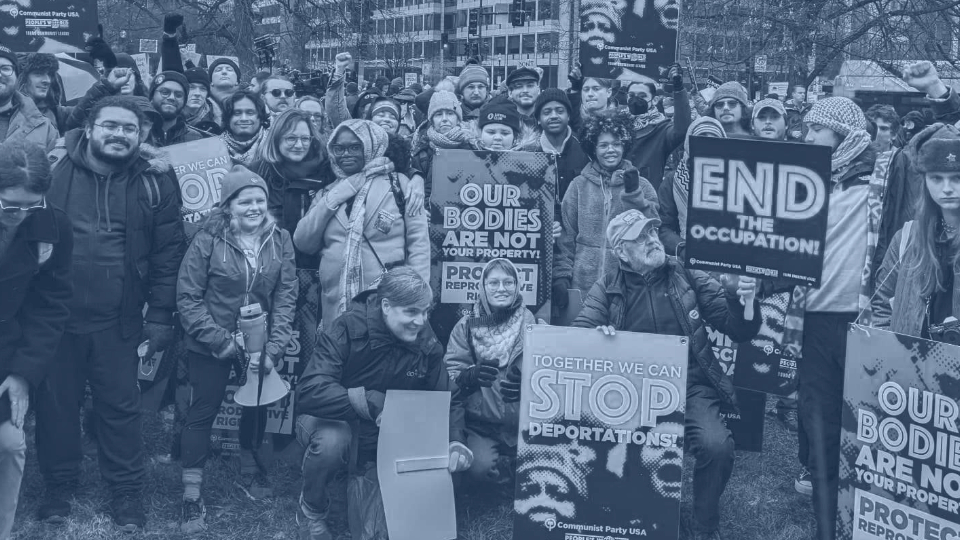
The gathering brought together 160 party members from across the country, involved, variously, in every single one of those struggles. Under the theme, “Driven for Justice, United for Peace,” they came forward to discuss the challenges they face in building support for peace among the people in those movements. In short, the assembly itself was a conference of a new type, aiming to build a peace movement of a new type.

Such fresh thinking about the fight for peace was spurred by both a need to address the interconnectedness of the various struggles under capitalism as well as a determination to tackle the racial, gender, and other imbalances often seen in the traditional peace movement or at anti-war demonstrations.
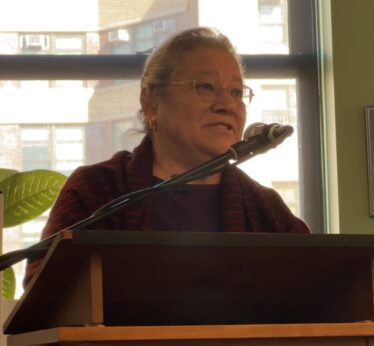
Rossana Cambron, co-chair of the CPUSA, probably described best the historical need for doing this when she opened the meeting. Cambron explained that as late as 2023, when the CPUSA held an initial peace conference, the movement in the U.S. seemed weak and divided.
“Many of the old anti-war groups seemed to have lost their energy. Then came the Oct. 7 Hamas attack, followed by Israel’s massive and deadly assault on Palestine. That tragedy reawakened people’s sense of justice. Across the country, thousands took to the streets demanding a ceasefire and freedom for Palestinians.”
Cambron said the goal should be to broaden what it means to fight for peace. It is about stopping imperialist misadventures and conflict abroad, but fighting for peace also means addressing racism and the turn toward fascism in the U.S.
“We must stand together to stop troops in our cities, deportations in our neighborhoods, and violence both overseas and at home.
“This is the goal of our peace conference,” she declared. “We believe, like Dr. Martin Luther King, that peace is more than just the end of war—it’s the presence of justice. We want a movement strong enough to change U.S. foreign policy and how our tax dollars are spent.”
Thinking differently about the fight for peace
Unique about the conference was that activists and leaders did not come into it with preset, rigid ideas of what is needed to rebuild the movement. Their intention was to discuss and thrash things out.
“Maybe the peace movement didn’t disappear—it just needed a spark to wake it up. In the months that followed [the attack on Palestine], hundreds of thousands of people marched for peace, justice, and Palestinian self-determination,” Cambron said in her remarks.
What happened in the world after the party’s 2023 peace conference made the tasks of building a united movement much more difficult. Only a year later, the country suffered the shock re-election of Donald Trump, who pretended he was for peace and appealed in his campaign for support from people who wanted peace.
He said he was the candidate who ended wars rather than one who would start new ones.
Showing how peace abroad and social progress at home are part of the same struggle, Trump also posed as the champion of the working class, supporting their jobs, their healthcare, and fighting to lower their cost of living. But as soon as he took office, he showed he had no intention of honoring his promises.
Participants in the conference were reminded by both Cambron and her fellow CPUSA co-chair, Joe Sims, how the peace movement suffered a blow as Trump “bombed Iran, backed the far-right Netanyahu government in Israel, and sent federal troops into cities like Los Angeles and Chicago.”
They underlined how he is currently carrying out killings in the Caribbean as a provocation and pretext for a Venezuelan invasion and reminded the gathering, “He put a Christian nationalist TV host—Pete Hegseth—in charge of the Pentagon, renamed it the Department of War, and fired women and people of color from top positions.
“Trump is not for peace, and he’s not for working people,” Cambron said. “We need to find creative ways—through social media, music, theater, art, and everyday conversation—to make that truth clear to everyone.”
Musical interludes during the meeting also served as illustration of the diversity of tactics for education and community-building that Cambron talked about.
Diversity of tactics
The search for those methods and discussion of how to pursue them was very much the topic of the breakout sessions at the conference. After their sessions, party members reported feeling energized by the variety of ways they learned to link up the fight for peace with the work going on inside the various movements they’re involved in.
They heard from party leaders in all the areas of struggle—from the fight for civil rights and against police violence to the struggles for immigrant rights and against the occupation of cities, the struggles for women’s rights, LGBTQ rights, students and teachers battling against school cuts and censorship, and so much more.
Participants were armed with information about not just Trump but many of the corporate enemies of peace who often slip under the radar. They discussed with one another, for example, how Trump, in his second term, is literally persecuting people who speak out for peace.
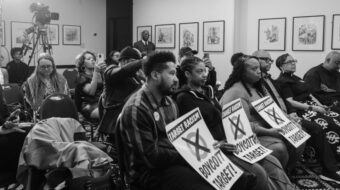
They discussed how the Heritage Foundation’s “Project Esther” plan seeks to label anyone who criticizes Israeli government policy as “antisemitic.” Among the party members present at the conference, there were students, teachers, and other activists who described how this was being done to intimidate and silence people. They said they would leave the conference determined to fight against this push by the administration.
Sims asked the participants, “When was the last time you heard elected officials condemning the more than one trillion-dollar military budget?” Getting a response of “Never” from the audience, Sims said that point proved that building a peace movement requires attention to the electoral arena and turning right-wingers who fund that budget out of office.
Participants heard about and discussed the need to hunker down for a big fight when it comes to the midterm elections in 2026. “Trump’s allies,” Cambron said, “are trying to make one-party rule permanent—by rigging voting maps, restricting who can vote, and even planning to use soldiers to intimidate voters in big cities. If they succeed, the oligarchy will tighten their control, corporations will gain more power, and working people will face more repression both here and abroad.”
Attendees clearly understood that most people in the United States want to live in a peaceful world. But they also understood that many have been told that war is inevitable—or that peace is unrealistic.
Conference attendees left determined to show, through real-life illustrations, that peace is a real possibility. Peace has to be seen, party leaders and activists at the gathering said, is much more than just a nice idea. “It is the way,” Cambron and Sims both emphasized, “to protect our families, our jobs, and the planet itself.”
Abandon the permanent war economy
The “just transition” from a war and militaristic economy to a peace economy was discussed as a thread that unites all the various struggles for social justice. Social and economic justice and civil and human rights never flourish under militaristic and fascist governments bent on war, it was noted.
Even workers with good union contracts who are building armaments would do much better if they were instead building the things needed to repair crumbling infrastructure across the country. Every dollar spent in the domestic civilian economy goes much further that dollars spent on weapons of war.
One participant pointed out how, in the 20th century, when William Winpisinger was president of the Machinists (IAM) union, he continually led battles to transition his members into infrastructure projects and the peace economy rather than the weapons-making economy.
Needless to say, Winpisinger was not popular in top government circles but loved by his members. He understood how labor rights for his members and peace were intimately connected. Many workers in the Machinists union, to this day, would prefer not having to make armaments for war.
Another important thing that came out of the conference is an understanding that there is a big difference between short-term protests against a specific war and a long-term organized peace movement. The situation in Gaza reflects this reality.
“Even when the bombs stop falling, other kinds of war continue—economic wars, proxy wars, coups, assassinations, sanctions, and occupations. The peace movement is made up of people who clearly understand and know that without justice, there can be no peace,” Cambron explained.
Capitalism: The ultimate cause of war
The CPUSA Peace Conference did not fail to pinpoint the fact that the ultimate cause of war is the capitalist system itself.
“As Marxist-Leninists, we understand that capitalism itself drives war,” Cambron said. “The pursuit of profit—the constant push for new markets, cheaper labor, and control over resources—creates a system that feeds on conflict.”
The conference also grappled seriously with current conflicts around the world.
“We are clear that the attacks on Venezuela are not really about fighting cartels or doing anything that benefits working people; it is about gaining access to their oil and other resources for more profits,” Cambron explained.
“I believe that we can agree on the need to organize in support of preventing an attack on Venezuela, but how do we respond strategically is key. Is attending a march or rally enough, or would other forms have a greater impact given that the sentiment of the U.S. people is more and more against wars?” she asked.
Again, it was clear, even from the way things were put by party leaders, that the CPUSA is grappling with the question of how to best pursue its aim of broadening the peace movement. It is inviting all of its members and allies to participate in making such decisions.
Right now, party members understand, that many people fighting for peace and justice don’t yet see that connection between capitalism and war. They may focus on ending one particular war, or on supporting the troops, without realizing that the same system that exploits workers also fuels endless wars.
Cambron noted that “you don’t have to call yourself an anti-imperialist to make a valuable contribution to the fight for peace.” But, she said, “without an anti-monopoly movement that takes on corporate power, we’ll never get to the root of war itself.
“Otherwise, peace activists risk jumping from one cause to another—opposing this war, supporting that one—without recognizing the common thread of imperialism that ties them together.”
She explained that this lack of understanding can lead to contradictions: “Some may oppose the genocide of Palestinians while backing the war in Ukraine, or reject the blockade of Cuba while calling for regime change in Venezuela. To win real peace, we need clarity, unity, and a shared vision that links every struggle against exploitation and domination.”
How to build unity?
Many party members at the conference said that one of the biggest challenges they face is that many people who oppose Trump’s far-right agenda still support U.S. wars abroad.
To help grapple with this problem, the conference took up discussion of a “Unity Program for Peace,” which is rooted in a few central principles:
- Respect for all nations’ sovereignty. Every country should have the right to make its own choices without being bullied by the U.S. or any other power.
- Diplomacy over war.We demand ceasefires in Ukraine and Palestine, humanitarian aid, and fair negotiations—not more bombs.
- No first-use of nuclear weapons. End the nuclear arms race on Earth and in space.
- Cut the military budget. Move billions from war spending into programs that serve human needs—a green and peaceful economy that leaves no worker behind.
- Transparency and accountability. Especially from the war industry, which must disclose its environmental impact.
The participants, including in their breakouts, called for continuing to build the movement in all their community activities through both political and social means, including open mic nights, chess clubs, book clubs, video game groups, and many other avenues. The idea is that wherever members engage with others they can and should discuss current events.
Fighters for healthcare, for livable wages, affordable housing, and other key issues represented at the peace conference left determined to connect those struggles to the need to build a peace movement.
Environmental activists were outspoken about how war also destroys the planet. The U.S. military is one of the biggest polluters on Earth, several pointed out. That’s why the peace movement must join hands with the environmental movement—because the fight for peace is also a fight for the planet and human survival.
Participants clearly understood that a strong peace movement is needed for other struggles to succeed. They even developed a toolkit to aid in assisting members in carrying out the work in their areas of activity.

People left with hope that they can succeed, having noted at the conference that the Nov. 4 election results—along with the massive No Kings protests, the March on Wall Street, and other events—showed just how strong the fightback has grown.
Note was also made of how anti-communist attacks by the right have mostly fallen flat lately, opening opportunities for broader participation by the CPUSA in the electoral arena and the various movements for change.
In the elections, voters were more moved by the real track record and dedication of candidates and activists who ran for office than by any divisive scare tactics. People showed they understand that power truly belongs in their hands.
Cambron, who lives in Los Angeles, asked, “Why else would so many stand in long lines to vote—even in places like California, where Prop 50 had already been declared a winner? When asked, many said they still wanted to cast their vote as a way to show their disgust with what the president is doing.”
Surveying the tasks of the moment, she quoted a famous Communist and anti-fascist fighter of the 20th century: “As Antonio Gramsci said, ‘The old world is dying, and the new world struggles to be born. Now is the time of monsters.’ We are living through that moment—but out of this chaos, a better world can rise. Our job is to help people see through propaganda and take action to make that change real.”
We hope you appreciated this article. At People’s World, we believe news and information should be free and accessible to all, but we need your help. Our journalism is free of corporate influence and paywalls because we are totally reader-supported. Only you, our readers and supporters, make this possible. If you enjoy reading People’s World and the stories we bring you, please support our work by donating or becoming a monthly sustainer today.
CONTRIBUTOR