HAVANA—Trump’s recent escalation against Cuba, threatening to tariff nations that trade oil with Cuba, is compounding hardships in the island nation and motivating the international solidarity community to help.
Since the kidnapping of Venezuela’s sitting President, Nicolás Maduro, on January 3rd, the MAGA administration has set its sights more intensely on Cuba, with Marco Rubio leading an all-out siege on the sovereignty of not only the Caribbean island nation, but all of Latin America.
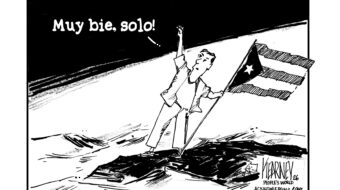
While Cuba has endured a blockade for over 60 years, in recent years it has had to withstand redoubled pressure from the colossus to its north, from being placed on the spurious State Sponsors of Terrorism List to the now virtual oil blockade. The effects of this pressure are palpable on the island: long gas lines, severe power outages, delays in trash collection, and scarcity of necessary medical equipment and supplies.
Yet, tuning in to the U.S. media gives the impression that Cuba is facing such challenges with crossed arms, waiting for the final blow to bring it to its knees. Corporate journalists spin the narrative with seemingly no evidence that the Cuban population is on the verge of mass starvation, all public services have ceased to function, and the nation awaits an external hero to relieve them of their suffering.
This is far from the truth.
Not only does this exaggerate the conditions on the ground, but it also obscures the rational and creative measures actively undertaken by the Cuban government and people to not only mitigate the effects of the crisis but also build toward a more independent and sustainable future.
Solidarity activists should be wary of reproducing the tropes of the corporate media, which paint the island as a hopeless vestige of a past era now in total decline. As the Cuba solidarity movement mobilizes to meet the moment and bring assistance in support of the Cuban people, it is crucial that activists have correct and accurate information, as well as a longer-term vision.
A few shipments of food or medical goods will provide short-term relief and be a welcome contribution, but a deeper horizon is required. Humanitarian aid may be helpful, but it will not solve the larger economic issues Cuba faces as a result of the blockade that shackles their capacity for autonomous development and international trade.
Solidarity actions would do well to follow the lead of the Cuban government and people to help co-create a stronger and more sovereign national energy system.
What is Cuba doing?
Dependence on imported petroleum makes Cuba vulnerable to attacks of the kind Trump, egged on by Rubio, is waging. This is why the national focus is on building an autonomous energy grid sustained by renewable energy and nationally produced oil.
With cooperation from both Russia and China, Cuba is building out its solar and wind energy capacities, as well as renovating its thermoelectric plants. Not only is the government developing large solar parks to supply the national grid, but it is also installing panels to electrify homes in remote rural areas, aiming to achieve full electrical access for the whole population. Additionally, the government is offering favorable financing options for individuals in critical sectors such as health and education to acquire solar panels for their homes.
While the expertise and solar panels themselves are supplied by China, Cuba is also developing an expert workforce trained in various aspects of renewable energy development. This is a further step toward energy sovereignty and constitutes an investment in human resources that will one day allow Cuba to aid other nations in developing their renewable energy sectors.
In a recent national press conference, Cuba’s President Miguel Díaz-Canel remarked that in addition to the over 1,000 megawatts added to the national electrical system in 2025, “we aim to add a similar number this year, so we will be achieving levels above 15 or close to 20 percent of our electrical generation with renewable sources.”
At the rate Cuba is going, they will reach their original goal of 25 percent renewable energy by 2030 a few years early. Cuba also boasts significant reserves of cobalt and nickel, empowering it to potentially produce its own solar panels, electric vehicle and battery technology with further development of its industrial capacities.
Another forward-looking policy, Cuba is incentivizing homes and businesses that have acquired their own solar and wind energy generation systems to engage in cogeneration. This means that private citizens and businesses would use their surplus energy (generated by solar panels or wind turbines) to share with their neighbors or sell back to the national grid.
What these examples show is that Cuba has known for some time that their future lies in renewable energy and autonomous national production of energy, technology, and other resources. The United States’ aggressive petro-politics, encapsulated by the campaign slogan “drill baby drill,” on the other hand, are evidence of its myopic and retrograde worldview.
Seen through these facts, Cuba is more than a passive supplicant, waiting on humanitarian aid to bring oil or other essentials back to its shores. It is a nation adapting to the artificial oil scarcity created by Trump and Rubio’s intensified blockade and preparing rationally for a future independent of fossil fuels, capable of confronting both the political and environmental challenges that will surely come.
A sign of the changing times, throughout Havana—a city known for its vintage American cars—the collective taxis people use on their everyday commutes are rapidly changing. Whereas these were usually old, gas-guzzling 1950s Chevrolets, increasingly Cubans are using new, electric Chinese tricycle wagons.
Imperialism vs Internationalism
Highlighting Cuba’s modes of resistance and future-oriented planning is not to negate the real material effects of the intensified blockade in Cuban’s lives. Currently, Cuba is still far from achieving its planned goals of energy independence, and the toll of fuel shortages on people’s lives is real and heavy; Cubans are dealing with difficult realities no one should have to endure.
The United States uses its financial and economic hegemony to prevent the island nation from full participation in the world market, cutting off its access to, for example, the dollar currency. Cuba must also rely on trade with geographically distant partners, such as Russia and China, which drives up prices for goods.
One example of this hardship is the shortage some Cubans are facing in gas for their home cooking stoves. Cooking over a charcoal fire may be a fun way to pass a Saturday afternoon in the park, but it’s no way to prepare dinner in your fourth-floor Havana apartment. Nonetheless, this is what some Cubans have had to resort to with increasing gas shortages.
As one young Cuban researcher at the Institute of Philosophy in Havana explained, there are two ways gas for cooking stoves is distributed to the population: through direct gas lines, which only some buildings in the oldest zones of the capital have, or through the distribution of liquid gas tanks. While the government provides these tanks for citizens through its socialized distribution system, breakdowns in the national refinement system—the result of wear and tear that cannot be easily repaired due to inaccessibility of parts and machinery—have meant there is not enough liquid gas to go around, and importation of these tanks means higher prices.
“The last time I had access to a tank was June 6th of last year,” the researcher explained. “In the informal market, a full tank costs around 18,000 Cuban pesos, a number that my modest salary as a researcher in a state institution cannot cover.” As a result, he further commented that he has had to change his diet and habits. Living alone and needing the maximum time in the week to advance in his work at the Institute of Philosophy, he focuses on cooking during periods of the weekend when he has electricity in the house. “I have also been incorporating more products in my diet that don’t need to be reheated to consume, like spaghetti, bread, and fruit and yogurt smoothies.”
Public institutions and services, while still operating, have had to resort to reduced hours and find themselves short-staffed as workers who live farther away are not able to find transit to work.
This adds extra pressure in the life of the researcher we talked to, who noted that because his personal laptop is broken, he has to complete most of his work on-site at the Institute. Between their limited hours and the difficulties of transit, he has to leave extremely early in the morning and typically returns home quite late.
Thus, many Cubans find themselves frustrated that the landmark rights they have achieved for themselves, like universal free healthcare and education, have been gradually compromised by the externally imposed material deprivations of the cruel U.S. blockade.
These issues will not be solved with humanitarian aid alone. They can only be solved by state-level measures, by the achievement of Cuba’s long-term plans. So how can activists and friends of Cuba help?
First—and we reiterate that while lentils, medicines and medical equipment, powdered milk, and rice constitute important and needed forms of relief—the Cuban solidarity movement should not ignore the political struggle back home. As long as the U.S. blockade is in place, Cuba will experience hardship.
Removing the embargo will require an act of Congress, and that is exactly where activists should focus their energy. We must exert pressure on congresspeople to support an end to the blockade, joining the coalition led by Representative Jim McGovern (D-MA) and others. On February 12, McGovern introduced bill H.R. 7521 to repeal the statutory basis for the U.S. embargo on Cuba. Senators Ron Wyden (D-OR) and Jeff Merkley (D-OR) introduced similar legislation in the Senate.
Mass political mobilizations are needed as well. U.S. aggression toward Cuba is not an isolated case—it is deeply related to a (largely bipartisan) foreign policy apparatus that uses intervention and market bullying to pave the way for U.S. business interests. Besides creating misery abroad, this policy hurts the U.S. working class, as vast military resources are used to choke other nations rather than support social programs at home. It is also a policy trend that leads to more offshoring of jobs, more environmental destruction, and less positive international cooperation (on, say, public health or environmental issues).
Here Cuba has a lot to teach as well. Cuba is a coveted international partner, with a record of helping other nations recover from climate disasters and bolstering their health and education systems. Cuban internationalism, based on cooperation and mutual respect, exists symbiotically with its history of anti-imperialist struggle.
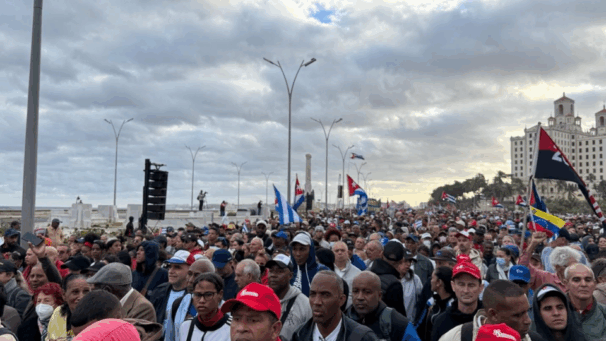
In January, the streets of Havana saw two major expressions of Cuban political will, manifesting as strong rejections of U.S. imperial aggression towards themselves and their sister nation, Venezuela. On January 16, half a million Cubans marched down the Malecón, past the U.S. embassy in Havana, in defense of their sovereignty and to honor the 32 Cuban combatants who were killed while completing their bilaterally coordinated service in Caracas.
The sentiments of participants ranged from solemn determination to pain and sadness to anger. One woman raised her middle finger at the U.S. embassy as she walked past, while speeches condemned the criminal actions of the U.S. government in Venezuela and the threats against Cuba.
Recent mass marches in the U.S. are powerful and large but need to grow exponentially in numbers and develop a more unified message, as well as a sharper anti-imperialist critique that connects domestic issues like job loss and inflation with a wasteful and violent foreign policy entrenched in the military industrial complex.
By linking an end to the embargo with a general call to build a peace economy rather than a war economy, activists can articulate a working-class vision of international relations. Our demand, fundamentally, should be to leave Cuba in peace and instead invest resources in our own social services and economic development.
Sustainable Solidarity for Cuba
Our struggle for basic rights and economic improvements in the U.S. is fundamentally linked to the struggle against worldwide imperialism. Cuba understands this, too. This is why their internal struggles focus on energy independence and growing their productive capacities. This is why solidarity work, when it includes bringing aid, should consider what kinds of aid will directly contribute to this long-term goal in addition to bringing much-needed short-term relief in the form of food and medicine.
Essentially, the wisdom here follows the old saying: if you give a man a fish, he’ll eat for a day, if you teach him to fish, he’ll eat for life. In the case of Cuba, it isn’t knowledge that’s lacking, but the material means of self-determined, more-efficient production. Rather than donating fish, leave the whole fishing boat behind.
As activists and supporters of Cuba mobilize to fundraise and prepare to bring goods to Cuban shores, they should prioritize things like solar panels, back-up battery stations, and other tools and technologies that will help reduce dependence on oil and improve energy resilience.
Other technologies that could make a real difference would be things like biodigesters. The trash crisis could be transformed into another source of fuel through these technologies that convert organic waste to gas that can be used directly for cooking or burned for electricity.
Another form this kind of sustainable solidarity could take is direct partnerships with productive industries, particularly agriculture and manufacturing. Through partnering with farms or factories, solidarity groups could identify the greatest needs in technology or other materials and commit to bringing these products as well. In other words, humanitarian aid should also take the form that will most empower Cuban institutions and industries to independently provide for the country’s needs.
This model of solidarity stands in stark contrast to the supposed aid that the Trump administration is distributing in collaboration with the Catholic Church. This thinly veiled attempt to further undermine Cuba’s social fabric aims to displace the role and take over functions that are the responsibility of the government. In so doing, they push anti-government propaganda, particularly the narrative that the government is incapable or unwilling to provide for its people. Meanwhile, even as Trump brags about the efficacy of his recent siege to reporters before boarding AirForce One, Chief of Mission of the U.S. Embassy in Cuba, Mike Hammer, claims there is no such thing as an embargo, let alone a blockade, and makes a show of his concern for the Cuban people, both on the island and in the diaspora community.
As a counterpoint, although Mexico has ceased selling oil to Cuba under the threat of U.S. tariffs, it has provided humanitarian aid in a way that upholds the sovereignty of the Caribbean nation and its international partners. Mexican President Claudia Sheinbaum sent 800 tons of essential goods in coordination with Cuban authorities, all while denouncing the U.S. government’s extra-territorial aggression against countries trading oil with Cuba. She affirmed the principle of self-determination of all people and nations, warning the U.S. against regime change and offering to mediate talks between the two countries.
Resistance, Reciprocity, and Regeneration
Cuba’s problems are not insurmountable. With a daily peak power demand of around 3,500 megawatts of energy for the entire nation, Cuba’s needs can theoretically be met with moderate investment in sovereign, largely renewables-based energy infrastructure, as well as modernization of its thermoelectric plants. To put things in perspective, a conservative estimate of the average continuous power demand in the U.S. is between 400 and 500 thousand megawatts, with a peak exceeding 700 thousand. This breaks down to roughly 1.4 kilowatts on average per person in the United States, compared to Cuba’s 0.35 kilowatts per person at max demand.
While Cuba’s ongoing energy infrastructure projects are achievable, especially with the renewed urgency of their implementation, prolonged economic blockade has left Cuba in a precarious circumstance to finance the transition. However, it is key to underscore how the U.S. social and economic organization produces prodigious waste and overuse of critical resources, such as electricity. In contrast, Cuba’s rationally organized distribution of resources and its general prioritization of essential human needs mean that it has the experience and vision to develop with greater efficiency and resourcefulness.
While much of Cuba’s resourcefulness results from the limitations imposed by the blockade, its vision for overcoming its singular circumstances is more generalizable than one might think. Indeed, Cuba offers a vision of a future in which human need is prioritized, and energy consumption is efficient and sensible. Meanwhile, oil monopolies and private utility companies in the U.S. will continue to artificially drive up energy demands and encourage waste to secure ever-growing profits. Solidarity with Cuba also means learning from their system and seeing them in many ways as a leader in environmentally and socially responsible development.
While narratives of suffering rightly emerge from critiques of the blockade, media manipulation often coopts them to create the impression of state ineptitude or societal collapse. Therefore, solidarity also requires a recognition and active support of the creative strategies Cuba already employs to overcome its compounding crises. Effective solidarity work directly challenges the imperial project of the blockade, links Cuba’s struggles to working-class struggles at home, and seeks to empower Cubans to manage and develop their own sustainable solutions.
As with all news-analysis and op-ed articles published by People’s World, the views reflected here are those of the author.
We hope you appreciated this article. At People’s World, we believe news and information should be free and accessible to all, but we need your help. Our journalism is free of corporate influence and paywalls because we are totally reader-supported. Only you, our readers and supporters, make this possible. If you enjoy reading People’s World and the stories we bring you, please support our work by donating or becoming a monthly sustainer today. Thank you!
CONTRIBUTOR