RICHMOND, Va.—Ahead of a government shutdown deadline, Virginia’s General Assembly voted to adopt 14 amendments and pass along a much-contested two-year spending plan for Democratic Gov. Abigail Spanberger to sign into law. A month-long budget battle has shown fractures in the Commonwealth’s Democratic Trifecta, revealed divisions both among and within trade unions, and given fuel to discourse concerning the impacts of data centers on community, environment, AI, and data privacy.
The budget divide was centered around data center subsidies. The Democrat-led State Senate fought to roll back tax incentives, adding up to an annual value of $2 billion. Removing this policy would both bring money into the state’s coffers and slow the explosive growth of data centers throughout the Commonwealth.
Spanberger and the Democrat-led House opposed the reversal, defending data center tax exemptions and back-pedaling on limits agreed upon earlier this year that placed environmental standards as a condition on these incentives. Instead, they favored forming a commission to perform an analysis for a report to be taken into account in 2027. Interestingly, a similar report was already issued by the Joint Legislative Audit and Review Commission in 2024.
The final budget includes amendments that propose a data center electricity consumption tax, which would charge a rate of “$0.011/kWh of all electricity consumed at each data center per month,” and a water supply planning policy that requires new data centers “to demonstrate” to the Department of Environmental Quality (DEQ) effective efforts to conserve water. While the new tax and policy aren’t bad, gone are the substantial tax incentive rollbacks.
As reported by ARLnow, Brennan Gilmore, executive director of Clean Virginia, stated:
“The data center industry still received the better end of this deal…. A two-year, capped consumption tax does not come close to offsetting a nearly $2 billion annual tax giveaway with no end in sight.”
An important footnote to this budget battle are the funds infused into state campaigns and political committees by pro-data-center lobbying groups. According to the Virginia Public Access Project, the Leesburg-based Data Center Coalition has spent $439,500 over the past two years. Almost three-fourths of this expenditure has benefited Democrats. Among the top beneficiaries was Spanberger’s 2026 inaugural committee.
The impact of Big Data
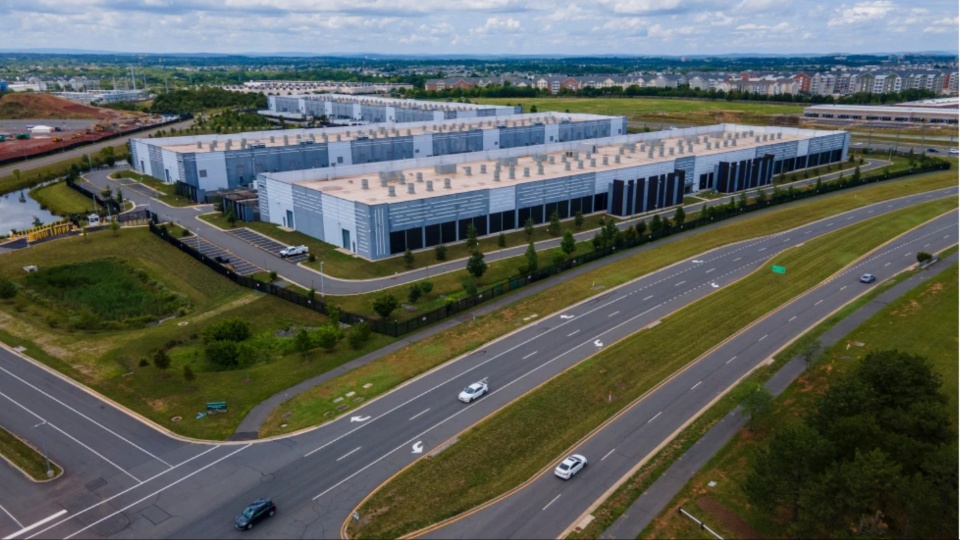
Since 2010, Virginia has offered sales and use tax exemption to attract data centers. This has resulted in the state becoming the fastest-growing data center market in the world, with nearly 50% of all U.S. facilities and, by some estimates, enabling up to 70% of the world’s internet activity. This unchecked growth has resulted in insatiable resource consumption, as data centers manage and process large amounts of data that enable online services like websites, cloud-based platforms, streaming, and, most prominently, AI.
One of the most critical resources in question is water. Data Centers’ unquenchable thirst is due to industrial-scale cooling systems required to mediate the electrical heat from high-performing computer equipment. As the Lincoln Institute of Land Policy reports:
“Even a mid-sized data center consumes as much water as a small town, while larger ones require up to 5 million gallons of water every day—as much as a city of 50,000 people.”
This water drain endangers the stability of groundwater in the region, especially in current conditions. Virginia has been experiencing an extended drought. Most of the state has been under a drought warning since May, while some communities have already implemented mandatory conservation measures.
Another major consumable resource is energy, leading to higher power bills for Virginia residents. Massive upgrades are perpetually required for the state’s already strained electric grid. This has led to reliance upon diesel generators, which emit harmful pollutants: nitrogen oxides, carbon monoxide, and particulate matter. Earlier this year, The Washington Post reported: “Pollution from generators at data centers could cause respiratory symptoms and deaths in the region.”
In addition to air pollution, data centers emit noise pollution. Though not loud enough to damage hearing or “rarely” loud enough to violate noise ordinances, data centers’ constant low-frequency hum has been a problem for nearby residential areas that have issued complaints. As reported by Paul Aversa, short-term effects of noise pollution like this “include sleep disruption and stress, while long-term exposure has been linked to cardiovascular, cognitive, and mental health risks.”
As data centers spread throughout the state, they devour more and more acreage. As Mac Carey reports for Oxford American, Loudon County, aka Data Center Alley, has the world’s largest concentration of data centers, and has seen data center proposals that encroach upon cemeteries and state parks:
“Historical preservationists allege that several headstones at two historic Black cemeteries in Prince William County were damaged by the construction of a data center and a power substation. This past spring, the National Trust for Historic Preservation declared Wilderness Battlefield in Orange County, Virginia, as one of America’s Eleven Most Endangered Historic Places because of a proposed data center development.”
Perhaps the most alarming of all of the consequences of the data center surge is the potential of what this infrastructure supports and enables: centralized, AI-powered, modern surveillance. Neil C. Hughes, writing for cybernews, lays out this concern: “They store, process, and move the huge volumes of data needed for AI systems, cameras, phones, apps, and government databases to be linked together into a single picture of a person’s life.”
In other words, data center infrastructure supports the collection, storage, and analysis of personal data by AI. The rate and scale of this is alarming, with dystopian potential.
The struggle—and unions’ role
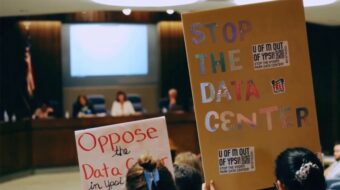
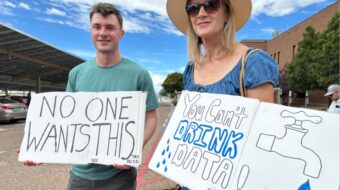
The compounded effects of data center growth, along with the unregulated application of AI, have led to growing pushback locally and nationally. Grassroots activism has led to protest organizing against newly proposed developments. Groups like the Piedmont Environmental Council, PEC, coordinate with local governments and residents for better planning and zoning to protect communities, “especially those most vulnerable to utility rate hikes, air pollution, and climate impacts, as well as our lands, waters and wildlife.”
In April, U.S. Sen. Bernie Sanders, Ind.-Vt., called on Congress to pass a moratorium on data center construction due to the increasing role of AI in displacing jobs. A half-dozen union leaders affiliated with the AFL-CIO stood with the senator. National Nurses United, the Association of Flight Attendants, and the American Association of University Professors have all voiced support for a slowdown.
Jamie Brown, co-president of National Nurses United, explained. “The unchecked explosion of AI data centers is a public health crisis, an environmental crisis, and a workers’ rights crisis.”
A big deal has been made out of a division within the AFL-CIO membership when it comes to this issue. North America’s Building Trades Unions have been vocal supporters of data centers, as their construction has become a growing part of the industry sector’s business model. The International Brotherhood of Electrical Workers urged its members to lobby Congress against a data center moratorium. What it comes down to is perfectly crystallized by Anne Lofaso, former National Labor Relations Board attorney: “This is about jobs.”
Indeed, the biggest defense of the data center surge has been its “robust permanent job creation.” Virginia Connects commercials tout 74,000 jobs annually. According to a recent analysis by Food & Water Watch, that data has been “grossly inflated” and is closer to 23,000.
The report also finds that most employment opportunities are heavily concentrated during construction rather than maintenance operations.
Even further, the amount of investment to create a permanent data center job is “100 times greater than what is required to create a job outside of that industry.” Mitch Jones, managing director of policy and litigation at Food & Water Watch, remarked:
“Now we also know the industry claims of healthy job creation…are completely absurd. We urgently need a full halt to new data center construction across the country, so state and local leaders can properly examine all manner of problems this industry brings – before it’s too late.”
Send it to a commission?
After a frustrating battle, Virginia’s budget proposal now becomes law, and tax incentives for data centers remain in place. Meanwhile, their expansion across the state will continue as resources are drained, pollution pollutes, and the infrastructure for AI and mass surveillance encroaches ever further.
Residents, communities, conservationists, and activists will continue to fight back while waiting until 2027 for another report from another commission for any kind of meaningful policy change from the state government. As Virginia Senate President Pro Tempore L. Louise Lucas (D) said in Manassas, “Governor, read the damn room.”
We hope you appreciated this article. At People’s World, we believe news and information should be free and accessible to all, but we need your help. Our journalism is free of corporate influence and paywalls because we are totally reader-supported. Only you, our readers and supporters, make this possible. If you enjoy reading People’s World and the stories we bring you, please support our work by donating or becoming a monthly sustainer today. Thank you!
CONTRIBUTOR