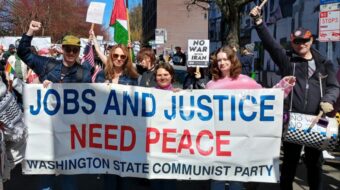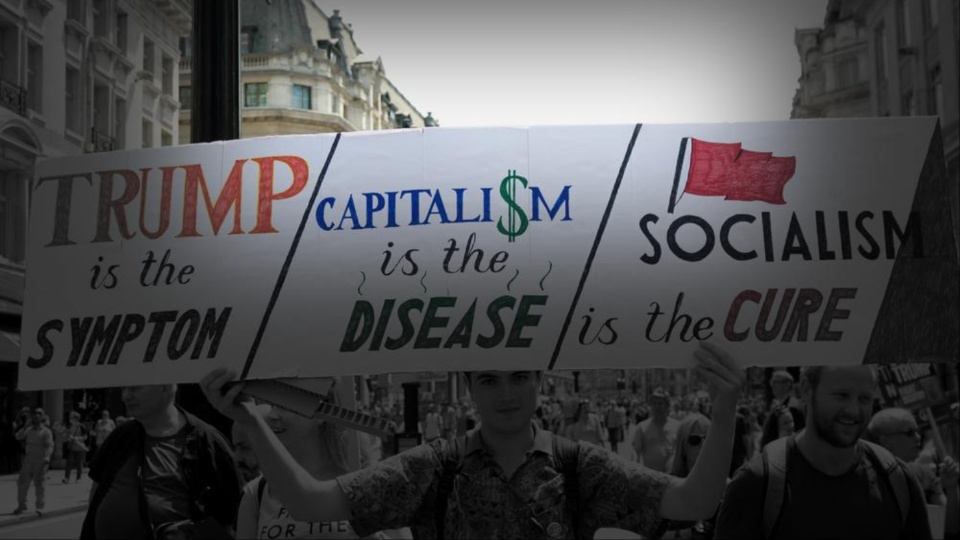
On a cool Saturday morning in Bellingham, Wash., something remarkable happened this past weekend, and those of us from the local CPUSA club were there to witness it, sign in hand and shoulder to shoulder with our neighbors.
Three others and myself—all members of the Communist Party—made our way down to Waypoint Park on March 28 as part of the national No Kings day of action, not quite knowing what to expect. What we found was a city transformed.
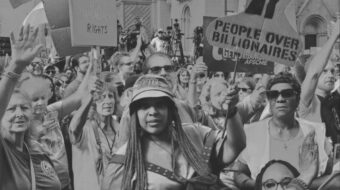
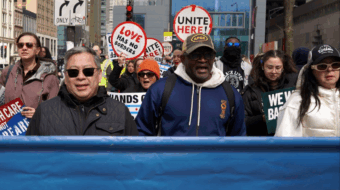
Indivisible Bellingham, one of the local organizers, estimated 6,000 people attended the event, filling the waterfront, spilling into the streets, and ultimately marching through dozens of blocks of downtown in a peaceful, disciplined demonstration that none of us will soon forget. Nationally, more than eight million people are estimated to have participated in at least 3,000 individual local events, constituting one of the largest coordinated days of resistance in U.S. history.
The crowd at Waypoint Park was cross-generational and cross-demographic in a way that heartened every one of us. Parents pushed strollers alongside retirees. Veterans marched next to college students. Hand-lettered signs expressed everything from constitutional concerns to fury over immigration raids tearing families apart in our own county.

Local organizers, Indivisible Bellingham and Bellingham Troublemakers, pointed to the federal government’s crackdown on immigration that has impacted families across the county and state, as well as the accelerating erosion of democratic norms, as the core motivations driving people into the streets.
One of the most significant moments of the morning came when Lummi Nation Master Carver Jewell James addressed the crowd, a powerful reminder that the struggle for sovereignty, dignity, and democratic rights in this region did not begin when Trump returned to office in 2025 and will not conclude when the current crisis passes. Indigenous leadership in this movement matters. It situates the resistance within a historical continuity that stretches far deeper than any single election or administration.
As we marched up Roeder Avenue and through downtown, chants rolled through the crowd in waves. What struck our small group of four was not merely the size of the turnout, but the character of it.
Suzanne Finch, 68, said she had become “much more politically active” in the last year, estimating she had attended 17 rallies or marches over that period. “I couldn’t believe that. I hadn’t been to 17 in my whole life,” the Bellingham retiree said.
Morgan Hanseen, a 29-year-old Ferndale resident we spoke with near the end of the march, believed a meaningful “mindset shift” may be taking hold among previously uncommitted people. “I think people who are maybe on the fence about what’s been going on are starting to see ‘maybe this is a right or wrong issue, and I want to be on the right side,’” she said.
These were not demoralized people. These were people awakening to their own collective power, and that is precisely what the ruling class fears most.
That awakening, however, will only carry the movement so far without a rigorous analysis of what, exactly, it is we are fighting against. The No Kings protests encompass so many issues: Immigration, democratic rights, economic anxiety, the gutting of federal agencies. These grievances are real, and they are urgent, but they are also symptoms—not the disease itself.
The disease is capitalism, and political realignment alone won’t cure it if the system is left intact and unnamed.
What we are witnessing under the current administration is not simply an aberration from U.S. democracy. It is the logical expression of a system in which concentrated economic power and concentrated political power tend, over time, to fuse. The ruling class of billionaires does not merely influence government. Increasingly, it is the government, making decisions about public resources, labor law, immigration enforcement, and military spending in its own material interest.
This is not conspiracy. It is political economy, operating more or less as Karl Marx described it.
The working people who filled the streets of Bellingham on Saturday know something is profoundly wrong. Many can articulate it with considerable precision when asked. The father worried about what his children will inherit. The veteran who feels his service has been made a mockery. The retiree who has attended 17 rallies because she cannot, in good conscience, stay home.
What they all share is the intuition that the current crisis is not simply a matter of one bad leader or one corrupt administration but rather of a system that produces such leaders as a matter of course.
Our role, as Communists, is to meet people and help develop that intuition into analysis. The No Kings framework is a beginning. Constitutional protections matter, and we should fight for them vigorously. But the Constitution was written to govern a society built on enslaved labor and the dispossession of Indigenous peoples, and its protections have always been unevenly distributed along lines of class, race, and gender.
Defending democratic rights and demanding structural transformation are not competing projects; they are sequential ones.
What the streets of Bellingham demonstrated on Saturday is that the mass base for a broader left politics exists. It is not latent or theoretical. It was there, thousands strong, in the rain, carrying signs and chanting and shaking hands with strangers. The task now is organizational.
Building the durable institutions, the clubs, the labor coalitions, the neighborhood assemblies, capable of channeling that energy into sustained political power is work that does not happen on its own.
The four of us walked back to our cars tired, hoarse, and genuinely encouraged. The people are in motion. The conditions for deeper organizing are ripening. The question, as it has always been, is whether we will build something worthy of this moment.
We believe we can.
As with all op-eds published by People’s World, the views expressed above are those of the author.
We hope you appreciated this article. At People’s World, we believe news and information should be free and accessible to all, but we need your help. Our journalism is free of corporate influence and paywalls because we are totally reader-supported. Only you, our readers and supporters, make this possible. If you enjoy reading People’s World and the stories we bring you, please support our work by donating or becoming a monthly sustainer today. Thank you!
CONTRIBUTOR