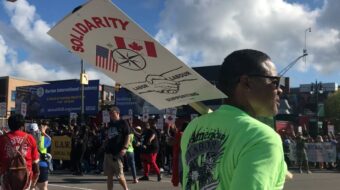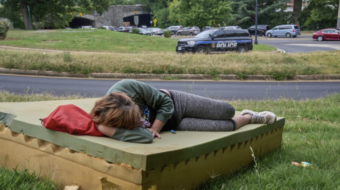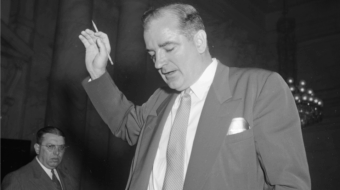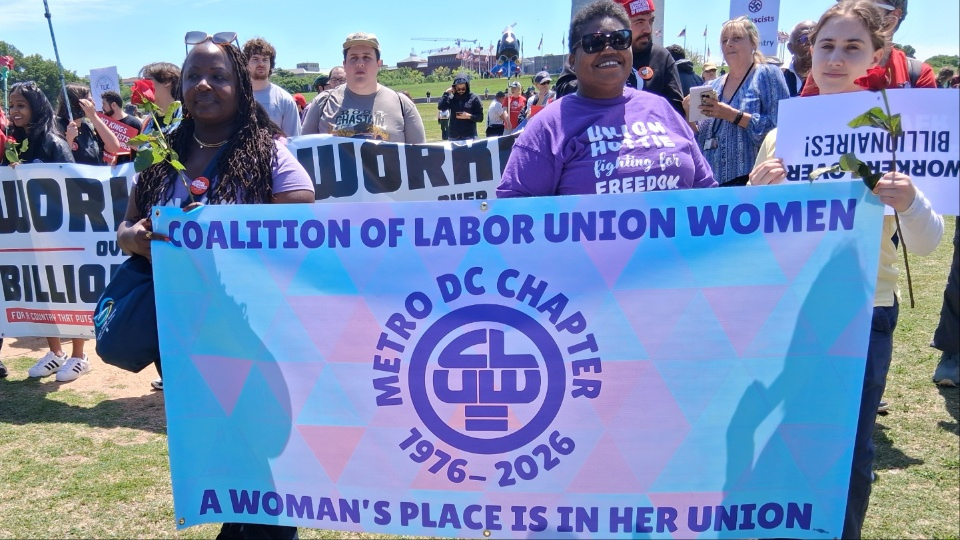
WASHINGTON—Depending on which city, suburb, or small town you marched in, demands for workers’ rights, for closing the income gap between the rich and the rest of us, and against the repressive Donald Trump administration highlighted the 5,000 May Day marches on May 1, International Workers Day.
In D.C.’s marches, Trump’s attacks on the standard of living of workers, caused by his war on Iran, his attacks on voting rights, his attacks on immigrant rights, and other actions, were a focus of the demonstrations. It was the biggest labor movement action on May Day in decades since the Cold War days, when there was an anti-labor movement geared to getting workers to drop the celebration of May Day in the U.S.
The historic shift in thinking regarding May Day was reflected early in the morning on May 1, when national news and cable networks reported on May Day actions scheduled that day for thousands of cities under the banner of “May Day Strong.”
“He tried to bully us, and he tried to make us an example, and he thought we were going to roll over,” AFL-CIO President Liz Shuler told a post-march gathering in front of AFL-CIO headquarters.
“But he didn’t know we wouldn’t,” and would instead fight for all workers. “And if you’re going to come after immigrant workers”—Trump’s top target—“you’re going to have to come through us first,” Shuler warned.
She also warned the crowd that the fight for workers’ rights, equal pay, and a say on the job, which has been going on for decades, will continue. “Everything we won in this country came because we fought for it.”
And this is a fight for everybody, Shuler declared. Trump and his allies “are striking back at us because they’re terrified” of the voting and economic power workers wield. She asserted powerfully that labor will not tolerate the attacks on the Voting Rights Act either. “But this is not just blue states versus red states…. It’s the billionaires versus the rest of us.”
In Manhattan, the top theme was income inequality, with marchers from the Sunrise Movement peacefully sitting in—and getting arrested—after breaking through fences around a capitalist citadel, the New York Stock Exchange. Wall Street, of course, loves fossil fuels and hates “greens.”
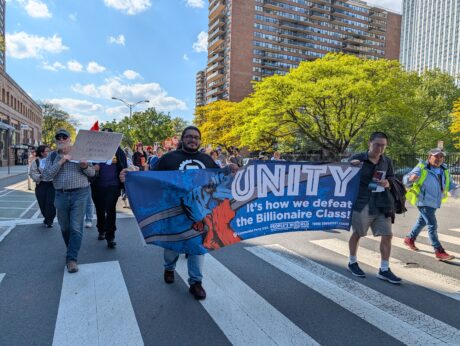
There, as elsewhere, a main theme was “Workers Over Billionaires.”
Public broadcasting networks joined the May Day actions this year.
In Portland, Ore., the prison where Trump’s violent and vicious ICE agents imprison people before trying to deport them, police confronted chanting protesters and arrested several. Abolishing ICE, its prisons, and its illegal arrests was the main theme of marches all over that state, Oregon Public Broadcasting reported.
Health workers used May Day to voice their support for all workers, including immigrant workers who have been a major target of the administration.
“This whole immigration thing is kind of off the charts,” Vivianne Kelly, RN, told Oregon Public Broadcasting. “Especially when they say they’re going after violent criminals and drug traffickers,” she continued. “When what I see is them going after women and children and anyone they feel like.”
In Los Angeles and San Francisco, immigration was the top cause, too. Three elected officials were arrested in San Francisco. But ICE agents there also dragooned at least eight other people. Across San Francisco Bay, in Oakland, marchers denounced Trump’s war on Iran.
And in Chicago, the birthplace of May Day as the international workers’ holiday—commemorating the Haymarket Square martyrs of May 4, 1886—it was a fight too for the full range of issues workers are struggling on. They ranged from workers’ rights to demanding ICE out of the city to restoration of diversity, equity, and inclusion to more money for the Chicago Public Schools.
The teachers in Chicago played a major role in raising the issue of the Voting Rights Act, which has been gutted by the Supreme Court. “This week, Trump’s Supreme Court, hoping to solidify the right wing’s hold on power across the country, gutted the Voting Rights Act,” the union said in a pre-march call to action. “That historic law paved the way for Black representation at all levels of government.
“And ICE agents are still snatching our neighbors off the streets, though, thanks to Chicago’s push back, not in the numbers we saw this fall, when our students and their families faced ICE assaults and human rights violations on a daily basis during Operation Midway Blitz.
“Every single one of these attacks is a choice. A choice to put billionaires before families. May Day exists to say: not on our watch. May Day has always been about defending workers, demanding rights for everyday people over billionaires’ fortunes.”
Other Chicago marchers supported workers’ rights, too. “Working families cannot afford life right now, and we as the wealthiest country must do better,” marcher Sarah Garza Resnick told the Tribune, while also backing the teachers. “And we have to protect workers’ rights to do that.”
Resnick brought her sons with her. The younger, aged 9, had learned about workers’ rights in his classes. “Civic education might be the most important thing my children are ever going to learn. We have to teach the next generation to step up and to fight.”
Some 22 North Carolina school districts also declared May Day a day off, as did Portland, Ore. At least 500 people marched there, then descended on ICE’s building,
Unions, their members, and their leaders were the prime movers in most of the marches, as organized labor lobbied for “No work, no school, no shopping,” through refusal to patronize multinational corporations and monopolies. If you had to shop, patronize mom-and-pop stores, organizers said.
Across the country, religious leaders joined the May Day actions.
“Like God called on Moses” to free the Israelites from Egyptian slavery, “he’s calling on us to be leaders” away from corporate masters who make workers slaves, one pastor told the D.C. crowd, translated from the Spanish.
In some cases, thousands thronged to meet the demands and show workers’ economic and political power. In Manhattan, for example, many teachers and students demonstrated rather than attend school. In other areas, such as D.C., there was good adult participation, but the schools didn’t close. In Chicago and in 22 districts in North Carolina, many did.
The lack of students didn’t stop the 18 D.C. area marches, or the demonstrators from choosing Donald Trump as a symbol of what’s wrong both economically and politically in the U.S.
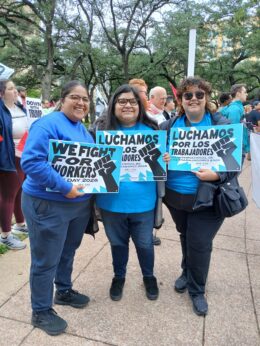
“Donald Trump, you’re a clown. You’re not wanted in this town,” was one chant during the main D.C. march, from the Washington Monument grounds to Franklin Square. Even before he fired almost 200,000 federal workers, Trump was an object of disdain in deep-blue D.C. In 2024, he got only 6.5% of the popular vote.
And one woman toted a sign she’s carried to prior “No Kings” anti-Trump marches: “In WW2 my Dad fought Fascists so we wouldn’t have to…But here we are.”
A retired University of Maryland professor’s sign read “A great democracy has got to be progressive or it will soon cease to be either great or a democracy!” The quote was from a 1910 speech by Theodore—not Franklin—Roosevelt.
One D.C. sign mimicked “Old McDonald Had A Farm”: “Old Con Donald screwed us all. Elon Elon oh,” referring to multibillionaire Trump pal Elon Musk and his government-wrecking and worker-destroying chainsaw.
“He [Trump] is everything we teach our children not to be,” read a sign carried by a marcher wearing a National Education Association royal-blue T-shirt. She was one of dozens of NEA members at the main D.C. march.
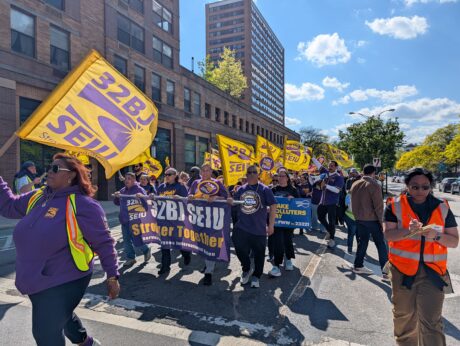
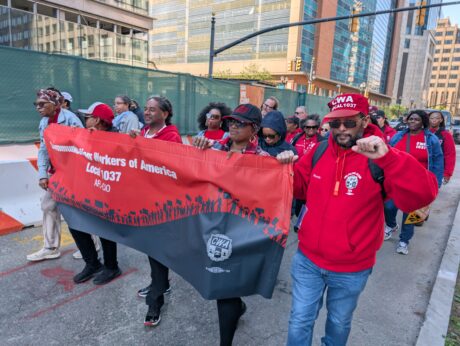
Other unions there included the Road Sprinkler Fitters Local 669—a national local—Service Employees 32BJ, the Communications Workers, the Metro D.C. Central Labor Council, the Coalition of Labor Union Women, the Auto Workers, more than a dozen National Nurses United members, Amalgamated Transit Union Local 698, the American Federation of Musicians, Unite HERE, and the Teachers/AFT.
“I’ve seen too many patients hospitalized because the health insurance companies wouldn’t pay for their medications” to prevent their ailments, a D.C.-area nurse named Olivia told the crowd there. “But when we” as unionized nurses “work together” on that issue, “we cannot be ignored.”
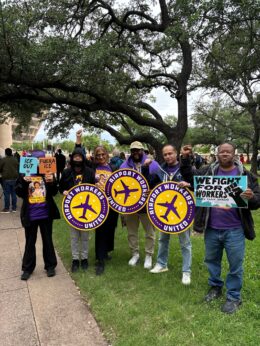
“Give people a light, and they will find the way” out of the chaos and anti-worker policies of the GOP Trump regime, National Education Association President Becky Pringle told the D.C. crowd.
“You all know they ruin housing and health care and let outsourcing get out of control,” Pringle, a Philadelphia science teacher, added. “Billionaires get richer and richer while we bear the pain. Black and brown communities remain exploited and underserved while that warmaking wannabe dictator in the White House can deploy thousands of troops”—his ICE agents—“in D.C. We say ‘Hell, no!”
Protesters at the Oregon State Capitol in Salem concentrated on the fate of immigrant workers at the hands of Trump’s brutal, violent, and vicious ICE agents. Their signs read “Tax the Rich,” “Principle over Party,” and “Stand United for Human Rights.”
“America doesn’t work without us,” said Reyna Lopez, the president of Oregon’s largest farmworker union, Pineros y Campesinos Unidos del Noroeste, or PCUN, told Oregon Public Broadcasting.
“We are an integral part of the economy; we pick the food, we build the houses. We are the people that take care of your kids. And today, for me, this is an important day for me to get a few of our messages out there.”
NEA President Pringle had a plan for workers and their allies to beat Trump and the oligarchs, too: “We march today, we march tomorrow, we vote them out in November. And the Supreme Court won’t stop us,” she declared, referring to its trashing of the Voting Rights Act.
“It’s a revolutionary idea of people standing up against the oligarchs in this country, against oppressive bosses and for people to organize,” Daniel Shea, president of Oregon Veterans for Peace, told public radio. “That’s why I’m out here.”
We hope you appreciated this article. At People’s World, we believe news and information should be free and accessible to all, but we need your help. Our journalism is free of corporate influence and paywalls because we are totally reader-supported. Only you, our readers and supporters, make this possible. If you enjoy reading People’s World and the stories we bring you, please support our work by donating or becoming a monthly sustainer today. Thank you!
CONTRIBUTOR