Senate Democrats are moving—again—to force a vote on a War Powers Resolution that would require congressional authorization before President Donald Trump can continue or expand his war against Iran.
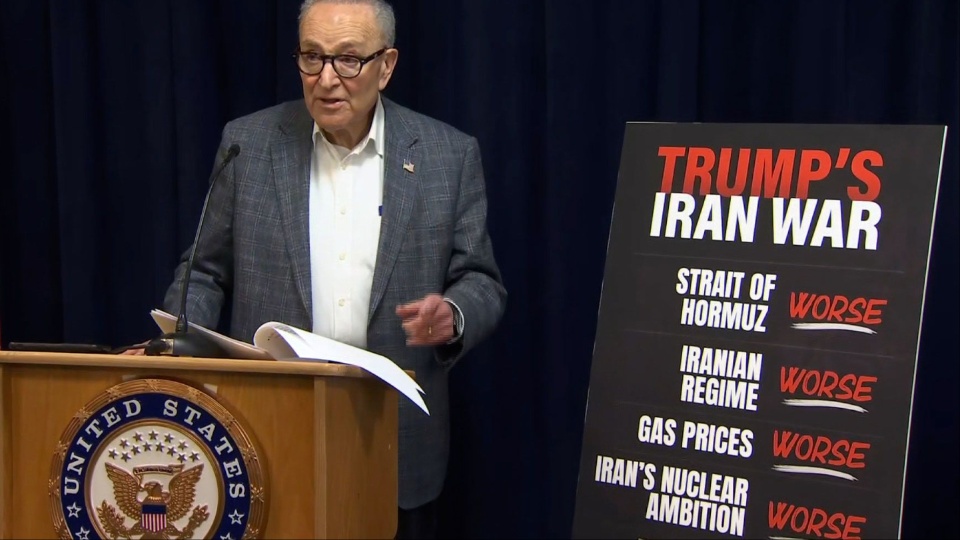
Minority Leader Chuck Schumer declared this week, “Congress must reassert its authority, especially at this dangerous moment. No president, Democrat or Republican, should take this country to war alone. Not now. Not ever.”
The push comes after more than five weeks of war and just after Trump announced a supposed ceasefire. So far, at least 3,500 have been killed in Iran by U.S. and Israeli strikes, another 1,400 or more in Lebanon by Israeli bombs, dozens of civilians in Israel due to Iranian retaliation, and 13 U.S. service members lost. The human toll is already staggering enough, but then there’s the economic fallout.
Schumer tallied some of the economic damage: $44 billion spent on weapons and mobilization and $4-a-gallon gas. There’s also the fact that Trump is pushing deep domestic spending cuts to fund an updated $1.5 trillion Pentagon war budget, but that went unmentioned.
His colleague, Sen. Cory Booker, D-N.J., has been more detailed in his accounting, saying in late March that “as money disappears overseas, Americans are feeling the consequences here at home: cuts to health care for millions, rising energy costs, billions stripped from veterans’ services, and deep cuts to school meals and support for children with special needs.”
The effort to reassert congressional authority over matters of war and peace is constitutionally correct, morally necessary, and overdue. And the War Powers Resolution itself is an important, if limited, tool to achieve that goal.

Several attempts have been made to pass one over the last several weeks in both the Senate and the House, with each try being shot down by the ruling Republicans. The attack on Venezuela in January prompted the first, and the war on Iran intensified the campaign. If passed, the measure would order a stop to Trump’s unauthorized war and ensure that any further U.S. military action be explicitly authorized by Congress.
Sen. Tim Kaine, D-Va., another of the initiators of the war powers effort, has called Trump’s Iran bombing campaign “a dumb war,” saying after a classified briefing that he found no justification for continued action and warning his colleagues: “I mean, have we really learned nothing?”
That bluntness is welcome, but honest analysis also requires honesty about the motivations of some of the war’s Democratic opponents.
Schumer’s critique centered on what he saw as Trump’s failures: the Strait of Hormuz left even more firmly under Iranian control, the Iranian regime still standing, gas prices higher, Iran’s nuclear ambitions “unchecked, if not accelerated,” and U.S. credibility with allies “down the drain.”
Schumer declared that “Iran’s ongoing campaign of terrorism, regional destruction, and oppression of the Iranian people must be met with a coherent strategy built on strength and clarity.” This is not the language of an anti-war opponent, but rather of a would-be better war manager. The implicit message is not “this war is wrong;” it’s “this war is being fought badly.”
The leader of the Democratic minority is, in effect, positioning his party as a more competent custodian of imperial foreign policy.
The same logic was on display when Schumer pushed back against Trump’s critiques of the NATO war alliance. Angry that the Europeans didn’t help him bomb Iran, the president threatened, again, that the U.S. might abandon the Cold War-era pact. But Schumer stood firm on the matter, declaring that the Senate would never vote to leave NATO and “abandon our allies just because Trump is upset they wouldn’t go along with his reckless war of choice.”
His initial statement after Trump launched the strikes on Iran made his framework explicit. He said, “Iran must never be allowed to attain a nuclear weapon,” and simultaneously argued that Trump’s “fitful cycles of lashing out” are “not a viable strategy.”
In every case, the demand is not for peace. Instead, it’s a pitch for a smarter path to the same ends.
This matters because it dodges a more fundamental question: Is the United States’ posture toward Iran—decades of sanctions, sabotage, assassination, and encirclement—itself just or productive for the cause of peace? Schumer wants the American people to weigh in on the war’s wisdom, while the deeper matter of its legitimacy is not addressed at all.
To be clear, forcing the War Powers vote is the right thing to do. It’s exactly what this publication has been urging its readers to demand of Congress again, again, and again.
 But the labor movement, peace organizations, and working people more broadly should be clear-eyed about what is being offered here. The War Powers Resolution is a procedural check, not a peace platform.
Though opposed to Trump’s style of war, leaders like Schumer aren’t coming at the issue from the same angle as some of their other congressional colleagues. Sen. Bernie Sanders said that, as with the wars in Vietnam and Iraq, the American people are again being “lied to” about the true aims of the bombing. Rep. Alexandria Ocasio-Cortez declared the war “unlawful… unnecessary… catastrophic.”
The clarity about the nature of the war has been even sharper outside the halls of the Capitol. Rev. William Barber denounced it as “unholy” in execution as well as intent. Claire Valdez—a New York State Assembly member, United Auto Workers organizer, and candidate for the U.S. House—is critical of the “throat-clearing and process critique” of Schumer and others. She’s adamant that “Democrats should speak clearly and with one voice: no war.”
The Communist Party USA has been similarly unequivocal: “The working class of the United States has no interest in this war. It is the children of working people who are sent to fight and die in the service of oil profits, military contractors, and imperial ambition.”
The party was also clear about who the real opponents of peace are: “The peoples of West Asia —Iranian, Palestinian, Lebanese, Yemeni—are not our enemies. Our enemies are the war profiteers and the political class that serves them.”
That point cannot be stressed enough. The war crimes threatened this week by Trump ahead of the ceasefire—destroying Iran’s power plants, bridges, and civilian water infrastructure—did not emerge from a vacuum. Though extreme, they are the product of a bipartisan consensus, decades in the making, that U.S. power in the Middle East must be maintained through force.
Democratic leaders who now object mostly to the execution of that project are not offering an alternative; they are auditioning to manage it better.
The War Powers Resolution must pass. Republicans who have blocked it four times must be held accountable. But working people, the labor movement, and the peace movement cannot let procedural victories be the final word on the matter.
The question before the country is not whether Trump is conducting this war incompetently. It is whether this war—and the imperial logic that produced it—was right in the first place.
As with all op-eds and news analysis articles published by People’s World, the views expressed above are those of the authors.
We hope you appreciated this article. At People’s World, we believe news and information should be free and accessible to all, but we need your help. Our journalism is free of corporate influence and paywalls because we are totally reader-supported. Only you, our readers and supporters, make this possible. If you enjoy reading People’s World and the stories we bring you, please support our work by donating or becoming a monthly sustainer today. Thank you!
CONTRIBUTOR