

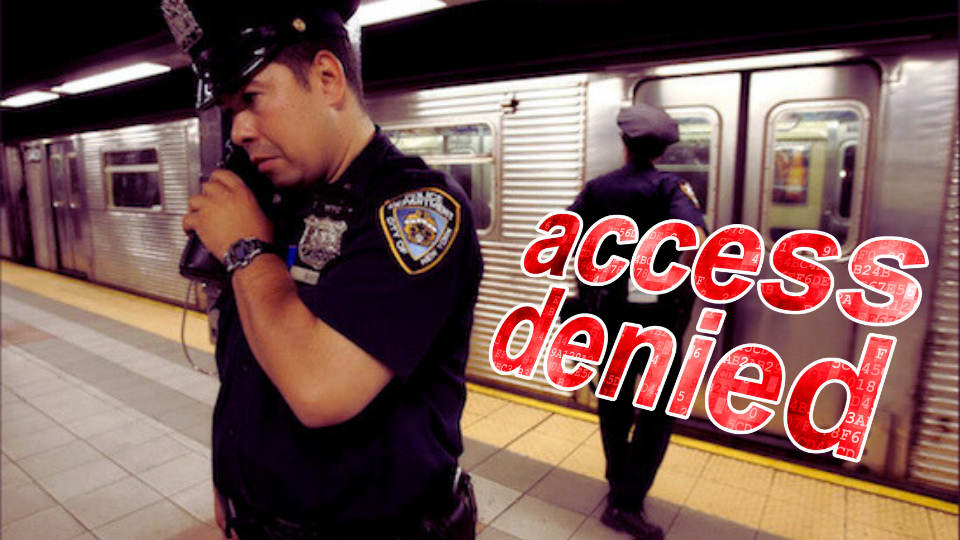
NEW YORK—In a move that many journalists are calling an attack on freedom of the press, New York Gov. Kathy Hochul vetoed a bill that would have granted press members across the state real-time access to encrypted police radio transmissions. The veto comes a day after the New York City Council voted to reopen the New York City Police Department’s blacked-out airways for credentialed media.
Police radio transmissions in the state have been accessible to journalists and members of the public via police scanners since the NYPD began using radios to communicate in 1932. A little over 90 years later, in 2023, New York police agencies began a department-wide shift to digitally encrypted radio transmissions not susceptible to scanner interception.
This move was backed by the New York City Council, which appropriated $21 million in 2021 for an NYPD radio upgrade to a digital system capable of encryption. The move sparked immediate backlash from journalists and others who saw it as hindering the press’s ability to provide real-time information to the public.
“By encrypting its radio communications, the NYPD is breaking with an almost century-old practice of allowing the press and the public to access information about critical developments in their communities,” New York Civil Liberties Union Senior Privacy and Technology Strategist Daniel Schwarz said in 2024.
“This latest move to shut out public access to communications and keep New Yorkers in the dark is part of a broader pattern of police secrecy, with the NYPD routinely denying or delaying requests for public records and attempting to shield itself from oversight.”
Democratic State Sen. Michael Gianaris introduced the “Keep Police Radio Public Act” in 2023. The legislation required state police agencies to restore access to authorized media outlets and volunteer agencies and provide a 10-minute delayed transmission to the general public.
“Preserving access to law enforcement radio is critical for a free press, use by violence interrupters, and the freedoms and protections afforded by the public availability of this information,” Gianaris was quoted as saying at the time of the bill’s introduction.
“As encrypted radio usage grows, my legislation would strike the proper balance between legitimate enforcement needs and the rights and interests of New Yorkers,” he said. The bill was also sponsored by Assembly Member Karines Reyes.
When the bill finally reached Hochul’s desk, it became one of nearly 50 vetoes she issued shortly before the Dec. 19 deadline after which it would have become law.
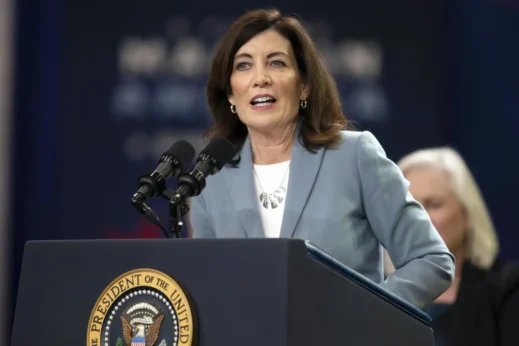
In a veto message, the governor claimed that access to “sensitive information” was a concern, equating it with public safety.
“While transparency is laudable, it should not come at the expense of public safety…. Municipalities remain free to make their own decisions as to whether to prohibit their police forces from encrypting radio transmissions,” she wrote. Hochul also claimed that the bill might endanger undercover officers and the locations of elected officials.
“In a time when public officials face growing threats of extreme violence, the bill also requires a police agency to effectively make real-time disclosure of the official’s movements to bloggers and paparazzi in addition to more traditional journalists,” the governor wrote.
Members of the press and their allies are pushing back against Hochul’s claims. The Deadline Club, a New York City chapter of the Society of Professional Journalists (SPJ), released a statement asserting that the governor’s veto claims are contradicted by the bill’s language.
They explained that the bill’s “sensitive information” exemption explicitly bars disclosure of confidential information related to criminal investigations or the identities of confidential sources. The group also asserts that the governor’s claims that the bill would require police agencies to disclose the whereabouts of public officials lack any evidence.
“Gov. Hochul’s justifications for vetoing this bill read like they were crafted by law enforcement lobbyists,” said Deadline Club President David A. Andelman. “It’s regrettable that she chose to put politics over public safety and the public’s right to know.”
The Deadline Club is part of a coalition of press groups that came together to support the “Keep Police Radio Public Act,” under the name the New York Media Consortium. The coalition also includes the News Guild of New York, the New York Press Photographers Association, the New York Press Club, the National Press Photographers Association, the American Society for Professional Photographers, the Radio Television Digital News Association, the New York News Publishers Association, the News Media Alliance, and more.
In an Op-ed published on Nov. 5, urging Hochul to approve the bill, Todd Maisel, founder of the New York Consortium, explained the importance of the press having access to police transmissions.
He noted that, “Insistence on transparency in law enforcement has nothing to do with whether one likes or dislikes police officers. It comes down to trust, and this is essential for a free society and the effective, honest policing of our streets.”
Maisel went on to assert that, “Some of the most important stories were learned through members of the media hearing radio calls…Would police have told the public in a timely manner about cops shooting to death Sean Bell on the night before his wedding?”
The NYPD is among a growing number of U.S. police departments moving to radio encryption, effectively blocking journalists and the public from access. The list includes several police agencies in California, Maine, Colorado, Illinois, Indiana, Virginia, and Pennsylvania.
As reported by TheFreeLanceNews.org, encryption is legal because of the Supreme Court’s Houchins v. KQED, Inc. (1978) decision, which holds that journalists have no greater right of access to information under government control than the general public. Which means that police departments are not required by the Constitution to provide journalists access to their radio transmissions if they don’t allow the general public access.
Many have called out the lack of transparency this creates, as journalists, with delayed information, are dependent solely on the information and narrative provided by the police.
“I think it is unfortunate that the bill was vetoed—we were committed to crafting something that would make law enforcement comfortable and uphold transparency for public and media,” Assembly Member Reyes said to the press. “We are in a time where the public is becoming less and less trusting of government and law enforcement, and this bill would actually help with the trust.”
“It is paramount that journalists have access to at least one important frequency that gives us important information for every police organization,” Lloyd Mitchell, a freelance photographer covering New York City, said in an interview with amNY. “It will help us tell stories in a timely manner from Buffalo, Albany, to the NYPD. It is critical that we work hand in hand with law enforcement and that they don’t have full control of the narrative.”
We hope you appreciated this article. At People’s World, we believe news and information should be free and accessible to all, but we need your help. Our journalism is free of corporate influence and paywalls because we are totally reader-supported. Only you, our readers and supporters, make this possible. If you enjoy reading People’s World and the stories we bring you, please support our work by donating or becoming a monthly sustainer today
CONTRIBUTOR



MOST POPULAR TODAY

As Iran war rages, Netanyahu builds ‘Greater Israel’ from Palestinian and Lebanese land
The other ‘lizard people’: Why the Epstein files are shattering global theory

Trump’s Postmaster General says USPS may shut down in a year

Europe refuses war script: Spain’s rebuke exposes limits of U.S.–Israeli escalation in Iran

U.S. Student Association tells Congress: Save education, Stop the SAVE Act