BERLIN—Things aren’t going well on the eastern front for Ukraine and the coalition of powers backing its government. The collective air defense system has proved to be as useless against countering Russia’s missiles as it has against those from Iran in Israel.
The search for a remedy has led them to find what they were looking for in the depths of the U.S. arsenal. Tomahawk cruise missiles have been gathering dust there since the early 1980s. Hopes have been quickly rising in the media that the U.S. might now supply them to Ukraine.
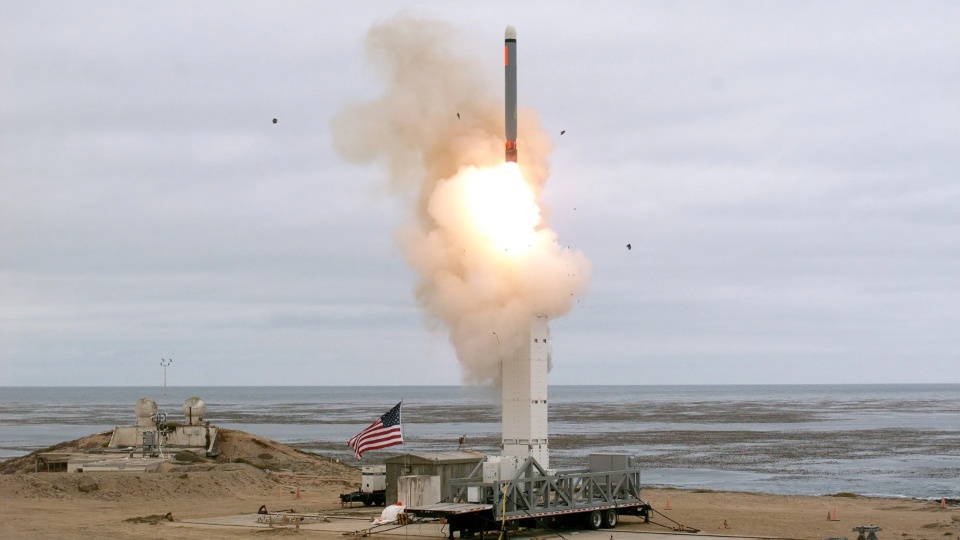
Despite numerous upgrades, these over 40-year-old devices are not exactly state-of-the-art. They are relatively slow (Mach 0.7), have a relatively small warhead (120 kg), a low flight altitude of 30 to 50 meters, and a range, depending on the variant, of 460 to 2,500 kilometers.
Tomahawks are designed for precision strikes against hardened targets. A “decapitation weapon” typical of the Reagan era, they can be fired from aircraft, surface ships, and submarines, as well as from special vehicle launchers. However, these launch platforms are not present in Ukraine.
Calculations have shown that the number of Tomahawks required to take out a large Russian oil refinery, for example, is approximately 100. On April 7, 2017, the U.S. Navy fired 59 such cruise missiles against the air base in Homs, Syria. The “success” was rather limited—or nonexistent.
In the case of Ukraine, the delivery of approximately 50 Tomahawks is now being discussed. Production has been around 200 since 2022, and 57 more are planned for 2026. However, thousands would be needed to achieve a significant effect on the battlefield. Regarding a possible delivery to Ukraine, Trump says one thing today and the opposite tomorrow.
Despite its limitations, the deployment of this weapon would significantly change the situation in the war. The missile’s potential range would make attacks on Moscow and/or St. Petersburg possible, changing the calculus of attack and counter-attack.
Furthermore, Tomahawks can only be supplied, equipped with a warhead, programmed, and fired from U.S. platforms by U.S. forces. Their deployment in Ukraine would deprive the Kremlin of the ability to continue pretending that Washington is not its real enemy in the war. A direct confrontation between Russia and the U.S. would then be almost unavoidable, with all the possible (nuclear) consequences that could arise from it.
This already dangerous scenario is dramatically exacerbated by the fact that Tomahawks themselves can be equipped with thermonuclear warheads. These warheads can generate an explosive yield of up to 150 kilotons of TNT. That’s about ten times the yield of the Hiroshima bomb.
Since it’s impossible to tell which warhead is being carried by approaching Tomahawks, the Russian side would have to assume a worst-case scenario. This means they would have to prevent the delivery and deployment of these weapons in advance. U.S. logistics would become the immediate target.
The hostilities in the Ukraine war have so far been mostly contained within the borders of the two countries officially in conflict with one another, but the deployment of Tomahawks would likely mark a “point of no return.”
European governments and media departments may celebrate this in their boundless delusion. Whether they would still be enthusiastic when Russian hypersonic missiles rain down on Europe and they stand before smoking ruins is another question.
This article originally appeared in the German newspaper Unsere Zeit. The English translation has been slightly edited for a U.S. audience.
We hope you appreciated this article. At People’s World, we believe news and information should be free and accessible to all, but we need your help. Our journalism is free of corporate influence and paywalls because we are totally reader-supported. Only you, our readers and supporters, make this possible. If you enjoy reading People’s World and the stories we bring you, please support our work by donating or becoming a monthly sustainer today. Thank you!
CONTRIBUTOR