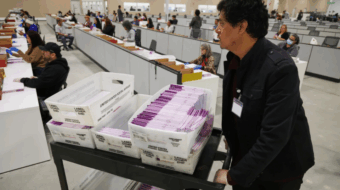
DETROIT—Voters here on Tuesday determined which of nine mayoral candidates will advance to November’s ballot. After 12 years as Detroit’s mayor, Mike Duggan will leave the position to pursue a bid for Michigan’s next governor, now running as an independent.
Duggan leaves behind a controversial legacy as mayor, notably for his tax-abatement-driven development schemes that defunded school programs and libraries to pay for luxury developments, as well as his acceptance of big money donations from Republican Party operatives and mega-donors.
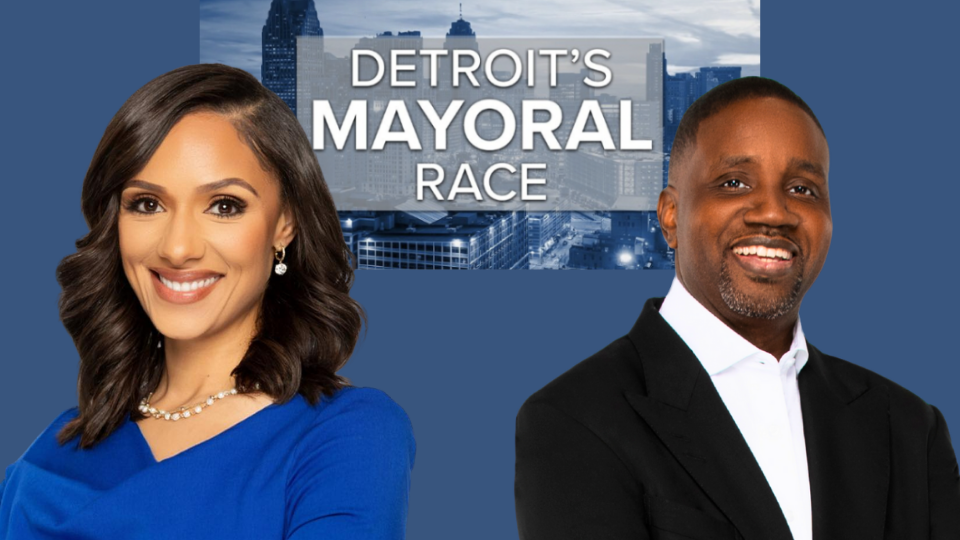
When the polls closed Tuesday night, the final choices for Detroit mayor this fall were set: Detroit City Council President Mary Sheffield and Rev. Solomon Kinloch, Jr.
It can be argued that Detroit certainly has no Zohran Mamdani on its hands. While no candidate stands out as the clear progressive force the city needs, the election will still determine how sharply Detroit can shift away from Duggan and his pro-corporate, big-business policies.
Only two major mayoral candidates received union endorsements. Unsurprisingly, they were the two top vote-getters. Sheffield handily won the primary with 50.8% of the vote. Kinloch secured second place with 17.4%.
Sheffield earned support from SEIU Michigan, which praised her track record of advocating for workers, including her appearance at a rally for striking arena and custodial workers and her establishment of an arena workers’ standards board.
She also pocketed endorsements from UNITE HERE! Local 24, IBEW Local 58 (which donated $5,000 to her campaign), Teamsters Local 283 ($1,500), Plumbers Local 98, and Laborers’ Local Union 1191. Additionally, the Detroit Police Lieutenants and Sergeants Association backed her with a $1,000 campaign donation.
Sheffield currently serves as City Council President and represents District 5, the largest of all nine districts. Due to her mayoral run, her seat is now open. She was elected to the City Council in 2013 when she was 26 and became Council President in 2022. For the mayoral campaign, she’s running on a platform focused on housing policy, equitable downtown development, property tax reform, and environmental justice.
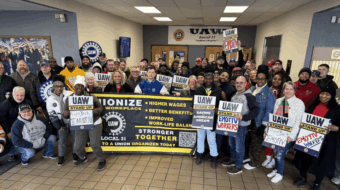
The United Auto Workers (UAW), meanwhile, endorsed Kinloch. UAW President Shawn Fain stated, “In this election, Detroit needs a champion who will fight for the working class and build a city that works for everyone—not just the few…. Rev. Kinloch has the heart, the vision, and the moral leadership to deliver for working people.” Kinloch, a former UAW worker himself, also received AFSCME 925’s endorsement.
“Pastor Kinloch stood by UAW members—on strike and in the community,” the UAW said. “We know he will fight to make sure the neighborhoods that have been left behind finally get a seat at the table. His campaign has been about affordable housing that Detroiters can actually afford, good jobs that allow people to take care of their families, and a seat at the table for those who have been left out.”
Kinloch’s agenda calls for creating 10,000 affordable housing units, bringing more grocery stores to the city to fight “food deserts,” poverty reduction, expanding workforce training programs for residents, and improving city services.
Kinloch previously worked as an autoworker and was a UAW member before founding the Triumph Church. His UAW backing aligns with his union background and ties to neighborhoods near auto plants.
Fortunately for Detroit workers, former Police Chief James Craig (2013–21) did not qualify for the general election. Though the race is nonpartisan, Craig is a known ultra-right ally. As chief in 2020, he oversaw the violent police response to protests against the police killings of George Floyd and Breonna Taylor.
Detroiters also demanded accountability for the 2010 killing of 7-year-old Aiyana Mo’Nay Stanley-Jones by Detroit police. Craig faced heavy criticism for his department’s excessive force against peaceful protesters, leading to multiple lawsuits, including a million-dollar settlement during the Black Lives Matter protests.
More recently, Craig defended President Donald Trump’s deployment of National Guard troops during Los Angeles protests, telling WDET he was “unapologetic” in his support, claiming local leaders had failed. After unsuccessful runs for Michigan governor and state senate, Craig called his mayoral bid a “natural” move. Yet, he won’t be a factor this fall.
Notable City Council races were in Districts 5 and 7. In District 5, former autoworker and UAW member Renata Miller and Detroit Police Commissioner Willie Burton advanced as the top two candidates. Miller won 23.2% of the vote and Burton received 19.4%.
In District 7, four candidates competed to replace Fred Durhal III, who ran for mayor. Democratic Socialists of America-backed Denzel McCampbell led with 34.5%, followed by Michigan State Rep. Karen Whitsett at 33.9%.
For the at-large seats, incumbents Mary Waters and Coleman Young II took the top spots. Former Councilwoman Janee’ L. Ayers and Detroit Fire Department community relations chief James Harris placed third and fourth. All these candidates will proceed to the November elections.
We hope you appreciated this article. At People’s World, we believe news and information should be free and accessible to all, but we need your help. Our journalism is free of corporate influence and paywalls because we are totally reader-supported. Only you, our readers and supporters, make this possible. If you enjoy reading People’s World and the stories we bring you, please support our work by donating or becoming a monthly sustainer today. Thank you!
CONTRIBUTOR