WASHINGTON—The popular 1984 song “2 Minutes to Midnight” by Iron Maiden—which highlighted humanity’s march toward nuclear war—needs an update to 85 seconds. Because that’s how close the world now stands to human-made global catastrophe, according to the experts behind the Doomsday Clock. It might be the catchiest tune, but the alarm has to be raised somehow, as scientists say the situation facing the world is more dangerous than ever.
The Bulletin of the Atomic Scientists’ Science and Security Board (SASB), which sets the Clock, released a statement, along with four supplemental reports, on Jan. 27 calling for urgent action to limit nuclear arsenals, develop international guidelines for AI use, and form multilateral agreements to address global biological threats. The board cited a “failure of leadership” in addressing factors that could lead to catastrophe, such as nuclear warfare and the climate crisis, as the reason for they moved up their countdown metric.
“A year ago, we warned that the world was perilously close to global disaster and that any delay in reversing course increased the probability of catastrophe. Rather than heed this warning, Russia, China, the United States, and other major countries have instead become increasingly aggressive, adversarial, and nationalistic,” the statement asserted.
“Hard-won global understandings are collapsing, accelerating a winner-takes-all great power competition and undermining the international cooperation critical to reducing the risks of nuclear war, climate change, the misuse of biotechnology, the potential threat of artificial intelligence, and other apocalyptic dangers.”
Founded in 1945 by Albert Einstein, J. Robert Oppenheimer, and University of Chicago scientists who helped develop the first atomic weapons in the Manhattan Project, The Bulletin of the Atomic Scientists created the Doomsday Clock two years later (1947) to give the public an easy-to-understand measurement of manmade threats to human existence and the planet.
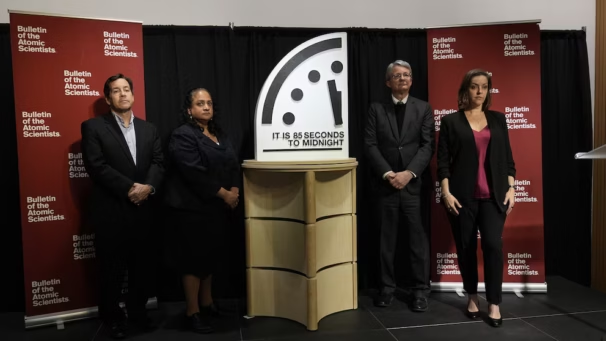
The Clock’s original setting was seven minutes to midnight. The farthest from midnight it has ever been was 17 minutes in 1991, when the Cold War ended, and the superpower nuclear rivalry eased. Last year, it was set to 89 seconds. This year’s time, 85 seconds, marks the closest the Clock has been to midnight since its inception.
The Science and Security Board stated that many world leaders have “grown complacent and indifferent” when it comes to addressing existential risks and are adopting “rhetoric and policies” that accelerate the crisis rather than mitigate it.
The board examined developments in four areas that it claims have increased the potential for “catastrophic risks.”
Nuclear
The world is “sliding further down a slippery nuclear slope,” the board said. Citing numerous war conflicts around the globe, such as Russia-Ukraine, India-Pakistan, and Israel and the United States’ aerial attacks on Iranian nuclear facilities, SASB emphasized that “as divisions between nuclear and non-nuclear countries deepen amid rising geopolitical tensions, the outlook for the Nuclear Non-Proliferation Treaty remains cloudy.”
They warned that in the absence of arms control, strategic competition among major world powers was becoming “a full-blown arms race.”
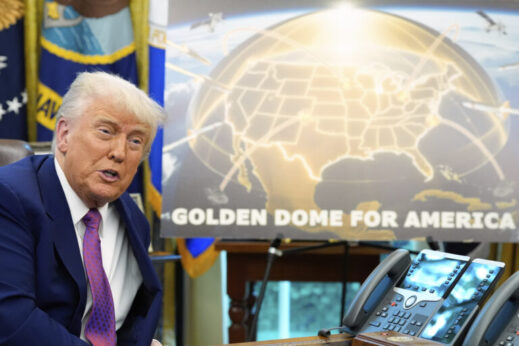
One example highlighted was the Trump administration’s announcement of the Golden Dome missile defense program. Described as a multi-layer missile defense system for the United States, if implemented, would allow the U.S. to maintain space weapons in orbit for the first time in history. The architecture of the Golden Dome is set to remain classified from the public, but on Jan. 20, Congressional appropriators released a fiscal 2026 defense spending bill that allocated $26 billion to the U.S. Space Force.
Stating that world leaders are leaning further into “nationalist and autocratic tendencies,” the board said this race for “strategic superiority” is spilling into other areas, including efforts to establish the first human settlement on the moon, to deploy military applications of AI, and to “weaponize space.”
“In 2025, it was almost impossible to identify a nuclear issue that got better. More states are relying more intently on nuclear weapons, multiple states are openly talking about using nuclear weapons for not only deterrence but for coercion…. [M]ore and more non-nuclear states are considering whether they should acquire their own nuclear weapons or are hedging their nuclear bets,” Jon B. Wolfsthal, director of global risk at the Federation of American Scientists (FAS) and SASB member, explained.
“Nuclear states are reducing their own security and putting the entire planet at risk. Leaders of all states must relearn the lessons of the Cold War—no one wins a nuclear arms race.”
Climate crisis
When looking at climate change, the board called the outlook “troubling.”
The report presented a grave list of worrying developments in recent years regarding the environment. They noted that atmospheric carbon dioxide—the greenhouse gas most responsible for human-caused climate change—has reached a new high. Important glaciers are melting, and sea levels are rising at their fastest recorded pace.
They explained that these developments were already having deadly effects on the human population.
“There were over 60,000 heat-related deaths in the summer heatwave in Europe. Floods in the Congo displaced 350,000 people. The deluge at Rio Grande do Sul displaced over half a million people. In the United States, the number of severe climate disasters increased nearly five-fold in 2024, compared to the 1990-2000 decade,” the board explained. They noted that the average time between these severe disasters is 12 days, compared with 82 days in the early 1980s.
The report took into account what the board considered an inadequate response by those in power to these severe disasters and criticized their negligence when it comes to seeing climate change as a key cause for concern.
“None of the last three U.N. climate summits has emphasized phasing out fossil fuels or monitoring emissions,” the statement said. “Reliance on carbon dioxide removal to help combat climate change is an uncertain, risky, and costly proposition.”
Turning an eye to the United States once again, the report asserted that the Trump administration seeks to “systemically repeal targets and policies, as well as decimate funding for climate change mitigation and science.” It said that these “aggressive” actions are the most consequential climate policy rollback that the Climate Action Tracker has ever analyzed.
Biological threats
The statement went into biosecurity dangers concerning unregulated science experimentation, threats of biological weapons, and infectious diseases.
Sounding like a science-fiction horror movie, the report detailed the laboratory synthesis of so-called “mirror life.” Mirror life refers to mirror bacteria and other mirror cells—composed of chemically-synthesized molecules that are the opposite of the molecules that are found on Earth. One potential benefit of mirror cells is that they could help produce more effective drugs and medicines. Yet scientists have long debated the benefits and drawbacks of such experimentation, with many noting that the risks aren’t worth the rewards.
Recently, 38 scientists from nine countries published a detailed assessment of the risks of mirror life. If its development goes unchecked, mirror life could “evade normal controls on growth, spread throughout all ecosystems, and eventually cause the widespread death of humans, other animals, and plants, potentially disrupting all life on Earth.” The board states that despite these drastic warnings, the international community has not devised a plan to address this risk.
Essentially, if there are no rules governing the creation of these molecules and bacteria, then there is nothing stopping governments, militaries, or private companies from conducting potentially hazardous experiments.
On the biological weapons front, the board noted that during the past year—which marked the 50th anniversary of the Biological and Toxin Weapons Convention (BWC)—”there were no meaningful measures to strengthen international control regimes against the development of biological weapons by states parties.” They raised the alarm that, among leading world powers, there is a likelihood of more resources being devoted to the development and deployment of biological weapons.
Lastly, the statement highlighted that the cuts in funding, particularly in the U.S., to health research and reductions in the health workforce have greatly damaged the infrastructure needed to combat the “continued emergence and evolution” of infectious disease threats.
Disruptive AI
And in a first for the board, the report placed a heavy emphasis on the growing use of artificial intelligence and its dangers.
They called AI a “significant and disruptive” technology that is growing rapidly. The SASB noted that AI has played a role in several important discoveries, but there are growing concerns about artificial intelligence being unregulated. In particular, the report noted the effects AI has had and continues to have on the information ecosystem.
“Increasing chaos, disorder, and dysfunction in the world’s information ecosystem threaten society’s capacity to address difficult challenges, and it is clear that AI has great potential to accelerate these processes of information corruption,” the SASB report stated. The authors went on to say that AI-enabled distortion of information would likely remain a significant obstacle to efforts to address urgent, major threats such as pandemics, nuclear war, and climate change.
Pointing to President Donald Trump, the report asserted that “the United States now has a president who personally participates in distributing fake information,” pointing to Trump’s past posting of an AI-generated video announcing the “medbed,” which the statement describes as a “conspiracy theory based on false beliefs about UFOs.”
“Trump revoked [former President] Biden’s AI safety initiative and banned states from crafting their own AI regulation, reflecting a ‘damn the torpedoes’ approach to AI development,” Steve Fetter, PhD, professor of public policy, and former dean of the University of Maryland and SASB member, said.
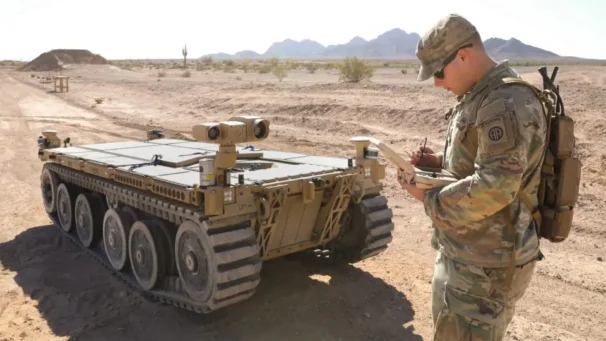
The report also highlighted the increase in AI use in military operations worldwide. The statement notes that leading world powers are incorporating AI across their defense sectors despite potential dangers. “Command and control applications [using AI] may be problematic, especially in decisions to employ weapons, and especially in nuclear command and control,” the statement explained.
A road forward
Despite the gloom and (literal) doom in the report, the SASB says there are still ways humanity can be “pulled back from the brink” of catastrophe.
The board encouraged open dialogue among leading world powers, regulation of potentially harmful entities such as mirror life and AI, and urged the U.S. Congress to “repudiate President Trump’s war on renewable energy” and instead provide incentives and greater investment to rapidly reduce the use of fossil fuels.
As the SASB statement concluded, “Our current trajectory is unsustainable. National leaders…must take the lead in finding a path away from the brink. Citizens must insist they do so… It is 85 seconds to midnight.”
We hope you appreciated this article. At People’s World, we believe news and information should be free and accessible to all, but we need your help. Our journalism is free of corporate influence and paywalls because we are totally reader-supported. Only you, our readers and supporters, make this possible. If you enjoy reading People’s World and the stories we bring you, please support our work by donating or becoming a monthly sustainer today. Thank you!
CONTRIBUTOR