

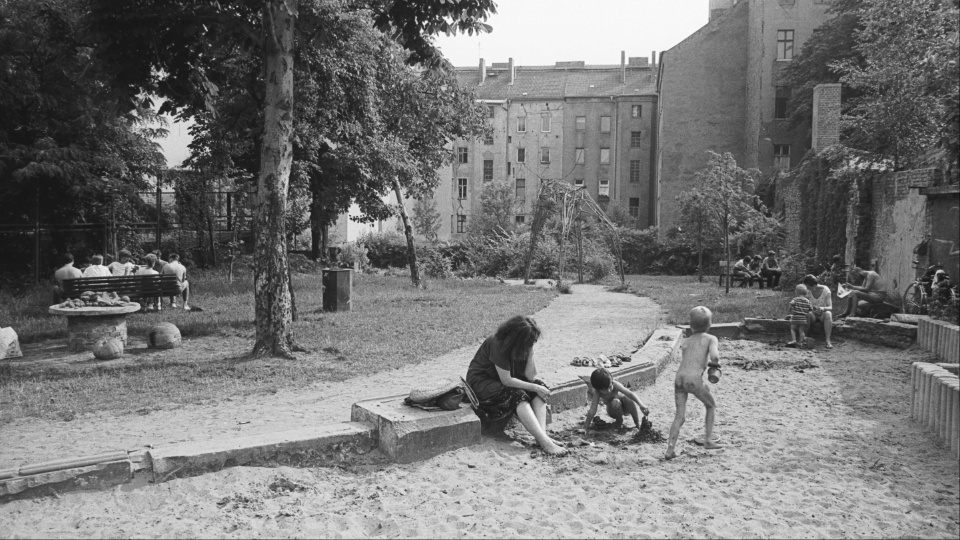
In the late 1960s, I completed an apprenticeship as a specialized glassworker in my hometown of Torgau, in the German Democratic Republic. Glass had been produced there for over 30 years. A new part of the factory had been built next to the old one, and the entire company was now called VEB Flachglaskombinat, or Flako for short, and was the largest and most important glass manufacturer in the GDR.
The training of high school students like myself, who were preparing for their Abitur (university entrance qualification) alongside their apprenticeship, took place in the old part of the plant. We pushed containers along rails on the ceiling to the individual filling stations, pulled the cord, and let sand, soda, fluorspar, and other ingredients slide in. This mixture was then mixed and continuously pushed into the melting tank, where it continuously melted at 1,500 degrees Celsius.
At the end, the red-hot glass flowed through a nozzle floating on the molten metal, through which the glass ribbon was pulled upwards over 17 pairs of rollers to the breaking platform. There, they broke it by hand, carried the heavy slab to a table, threw it onto it, cut it into the specified strips, and placed the slices on trestles. Around the clock.
It was sweaty, physically demanding work using old technology. I toiled there in a four-shift system. And I felt the power of the class I was briefly a part of, and wrote my first articles for the company newspaper, which was named—perhaps no surprise—Klare Sicht, or Clear View.
Today, flat glass is manufactured quite differently, computer-controlled and largely by machines. When I recently read an article in Freitag in which a film reviewer gloated that “now” the “entire holdings of the State Film Documentation Service (SFD)” of the GDR have been documented and “can be viewed online in the digital reading room of the Federal Archives, free of charge and without registration,” I went online to search.
There, I found what I was looking for. There were three films from the Torgau flat glass combine listed there. However, when I clicked on the title, I got the response: “The video is not available online for legal reasons and is not available digitally.”
This was repeated with dozens of other titles I attempted to access. The reviewer’s praise of complete digitization (“a remarkable achievement given tight budgets”) was apparently just verbalized hot air, contemporary propaganda.
This certainly also applied to his assessment of the content of individual films he might have seen at the Zeughauskino theater, located in the German Historical Museum in Berlin. Since 2014, such historic GDR films have been shown there in thematically organized series. These events enjoy great demand and are always sold out.
Why are they so popular? It’s because these are original recordings from the GDR, insights into everyday life in the defunct country, undisguised by today’s zeitgeist. People who lived it, want to see glimpses of their old life again, and the people who didn’t grow up in that socialist state are curious.
GDR life is there on the screen—with its hardships, its shortcomings, its annoyances, but also its likeable sides. The way people spoke without mincing their words! From their manners and gestures alone, you can see, firstly, which class was in charge here, and secondly, how “democracy in the workplace” actually functioned. The way one worker spoke to his factory manager in a film screened at the theater has become legendary. Today, it would be a threat to one’s job.
Between 1971 and 1986, the State Film Documentation Service of the GDR produced 300 such films, more than half of which were interviews with both unknown and prominent labor veterans, anti-fascists, and academics who spoke about themselves and their lives—from Bruno Apitz (author of Naked Among Wolves) to actor Erwin Geschonneck and Spanish fighter Eva Jonack to Alfred Zimm, a new teacher after the war and then research director at the Humboldt University of Berlin. These are moving testimonies of contemporary history captured on celluloid for future generations.
Now, one could mock the fact that the filmmakers mostly shot in Berlin because they were supposedly only allowed 70 liters of gasoline a month. Or one could pretend that every film was classified because it featured an unfiltered depiction of the GDR. As the Freitag reviewer puts it, the government commissioned these “documentaries that were never allowed to be shown.” (What a stupid argument: After all, the potential audience lived in this reality.)
The truth is that these recordings were intended for the archive from the very beginning; they were made as a documentary record of socialism under construction in the GDR—achievements, flaws, and all. It’s also clear that the citizens interviewed in the films never held back their words simply because—as the reviewer mockingly put it—the filmmakers “had the proverbial scissors [of censorship] in their heads.”
Damn, the conversation culture in the GDR back then was simply different than it is today, and people who didn’t live it just don’t get it.
So, let’s summarize: The Federal Archives houses around 320,000 films, including almost 12,000 from the GDR. Of these, 2,332 are documentaries, of which only 270 come from the State Film Documentation Center (SFD). Contrary to claims, not all of them are available online, but the ones that are there are highly informative and enlightening—provided you approach them with an open mind and free of clichés and prejudices.
For example, the 1982 film entitled Forms of Living Together: Unmarried Partners with Children is something the West would have never made. The street surveys on lifestyles in this half-hour film alone more than compensated for the film about the Flako glass plant which I couldn’t watch. Incidentally, at the end of the GDR, this was the most modern flat glass factory in Europe before being privatized. Today, it belongs to a publicly listed French industrial group.
The films can be found on the internet, provided they actually exist and are also accessible online.
Unsere Zeit
(Lead photo by Gerd Danigel, ddr-fotograf.de, covered by CC BY-SA 4.0 license.)
We hope you appreciated this article. At People’s World, we believe news and information should be free and accessible to all, but we need your help. Our journalism is free of corporate influence and paywalls because we are totally reader-supported. Only you, our readers and supporters, make this possible. If you enjoy reading People’s World and the stories we bring you, please support our work by donating or becoming a monthly sustainer today. Thank you!
CONTRIBUTOR



MOST POPULAR TODAY

As Iran war rages, Netanyahu builds ‘Greater Israel’ from Palestinian and Lebanese land

The other ‘lizard people’: Why the Epstein files are shattering global theory

Trump’s Postmaster General says USPS may shut down in a year

Trump’s catalog of constitutional crimes: Long and getting longer

Rooted Resistance: Sustaining Detroit’s movements through education and revolutionary optimism