

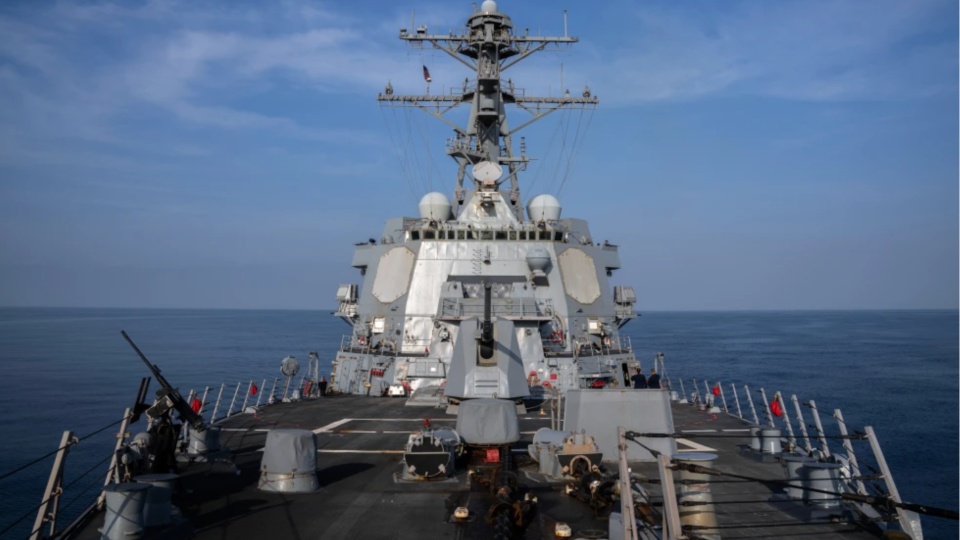
On Sept. 2, President Donald Trump and Secretary of State Marco Rubio separately reported that a U.S. attack on a small boat off Venezuela’s coast had destroyed illegal drugs on board and killed 11 passengers. Trump showed a video on social media displaying the boat’s fiery destruction.
He alleged the victims were members of the Tren de Aragua drug-dealing and terrorist gang. Analyst Vijay Prashad says Tren de Aragua is certainly a criminal gang, but doesn’t meet the definition of a narco-trafficking cartel.
The Tren de Aragua storyline, however, has been the justification for having U.S. naval vessels with 4,500 Marines aboard, a nuclear-powered submarine, and F-35 stealth aircraft patrolling in nearby Caribbean waters for weeks.
Many commentators denounced the illegality of the U.S. attack, as it took place without a declaration of war. These were summary executions, some have claimed. No one was captured, and criminal proceedings were lacking.
La Jornada journalist Carlos Fazio suggests the attack possibly did not happen, this on the basis of no available information on the boat’s location or home port and confusion about its destination. As for Venezuelan officials, they attributed the video to artificial intelligence.
On Sept. 12, troops from a U.S. destroyer boarded a Venezuelan tuna fishing vessel where they harassed nine crew members for eight hours. The action occurred in one of the country’s “exclusive economic zone[s].”
Venezuela’s defense minister on Sept. 14 denounced U.S. reconnaissance and intelligence flights along the coast. The next day, Trump announced that three “confirmed narco-terrorists from Venezuela” were killed in a U.S. attack on yet another vessel.
Actualities
The U.S. military build-up and the attacks are as real as the Monroe Doctrine of 1823, when European powers were told to back off from South and Central America. The Doctrine became license for U.S. intervention throughout the region then—and in Venezuela now.
It’s true: The U.S. government has interests, among them: access to Venezuela’s oil deposits that are the greatest in the world, overcoming competition from China for resources and trade, and seeing the disappearance of Venezuela’s socialist government. Another area of truth concerns arrangements coming out of historical experience that shape the U.S. government’s actions. The United States acts according to a script.
U.S. political leaders know their kind of economy always has to expand. Historically, they and leaders in other developed capitalist countries have sought to overcome shortages of the raw materials, fuel sources, and cheap labor they need so as to be able to expand production and make profits. They’ve done so by plundering poor countries of the world.
It’s not easy. Working and marginalized people, at home and abroad, deprived and oppressed, rise up in opposition and, worse, do it together. This kind of tension has continued ever since the onset of the Industrial Revolution. Tensions mounted after Venezuela’s change-oriented Bolivarian government came to power in 1999.
The stage was set. The capitalist, debt-ridden U.S. government faces internal crises, has to deal with newly-strong rival states, and tries to adjust to a failing neoliberal system. It lashes out. Venezuela, with oil and a government representing “socialism of the 21st century”—as propounded by the late President Hugo Chávez—is a ready target for U.S. imperialism.
The U.S. government may be falling back on the Monroe Doctrine. According to Politico, officials “are proposing to shift the U.S. military posture away from a focus on China, instead prioritizing alleged threats in Latin America and the Caribbean.”
Fakery
Myth-making is no stranger to the politics of change. The U.S. raised the cry of anti-communism after World War II and then switched to the “War on Terrorism” in the post-9/11 era. Now, as the U.S. war machine goes to Venezuela and elsewhere in the region, the agenda is the supposed fight against narco-terrorism, with anti-communism still very much a part of the mix as well.
Current Venezuelan President Nicolás Maduro, object of a $50 million U.S. bounty for his capture, becomes narco-terrorist-in-chief in this narrative. U.S. officials say Venezuela’s government operates a drug cartel called the “Cartel de los Soles.” Pino Arlacchire, former director of the United Nations Office on Drugs and Crime (UNODC) regards that entity as “a creature of Trumpian imagination.” UNODC’s 2025 report declared Venezuela to be “a marginal player in the great theater of international drug trafficking.”
Most of the cocaine (and methamphetamine) consumed in the United States and Europe flows up the Pacific coast and across Central America. A lot of cocaine goes to Europe in Ecuadorian banana boats. Only five percent of cocaine arriving in the United States passes through Venezuela. The most prominent producing and trafficking countries are Colombia, Peru, and Ecuador, all close U.S. allies at one or another time.
And contradictions
The United States itself is a great facilitator of the current narco-trafficking system. People in the U.S. are by far the world’s champion users of illegal drugs. The United States might have mounted a well-resourced, comprehensive, and effective offensive against drug use and addiction, but did not.
The “war on drugs” announced by President Richard Nixon in 1971 concentrated on inner city users during the Reagan era—the better to oppress ethnic minorities—and, later, on drug-traffickers abroad. Beginning in 2000, U.S. Plan Colombia, the drug war’s crown jewel, represented a militarized U.S. effort costing $10 billion ostensibly to reduce that country’s cocaine production. The U.S. government used Plan Colombia to undermine FARC leftist insurgents.
According to the Harvard International Review in 2024, “[Coca] “plantations are again quickly spreading” in Colombia. The report is damning: “For decades, Latin America has remained a hub for the illicit drug market … and drug production continues to increase”—despite the long U.S. drug war.
Uncomfortable truths
A big portion of the profits from narco-trafficking in the Western Hemisphere remains in the United States, serving as incentive to import more. The vastness of the U.S. drug trade is clear from penalties imposed on U.S. banks caught laundering drug money. There was the $3 billion judgment against TD Bank in 2024, $1.9 billion imposed on HSBC Bank in 2012, and, earlier, $160 million paid by Wachovia-Wells Fargo.
A convicted trafficker told an interviewer about delivering “billions of dollars worth (sic) of cocaine, heroin, and methamphetamines to their US and Canadian wholesale clients.” He reported that, “Heading south…we just had the money put on tractor trailers and had it driven it across the border. We never lost a dollar.” The total “sent back to Mexico…[over a decade] was probably more than US$3.5 billion.”
Weapons exported from the United States under the eyes of authorities benefit the drug cartels. Of guns confiscated in Mexico and across the Caribbean, 70% and 80% of them, respectively, came from the United States. Activist John Lindsay-Poland asks, “Why would we be arming the very people that we say we are fighting?”
We hope you appreciated this article. At People’s World, we believe news and information should be free and accessible to all, but we need your help. Our journalism is free of corporate influence and paywalls because we are totally reader-supported. Only you, our readers and supporters, make this possible. If you enjoy reading People’s World and the stories we bring you, please support our work by donating or becoming a monthly sustainer today. Thank you!
CONTRIBUTOR

MOST POPULAR TODAY

Europe refuses war script: Spain’s rebuke exposes limits of U.S.–Israeli escalation in Iran
Trump’s Postmaster General says USPS may shut down in a year
As Iran war rages, Netanyahu builds ‘Greater Israel’ from Palestinian and Lebanese land
Praising Trump’s war, monarchist forces hijack Iranian diaspora