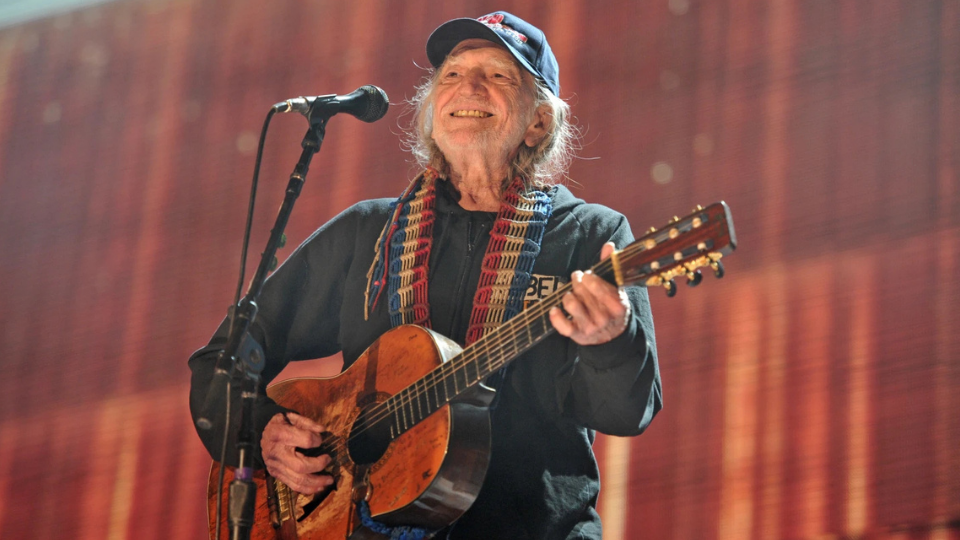
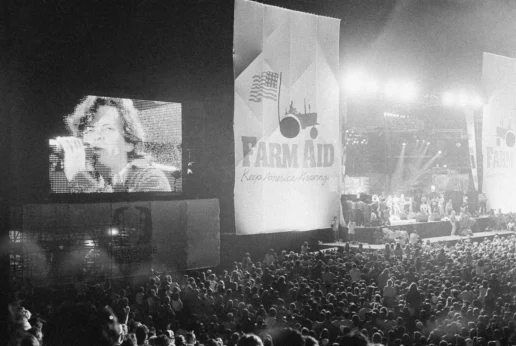
More than 50,000 fans packed the University of Minnesota (UMN) Huntington Stadium for the 40th Anniversary Farm Aid concert the evening of September 20. The enormous crowd that filled every stadium seat and packed the playing field cheered as country and western stars Willie Nelson, Neil Young, Margo Price, John Mellencamp, Bob Dylan, and many more sang.
It was a triumph for Farm Aid, which has helped thousands of family farmers stave off foreclosure and remain on their land. Ticket sales for the sold-out concert brought in $9 million to help more hard-pressed farmers. Singer Margo Price expressed how vital Farm Aid is, telling the crowd that she grew up on a farm in Illinois, her family forced off their farm by bankruptcy.
Willie Nelson, 92, sang as clear and sweet as he did 40 years ago, “I still remember angels flying too close to the ground.”
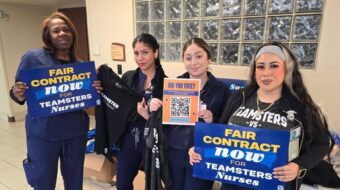
But it was also a huge victory for farmer-worker solidarity. Weeks before the concert, Teamster Local 320, which represents 1,400 cooks, janitors, housekeepers, and groundskeepers at the five campuses of the University of Minnesota (UMN), went out on strike, battling against the hardline corporate-minded university management.
Local 320 represents the workers who keep UMN’s Huntington Stadium clean, the football playing field green. Brian Aldes, Sec.-Treasurer of Teamster Local 320, commented on the modest demand, a 3.5% wage increase—less than the rate of inflation—on the $26.11 wage paid to the 1,400 workers. By contrast, UMN President Rebecca Cunningham is paid $481 per hour.
The University employees, Aldes continued, “should not be facing systemic poverty and racial disparities driven by the University’s own policies. With a $6 billion endowment and $71 million budget surplus, UMN should be dismantling inequity not reinforcing it.” He pointed out that workers on the picket line have been “handcuffed, zip-tied and charged with crimes for daring to engage in their constitutionally and statutorily protected right to protest and picket.”
In the midst of this sharp labor-management faceoff, Willie Nelson announced that he would not cross the Local 320 strike picket line, nor would any of the other performers, nor the carpenters scheduled to build the stage they were scheduled to perform on.
Farm Aid released a statement Sept. 11, declaring, “The farm and labor movements are intertwined. Time and again, farmers and workers have shown up for each other in solidarity. We are proud that the Teamsters support our festivals each year. Our artists, production team, and partners have made clear that they will not cross a picket line….The farm and labor movement are inseparable, and we believe that the University must return to the bargaining table in good faith.”
Nelson warned that the alternative would be the cancellation of this first-ever Farm Aid concert in Minnesota. It would be a financial disaster for Farm Aid—and for the State.
Finally, in consultation with Neil Young and other Farm Aid leaders, Nelson telephoned Governor Tim Walz: Is there anything he could do to help settle this strike in time for the carpenters to construct the stage?
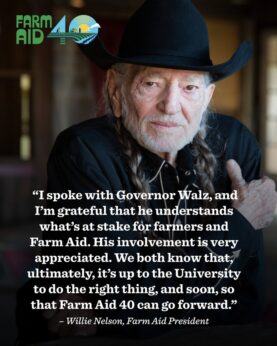
Walz vowed to take care of it. He phoned UMN management. Within 24 hours, the strike was settled with UMN agreeing to the workers’ demand. We don’t know what Gov. Walz said in the phone conversation, but he announced that Sept. 20, 2025, is “Farm Aid Day” statewide. He and his family attended the concert, and the Governor introduced Willie Nelson and thanked him for his lifelong role as a champion of family farmers. Walz was the running mate of Democratic Presidential nominee Kamala Harris in the 2024 election.
This celebration of Farm Aid’s 40th anniversary came at a time of deep worry among farmers. President Donald Trump’s unilateral 50% increase in tariffs imposed on goods imported from China caused a retaliation devastating to farmers who lost an estimated $13 billion in the sale of U.S. soybeans to China—all of it taken up with the export of soybeans from Argentina to China. Trump’s drive to terminate SNAP nutrition benefits to children and low-income families also hits farmers who strongly support these nutrition programs as beneficial to farmers.
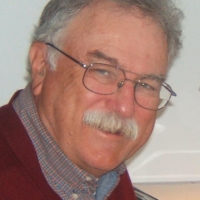
Mark Froemke, a retired grain miller from Crookston, Minnesota, a member of the Minnesota AFL-CIO Executive Board, hailed Willie Nelson and Gov. Walz for their role in settling the strike.
“When the University workers went out on strike, people were supportive,” Froemke told the People’s World. “But if it hadn’t been for Willie Nelson, Neil Young, and all those other Farm Aid folks announcing they would not cross the picket line, and if it hadn’t been for Willie Nelson calling Gov. Walz, I don’t know if they could have won that strike. Sometimes it is people we know in high places who can help us win a victory.”
Froemke also expressed pride that his son, Gus, the Recording-Secretary of Teamsters Local 320, inserted a paragraph in the union’s victory statement stressing the long history of solidarity between workers and farmers in Minnesota, so strong that the ruling party was called the “Farmer-Labor Party.”
Froemke added, “It was the politics of Gov. Tim Walz and Agriculture Commissioner, Thom Peterson, that caused the University to collapse and agree to this settlement. This was a great victory for the solidarity of workers and farmers.”
“Tim Walz and Thom Peterson are remnants of the Farm-Labor movement,” he noted. “The settlement clearing the way for the concert is part of that legacy.”
We hope you appreciated this article. At People’s World, we believe news and information should be free and accessible to all, but we need your help. Our journalism is free of corporate influence and paywalls because we are totally reader-supported. Only you, our readers and supporters, make this possible. If you enjoy reading People’s World and the stories we bring you, please support our work by donating or becoming a monthly sustainer today. Thank you!
CONTRIBUTOR