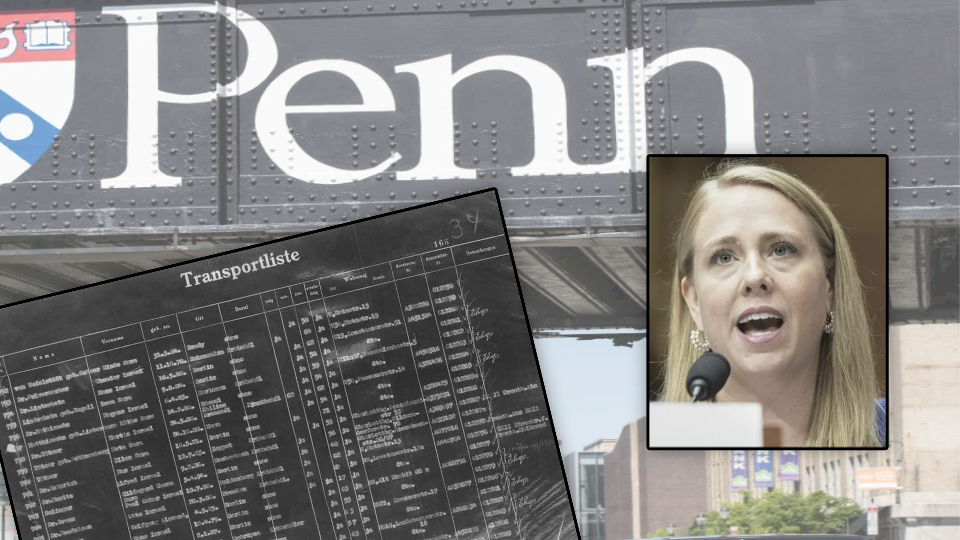
A federal judge ordered the University of Pennsylvania Tuesday to hand over lists of Jews on campus to the Trump administration to aid an alleged investigation into antisemitism. The ruling bolsters the government’s effort to force administrators at other college campuses to also turn over lists of faculty and staff.
U.S. District Judge Gerald Pappert ruled that the U.S. Equal Employment Opportunity Commission (EEOC) “needs the opportunity to talk to them [Jews on campus] directly to learn if they have evidence of discrimination.” The judge set a deadline of May 1 to comply.
The investigation at Penn was requested by Andrea Lucas, a Republican commissioner on the EEOC who is now its chairwoman. She claimed her concerns were based on news articles, public statements from university leaders, and congressional testimony showing what she claimed was “a pattern of antisemitism” at the school.
Lucas pointed to reports of antisemitic obscenities being shouted on campus and vandalism at a Jewish student life center. However, the investigation at Penn has also focused on protests by Palestine solidarity activists related to Israel’s war in Gaza, and the EEOC’s investigations are seen by many as an attempt to silence such initiatives.

Last July, Columbia University paid $21 million to settle a complaint filed by Lucas related to Gaza war protests, which she alleged were antisemitic. Cornell University has also faced similar scrutiny by the EEOC.
The University of Pennsylvania is appealing the decision and said in a statement that it has always challenged antisemitism and all forms of discrimination and has “taken steps to prevent and address these despicable events.
“While we acknowledge the important role of the EEOC to investigate discrimination, we also have an obligation to protect the rights of our employees. We continue to believe that requiring Penn to create lists of Jewish faculty and staff, and to provide personal contact information, raises serious privacy and First Amendment concerns.
“The University does not maintain employee lists by religion,” the statement read.
One of the first things that’s come to the minds of many regarding the Trump demand for lists of Jews and the court ruling backing them up is the historical memory of the Holocaust and the demands for such lists by the Nazis in Germany.
Pappert said the resistance to turning over such lists by the university and the filing of lawsuits against the administration “significantly raised the dispute’s temperature by impliedly and even expressly comparing the EEOC’s effort to the Holocaust and the Nazis’ compilation of lists of Jews.” Pappert labeled that “unfortunate and inappropriate.”
Timothy Snyder, a Holocaust historian who earned his doctorate in history from the University of Pennsylvania, told the publication Religious News Service that when he heard of the demand for the list, “I held my breath. Would I be able to continue to be proud of the University of Pennsylvania?”
Other universities have been told by the administration to turn over lists of Jews, with some resisting and others complying. Barnard College of Columbia and the University of California at Berkeley, in a slap at its storied history of resistance to tyranny, have complied.
Not everyone at the complying universities is happy about what their institutions have done. Nara Milanich, a Barnard professor, said it reminded her of 1930s Italy when lists of Jews were put together by the local governments.
“We’ve seen this movie before and it ends with yellow stars,” she said. She also said that she is troubled by what appears to be a “fishing expedition” by the administration to find antisemitism on campuses so it can then demand lists.
“Lists of Jews were never a good thing,” Amanda Shanor, a professor at the Wharton School and Penn’s Law School told the student newspaper, the Daily Pennsylvanian.
Fascists have long engaged in the practice of compiling lists of various categories of individuals in order to carry out repression afterwards. Those lists were not just limited to Jews. In Germany, for example, the Nazis demanded lists of political activists form a wide variety of institutions, particularly universities. Communists, social democrats, and trade union leaders were high up on those lists.
The Nazis ended up filling the Buchenwald concentration camp, for example, with these activists, creating a camp largely dedicated to persecution of political opponents. That ended up not being the best decision the fascists could have made, however, because a camp heavily populated with such activists, including Ernst Thälmann, the leader of the Communist Party, was later able to become the only camp that liberated itself.

Ben Porath is a Penn professor whose family came from the Netherlands. She wrote about her relatives: “In 1941, the Dutch government had the Jews register as such, and this is how the Nazis found many of my family members. Jews at Penn have diverse views on politics and on the efforts to fight antisemitism. I think we are united in our strong opposition to being put on a list.”
The national office of Jewish Voice for Peace and its Penn chapter issued a joint statement condemning Pappert’s ruling and the government’s demand for lists, characterizing them as a “continuation of the…authoritarian attacks on higher education using the false premise of antisemitism.”
The group, which has been a leading force in the movement opposing Israel’s war in Gaza and U.S. support for it, also pointed to the historical parallels of the Nazis’ lists and warned:
“We know where this can lead, especially as the Trump regime is escalating targeted attacks on many marginalized communities, including our immigrant, transgender, and Muslim families and neighbors.
“We know that true safety comes through our collective solidarity, where all individuals’ civil and human rights are upheld.”
We hope you appreciated this article. At People’s World, we believe news and information should be free and accessible to all, but we need your help. Our journalism is free of corporate influence and paywalls because we are totally reader-supported. Only you, our readers and supporters, make this possible. If you enjoy reading People’s World and the stories we bring you, please support our work by donating or becoming a monthly sustainer today. Thank you!
CONTRIBUTOR