BOSTON—On the eve of a mass union-led nationwide campaign on July 28 to “Protect Our Public Post Office” financially, the U.S. First Circuit Court of Appeals in Boston gave postal workers and the nation’s voters a win by forcing a delay—probably until after this fall’s election—on implementing a Donald Trump demand to almost completely curb mail-in balloting.
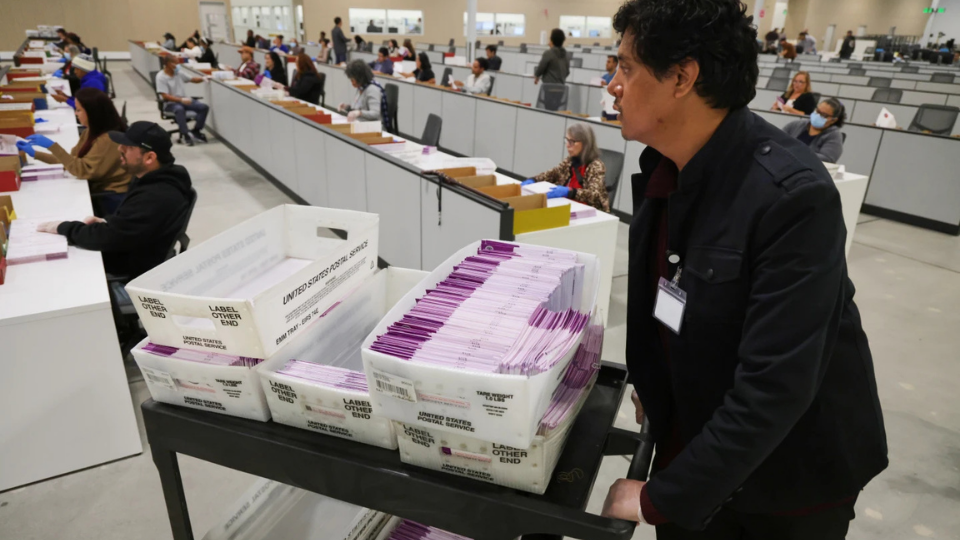
On July 27, appellate Judge Indira Talwani, speaking for the court, issued a nationwide injunction against a planned U.S. Postal Service rule, unveiled by Postmaster General David Steiner, to force all the states, plus D.C., to turn over lists of names, addresses, and other identification of people who requested mail-in absentee ballots in advance of this November’s voting.
USPS said it would compare the names on those lists, which only half the states have submitted, with other data it gathered from the Social Security Administration and other federal agencies to root out suspected “fraud” by people ineligible to vote.
But 23 states plus D.C., sued to stop the rule, and Democratic governors of eight of them, led by Illinois’ J.B. Pritzker, separately wrote Steiner urging him to drop the idea. Steiner’s rule also threatened that uncooperative states would not have any election-related mail delivered.
After the court ruling, though, “The Postal Service will not publish a final rule unless and until the government obtains relief from all relevant injunctions,” the USPS announced.
Steiner’s proposed rule, unveiled on May 29, is in line with Trump’s assault on mail-in voting, dating to even before the 2020 presidential campaign. He claims, despite all the evidence, that mail-in ballots are fraudulent.
Trump rants that mail-in ballots “cost” him the 2020 election because those ballots—often the last to be counted—swung the key states of Pennsylvania, Georgia, Michigan, Wisconsin, and Arizona against him. He’s campaigned to abolish mail-in voting ever since, even though he uses it himself.
The donors who fund Trump and his MAGA followers in Congress and the states agree, as a stranglehold on who can and cannot vote is in their political and profitable interests. The judge’s ruling offers the prospect of a break in that stranglehold.
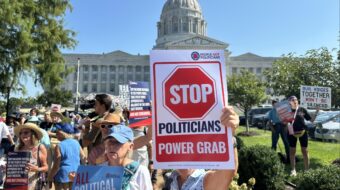
All this preceded the “Protect Our Public Post Office” demonstrations which the American Postal Workers Union (APWU) sponsored nationwide on July 28. Most were scheduled at noon local time.
“Americans deserve a Postal Service that remains public, financially secure, accountable to the people, and capable of serving every community for generations to come,” APWU says. It demands that the government provide the USPS “the financial tools it needs to succeed” and “a postal leadership that supports this vision.”
Steiner retorts the USPS is still running deeply in the red, facing the prospect of literally running out of cash early next year. His solution, repeating that of his predecessor, Louis DeJoy—another corporate executive Trump named to public office—is to close hundreds more local post offices, end Saturday delivery, raise postage rates, and cut the number of workers by forcing them to move to more centralized sorting facilities or quit.
And that would greatly harm not just the workers of USPS—many of them women, people of color, veterans, or combinations of those characteristics—it would also harm the public generally, the unions argue.
“The Postal Service belongs to the people, not corporate interests. It is a service, not a business,” APWU believes.
The USPS faces another problem besides its finances: The record high heat that hit the country. On July 20, it killed a second USPS worker in Texas within a year. Umeshkumar Thakkar, 58, a part-time carrier and member of the National Rural Letter Carriers Association, collapsed while making deliveries in rural North Texas and was pronounced dead at the scene after EMTs could not revive him.
Deaths to high heat exposure are a concern for all postal workers. Letter Carriers Branch 28 posted a video on social media, showing carriers struggling through the high heat.
“I drink between a gallon and 2-1/2 gallons of water a day, and I’m drenched in sweat” at the end of his route, one carrier says. “It’s a struggle every day, with 800 possible stops.”
Another carrier said in a voice-over that symptoms of heat stress and overexposure include “nausea, headaches, and extra fatigue…That’s your body telling you that something’s wrong.”
We hope you appreciated this article. At People’s World, we believe news and information should be free and accessible to all, but we need your help. Our journalism is free of corporate influence and paywalls because we are totally reader-supported. Only you, our readers and supporters, make this possible. If you enjoy reading People’s World and the stories we bring you, please support our work by donating or becoming a monthly sustainer today. Thank you!
CONTRIBUTOR