

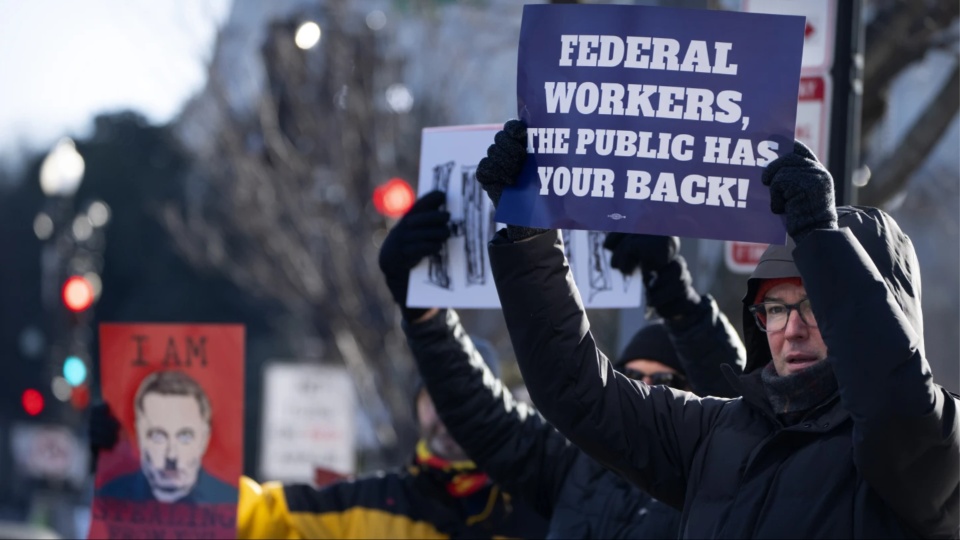
SAN FRANCISCO—Two top federal worker unions, the Government Employees (AFGE) and the Treasury Employees (NTEU), are vowing to fight on for their collective bargaining agreements and rights despite a pro-Trump federal appeals court ruling tossing most of those contracts out.
But AFGE, led by President Everett Kelley, and NTEU, headed by President Doreen Greenwald, still are hashing out what their next legal moves will be.
The need for further struggles occurs because on March 5 a three-judge panel of the Ninth U.S. Circuit Court of Appeals in San Francisco overturned a prior lower-court pro-union ruling.
That means the unions and workers now have no protections against mass firings—or against pressure from corporate special interests, acting through dark money and campaign contributions—to get Trump-supporting top officials to order the workers to disobey the law, or else.
That pro-union decision by Judge James Donato also produced an injunction banning Trump from dumping 21 union contracts. That injunction is now gone, too. A federal court in D.C. is weighing the fate of 16 other contracts. The fate of all union contracts covering the federal workers is important not just to them, but to everyone in the U.S.
Without protections of a contract, the federal workers can be fired, regardless of what the law covering them or the law they enforce says.
Further, GOP donors and corporate leaders can get the Trump regime to reverse non-partisan law-oriented rulings against them by the federal workers, or give those special interests favorable treatment, through the pressure of dark money and campaign contributions. Consumers, citizens, and workers are left with little or no counterweight from the resulting harm—unsafe products, toxic fumes, safety hazards, death on the job, and more.
Trump and Office of Management and Budget Director Russell Vought really want to abolish all public sector unions—and said so in the Vought-written labor section of Project 2025, which was Trump’s GOP “platform” in the 2024 campaign.
What they didn’t say, but first-term Trump White House aides drawn from the radical right Heritage Foundation did, is abolishing government worker unions is only their first step. Their ultimate goal is to outlaw or abolish all unions.
The contracts NTEU and AFGE are fighting for cover more than a million federal workers, with key groups in the Environmental Protection Agency and the Treasury, especially the IRS. The other 16 contracts, tied up in federal court in D.C., cover another 750,000 or so federal workers.
No sooner had the judges in San Francisco sided with Trump, accepting his claim that “national security” is involved and thus nullifies the contracts, then his Treasury Secretary and his IRS Commissioner terminated the contracts covering the Treasury and IRS workers.
AFGE’s Kelley called the original Trump executive order last July to trash the contracts illegal, unconstitutional, and retaliatory union-busting. After this latest ruling for Trump, they still are, he said. Trump, in turn, has called AFGE “enemies.”
The appeals court’s decision “is not a final decision on the legality of this executive order,” said Kelley. “The court addressed only whether a preliminary injunction should remain in place while litigation continues. This case is not over. The merits of this case are still very much alive.”
Trump’s lawyers had also argued the unions had no right—“standing” in legalese—to bring the case because the workers involved had already been fired and the unions had to have gone through an intricate obstacle course, beforehand, within the agencies involved. That obstacle course is weighted against the workers.
The appellate judges rejected that Trump argument, and Kelley called that rejection “a precedent-setting victory.” So the unions’ lawsuit challenging the legality of Trump’s union-busting will continue, he added. The question AFGE and its allies must decide is where.
Treasury Employees President Greenwald said as far as her union is concerned, its contracts with Treasury, its Bureau of Fiscal Services, and the IRS are still in force. And NTEU will still represent its workers at those agencies in bargaining, arbitration, and grievances, even if the bosses don’t show up for the sessions, she said.
Greenwald cited the union’s letter to the Trump appointee heading Treasury’s Bureau of Fiscal Services. It says that by civil service law, and by the pact BFS signed, the agency “must have a CBA with that exclusive representative” of its workers, the union.
“And regardless of whether BFS continues to recognize NTEU as the exclusive representative of its bargaining unit employees, there is no dispute the Federal Labor Relations Authority certified that status, as your memorandum acknowledges, and has taken no action to undo it,” her letter adds. The FLRA is the equivalent of the National Labor Relations Board, but for federal workers and unions.
We hope you appreciated this article. At People’s World, we believe news and information should be free and accessible to all, but we need your help. Our journalism is free of corporate influence and paywalls because we are totally reader-supported. Only you, our readers and supporters, make this possible. If you enjoy reading People’s World and the stories we bring you, please support our work by donating or becoming a monthly sustainer today. Thank you!
CONTRIBUTOR

MOST POPULAR TODAY

Strategic retreat or strategic pivot? The state of the Target boycott


Profit protector: Shield of the Americas summit builds MAGA world order

The other ‘lizard people’: Why the Epstein files are shattering global theory

Trump answers public worries about war and economy with same old campaign rallies