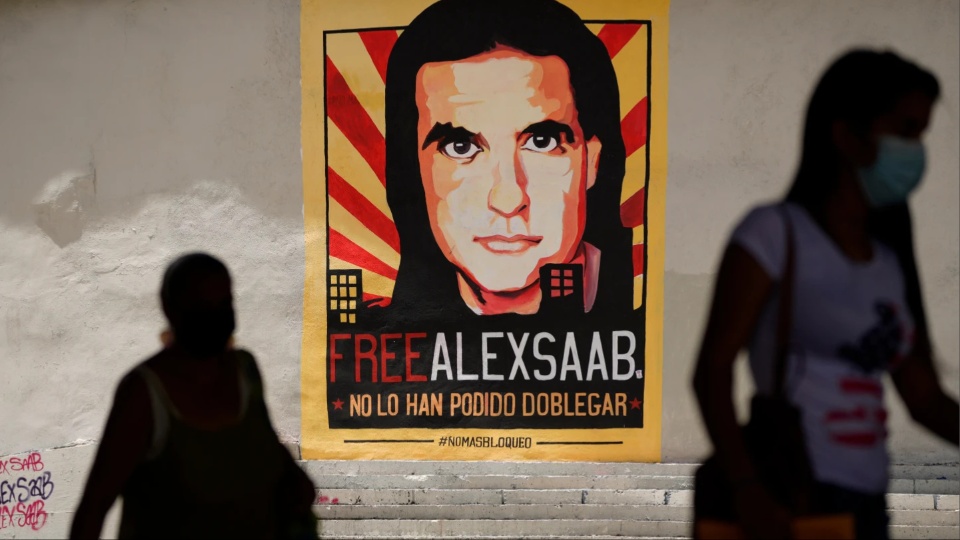
On Saturday, May 16, The Venezuelan government, represented by Interior Minister Diosdado Cabello, announced that it had “deported” former diplomat and Minister of Industry and National Production Alex Saab to the United States because he is “implicated in various crimes in the United States.”
Saab faces renewed federal money laundering and conspiracy charges unsealed in Miami. U.S. prosecutors allege that between 2015 and 2026, Saab siphoned hundreds of millions of dollars from state contracts, specifically targeting the Comité Local de Abastecimiento y Producción (CLAP) subsidized food program and Petróleos de Venezuela (PDVSA) oil sales through a network of shell companies and bribes.
From the perspective of supporters of Venezuela’s Bolivarian Revolution, however, Saab’s financial maneuvers were a necessary mechanism of economic resistance. He acted as a vital diplomatic envoy who managed to source fuel, medicine, and food imports for vulnerable populations at a time when Western financial blockades sought to completely strangle the Venezuelan state and force regime change.
In the aftermath of Venezuelan President Nicolás Maduro’s abduction, Saab was fired as Minister of Industry and National Production on Jan. 16 and arrested in a joint operation by Venezuela and the United States. His wife, Camilla Fabri, was also dismissed as Deputy Minister of International Communication.

Fabri was also dismissed as the head of the Return to Homeland Program in April, which helped return Venezuelan migrants in the U.S. unjustly detained by ICE or imprisoned in Cecot in El Salvador. The program returned over 700 Venezuelan citizens facing imprisonment by ICE to Venezuela to be reunited them with their families.
Saab was brought from El Helicoide detention center in Caracas to Simón Bolívar International Airport in Maiquetía, where he was flown on a plane staffed by FBI and CIA officials directly to the United States, where he was charged with money laundering in a federal court.
Saab stands accused of using “shell companies” to circumvent crippling U.S. sanctions and “illegally” selling oil to nations which had not agreed to follow the U.S. sanctions.
Much of the profits of these oil sales were then used to buy food, medicine, and other supplies for the people of Venezuela, the government in Caracas previously claimed, who were suffering from malnourishment and grappling with the COVID-19 pandemic.
Looking beyond the competing narratives about the allegations against Saab, however, there are two major legal issues with the justification of his deportation.
One issue is that Alex Saab is originally from Colombia, and thus “deporting” him to the United States, a country he’s barely resided in except for his imprisonment from 2020 to 2023, does not constitute a deportation, but an extradition.
Another issue is that Venezuela’s constitution prohibits the extradition of Venezuelan citizens. Cabello claimed that Saab was only a Colombian national, despite Venezuelan officials arguing that Saab was a Venezuelan national in 2020. If that’s the case, then this constitutes a de facto stripping of citizenship without legal due process.
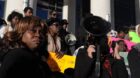
Saab has been in U.S. custody previously. In 2020, he was detained in the African nation of Cabo Verde while stopping for fuel for his jet and deported to the United States. An international campaign to free Alex Saab was started by the Venezuelan government to demand his release. In many U.S. cities, protests were held by various supporters of the Bolivarian Revolution against his detention, and the hashtag #FreeAlexSaab was spread around social media.
In December 2023, Saab was released by President Joe Biden in a prisoner exchange with Venezuela for ten U.S. citizens (including two U.S. mercenaries involved in Operation Gideon, an attempt to invade and overthrow the Venezuelan government) detained in the country.
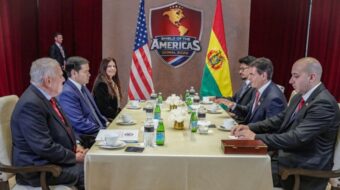
The latest extradition comes as Venezuela, led by interim President Delcy Rodríguez, increasingly pursues rapprochement with the Trump administration after the kidnapping of Maduro and his wife Cilia Flores by U.S. forces.

According to reporting by The Guardian, Rodríguez is alleged to have made a secret deal alongside her brother, National Assembly head Jorge Rodríguez, with the Trump administration in Qatar, a country she has strong ties to, to collaborate with U.S. interests after Maduro’s ouster.
Rodríguez denies this allegation, though critics point out her policies in office have greatly differed from those of her predecessors, Maduro and Hugo Chávez.
Rodríguez’s administration put forward and signed a hydrocarbon law on Jan. 30, shortly after Maduro’s ouster, opening up Venezuela’s largely nationalized oil industry to private investment from foreign countries, including mainly the United States.
The new law offers private companies control over the production and sale of oil and eases state control of exploration. The law enables independent arbitration of disputes by private companies, whilst previously they were required to go through the courts. The law also limits taxes to a one-time payment of 15% of profits, whilst royalties are 30%.
In April, Trump-allied billionaires Peter Thiel and Fred Ehrsam made multiple trips to Caracas to discuss tech and crypto investment opportunities with Venezuelan government officials. Thiel and other tech billionaires have strong influence in Latin American domestic affairs and are working to leverage those ties to build neo-colonial libertarian hubs of industry in various countries.
On May 19, Rodriguez hosted a meeting with the International Monetary Fund to discuss resumption of relations for the first time in 19 years after former President Chávez halted participation in the western financial institution, calling it a “weapon of U.S. imperialism.”
Venezuela has also dramatically scaled back its collaboration with Cuba, reducing it to essentially a standstill after Maduro’s abduction. In February, Rodríguez dismissed Cuban security forces who had been in the country since 2008 following the signing of a defense pact between the two nations.
Meanwhile, Venezuelan oil supplies to Cuba have remained completely halted since Maduro’s removal, with the new government not attempting to materially aid Cuba in any substantial way. Once the supplier of around 50% of Cuba’s oil supply, Venezuela’s halt in shipments has contributed to repeated power outages all over the island. Venezuela’s new position has left Cuba more isolated than ever.

All of these developments have led to increased control of Venezuela’s resources and economy by U.S. corporations, and the gains are not only in the oil industry. In talks with U.S. Secretary of the Interior Doug Burgum, Jorge Rodríguez, announced plans to open up large sections of the country’s mining to “large foreign corporations.”
In February, Venezuela allegedly sent its first crude oil shipment to Israel 17 years after Chávez had cut off relations for treatment of Palestinians. Venezuela has denied sending the shipment.
Meanwhile, as Venezuela restores ties with U.S. imperialism, Maduro, Cilia Flores, and Alex Saab remain behind bars in a country they scarcely know.
We hope you appreciated this article. At People’s World, we believe news and information should be free and accessible to all, but we need your help. Our journalism is free of corporate influence and paywalls because we are totally reader-supported. Only you, our readers and supporters, make this possible. If you enjoy reading People’s World and the stories we bring you, please support our work by donating or becoming a monthly sustainer today. Thank you!
CONTRIBUTOR