
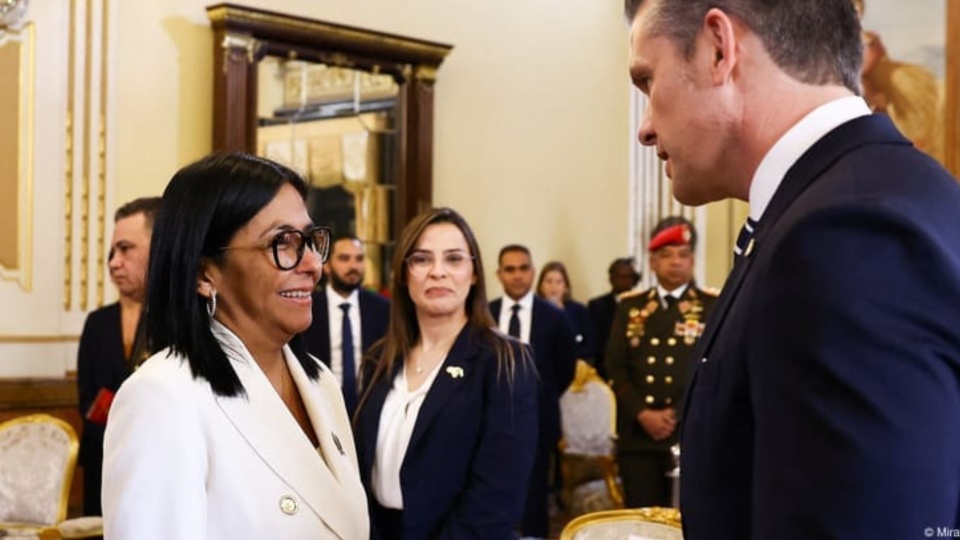
Venezuela “has gone from our most aggressive regional threat to a compliant security partner,” according to U.S. War Secretary Pete Hegseth. That’s how he summed up the last ten months during a surprise trip to Caracas on Nov. 18. Speaking to diplomats and military officers at the U.S. Embassy, he announced the two countries had signed a deal restoring military ties that were cut off two decades ago.
The word “compliant” was a blunt description of what U.S. imperialism believes it has won since Jan. 3, when U.S. forces kidnapped President Nicolás Maduro and First Lady Cilia Flores in a raid that left nearly 100 people dead. The two of them remain in a Brooklyn jail awaiting trial before a U.S. court.
Since then, Acting President Delcy Rodríguez has been pressured to rearrange Venezuela’s economy and armed forces to suit U.S. capital and the Pentagon. She is governing under an open threat. President Donald Trump has said she will “pay a very big price, probably bigger than Maduro” if she refuses U.S. demands, leaving open questions about her country’s future path.
The United Socialist Party of Venezuela (PSUV) still runs the government, and no one at Miraflores Palace has declared the Bolivarian Revolution is over, but the turn away from the developmental model built by the late Hugo Chávez is getting harder to deny.
Oil goes first
On Jan. 29, less than four weeks after the kidnapping, the National Assembly passed and Rodríguez signed a rewrite of the Hydrocarbons Law. Corporate attorneys called it the biggest overhaul of the sector since nationalization in 1976.

abduction on Jan. 3, 2026. Currently, he remains in a Brooklyn jail awaiting trial before a U.S. court.
The reform lets private companies operate oil fields at their own cost, sell their share of crude directly, and lease assets belonging to the state oil company, PDVSA. The 30% royalty Chávez imposed can now be cut to 15%. Disputes go to independent arbitration, a long-standing demand of the foreign oil giants Chávez faced down in the 2000s.
On the same day the law passed, Washington eased its sanctions so U.S. companies could do more business in Venezuela. One U.S. law firm put it plainly: Caracas changed its oil law, and in return Washington loosened its sanctions.
In August came the bigger prize. A deal Trump said Hegseth helped broker gave North American Blue Energy Partners, a consortium controlled by Venezuelan businessman Alejandro Betancourt, long-term access to 17 oilfields holding about a fifth of the country’s reserves. The U.S. government took a 35% stake in the consortium’s parent company, a guaranteed share of output, and right of first refusal on the rest.
Hegseth boasted in Caracas that the arrangement “makes the Strait of Hormuz a non-factor for the Western Hemisphere,” a reminder of where Venezuelan crude fits in the administration’s decision to attack Iran.
Then the rest
The sell-off is no longer confined to petroleum, though. In April, Rodríguez named a commission to sort state-owned enterprises into four groups: strategic assets that stay public, firms to be restructured as public-private partnerships, “non-strategic” holdings that can be sold, and those headed for liquidation.
On Oct. 29, she went on national television to say she had ordered the valuation of “non-essential assets held by the State” that could be offered to private buyers or returned to their former owners. The process, she said, was “already well underway.” Her justification: “Private property is a right protected and guaranteed by our constitution.”

No list has been published, but the state holds enterprises in telecommunications, mining, agriculture, finance, and tourism—what might be called, in addition to oil, the “commanding heights.” Right-wing deputies in the legislature, the representatives of the economic ruling class, are already demanding faster handovers.
The opening did not begin in January. U.S. sanctions starved public industry for years, and Maduro’s 2020 Anti-Blockade Law already let private operators into some oilfields. Washington strangled the state sector and now holds up the wreckage as proof that only private capital can rebuild. What the kidnapping changed was the speed of this process and the direction it was heading.
Guns follow
In 2005, Chávez ended a military partnership with Washington dating to 1951, accusing the U.S. of meddling in Venezuela’s affairs and seeking ideological influence inside the armed forces. A year later, the Bush administration banned U.S. arms sales to the country.
The new agreement, Hegseth said, means “training together, partnering together, sharing intelligence, more defense equipment and capabilities together.” Rodríguez said it includes training and equipment upgrades for the armed forces and that she hoped cooperation would reach “its highest possible level.” No text has been released as of press time.
The Venezuelan military’s strategy was built around the danger of U.S. intervention and relies heavily on Russian and Chinese equipment. The shift outlined by Hegseth and Rodriguez means Venezuela will now rely on the Pentagon for everything from spare parts to decision-making.

There’s even more on the table, though. Asked in October about opening a U.S. military base in Venezuela, Trump answered: “We’re considering doing a lot of things.”
A message to the region
For a quarter century, the Bolivarian Revolution anchored Latin America’s pink tide. Through Petrocaribe and ALBA, it financed regional integration and showed that natural resource wealth could fund social development instead of foreign profits.
Now, Venezuela is being turned into an outpost for reversing those trends. Trump even presents Venezuela as a model for how to “handle” Iran and Cuba.
Hegseth clearly expressed the viewpoint of the administration. A “threat” was a country that charted its own course. A “compliant partner” is one whose oil, factories, and soldiers answer to Washington.
No paywalls at People’s World
At People’s World, we believe news and information should be free and accessible to all, but we need your help. Our journalism is free of corporate influence and paywalls because we are totally reader-supported. Only you, our readers and supporters, make this possible. If you enjoy reading People’s World and the stories we bring you, please support our work by donating or becoming a monthly sustainer today. Thank you!
CONTRIBUTOR