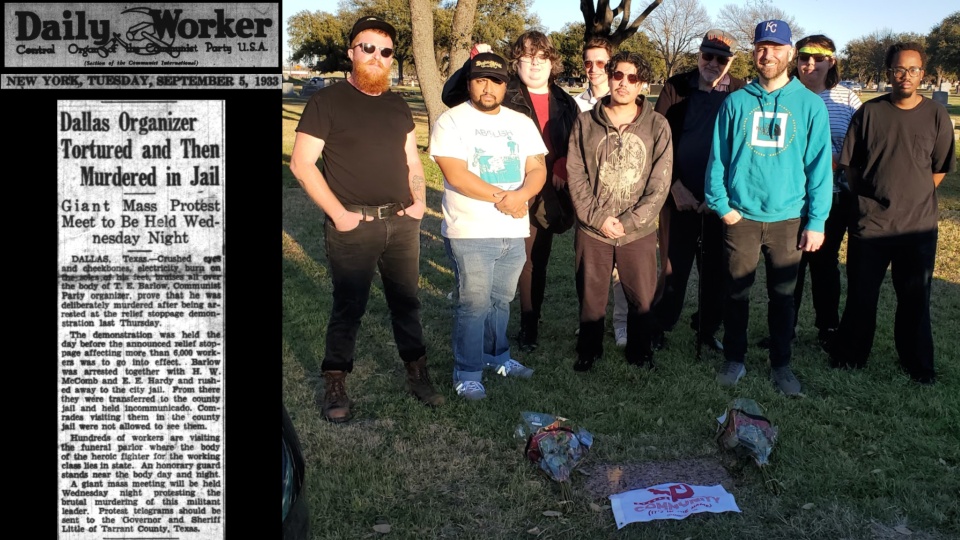
FORT WORTH, Texas—Members of the Dallas-Fort Worth Club of the Communist Party USA gathered at Mount Olivet Cemetery on Sunday, Feb. 15, to pay tribute to Terrence Earl Barlow, a leader of the CPUSA in Texas killed by Fort Worth police in September 1933.
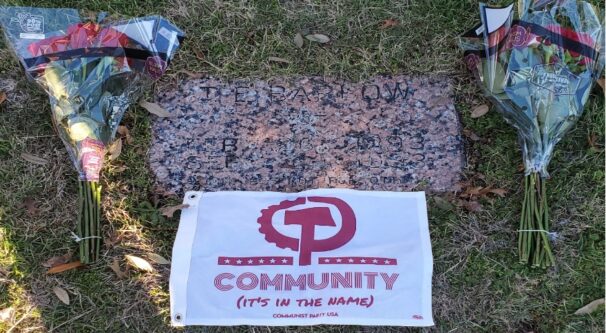
Communists laid flowers at his grave and recounted the story of his life. Also discussed were possible plans in the future to raise money to restore Barlow’s headstone, which has not been maintained and showed signs of weathering.
T.E. Barlow was born in 1893 in Ohio and grew up in western Kentucky. He learned carpentry from his Socialist father and was working as a carpenter at the Chino copper mine in New Mexico at 17 when he was drafted to fight in World War I.
After the war, Barlow found himself jobless and homeless, drifting into Texas in the early 1930s, during the Great Depression. In Houston, Barlow came into contact with members of the National Unemployed Council, a mass organization initiated by the CPUSA. In 1932, Barlow attended the party’s nominating convention in Chicago and officially joined its ranks, even becoming the Communists’ write-in candidate for lieutenant governor of Texas.
In 1933, Barlow was sent by the party to Fort Worth to organize Unemployed Councils resisting evictions of jobless workers and their families and demanding more unemployment infrastructure from local government.

Under his leadership, the Unemployed Council grew from a small group to an influential force of around 2,000 members. The main tactic used to resist evictions was to organize crews to come behind the sheriff and return tenants’ furniture into their homes, forcing landlords to apply for an eviction order all over again.
One such family assisted by the Unemployed Council was that of Jack Daniel, 36, an jobless refinery worker, and his wife and three children. They were evicted twice in one month for failure to pay rents. The council mobilized a crowd of around 100 people to resist the Daniel family’s eviction, leading to multiple arrests.
As a result of the publicity around the action, the local welfare department intervened, agreeing to subsidize the Daniel family’s rent if they picked a new place to live.
On Aug. 31, 1933, the council rallied in Bluff Park to protest Texas Gov. Miriam Ferguson’s suspension of relief to the unemployed. After the rally, Barlow and two other comrades walked to a Western Union office where they telegraphed Ferguson to protest the cuts. As they left the office, they were arrested and brought to the notorious Tarrant County Jail on charges of unlawful assembly.
Barlow was badly beaten by Charley Morgan, a prizefighter, likely at the instigation of guards, and died in the hospital as a result of this savage attack. Morgan was released the next day.
The official autopsy stated: “Barlow’s skull was one-sixteenth of an inch thick, which is one-half the thickness of the average white person’s skull.” Barlow’s comrades and brothers paid for an independent autopsy which stated he was murdered. No one was ever held accountable for Barlow’s death.
Barlow’s comrades and workers aided by the Unemployed Council held a funeral for him on Labor Day at the same time as a parade by local unions, which was boycotted by many workers for being racially segregated. Some 5,000 workers attended Barlow’s funeral, more than the racially-divided parade.
Barlow’s comrades erected a red granite tombstone at Mount Olivet Cemetery bearing a hammer and sickle emblem in the middle and the inscription: “Gone But Not Forgotten.”
We hope you appreciated this article. At People’s World, we believe news and information should be free and accessible to all, but we need your help. Our journalism is free of corporate influence and paywalls because we are totally reader-supported. Only you, our readers and supporters, make this possible. If you enjoy reading People’s World and the stories we bring you, please support our work by donating or becoming a monthly sustainer today. Thank you!
CONTRIBUTOR