WASHINGTON—Do President Trump, his Agriculture Secretary, and congressional Republicans want 42 million people to starve? By their actions in enacting the so-called “big, beautiful bill” in July and in cutting off federal food stamp funds this weekend, the answer may well be “yes.”
Fearful of calamity accompanying mass hunger, congressional Democrats are pressing Trump’s Agriculture Secretary Brooke Rollins to release a $6 billion “reserve fund” the agency holds for handling emergencies. That money’s already been appropriated and is just sitting in the U.S. Treasury.
Proposing congressional legislation rather than pushing for the release of emergency funds is essentially useless because the aristocratic Trump government has, via a government shutdown and in true fascistic style, suspended the U.S. Congress, which has not been operating for 30 days. The virtual suspension of the legislative branch has been used as an excuse by Trump to rule by decree.
Even the emergency fund, however, is not quite enough: For the last two fiscal years, which ended Sept. 30, the program spent $8 billion monthly.
But if 42 million people—one of every eight in the U.S.—lose food stamp aid to help buy groceries, isn’t an emergency, what is? That’s what the Democrats, governors, and advocates of food aid ask.
Making millions go hungry this weekend is the latest salvo, then, in Trump’s war against the American people. Unions like the Service Employees link the latest act in the Trump war to corporate greed.
“The question isn’t why over 40 million Americans are on SNAP, it’s why corporations get away with paying the poverty wages that make it necessary,” SEIU tweets.
And earlier this year, the AFL-CIO and dozens of unions argued against any food stamp cuts.
“We urge you to oppose cuts to SNAP benefits, cost-shifts to states, additional work requirements, restrictions on needed updates to ensure benefit adequacy, or attempts to privatize state and county merit-based workforces,” the unions wrote. “Congress should instead work to preserve and strengthen essential food assistance benefits and the jobs supported by this important program.
“SNAP is our first line of defense against hunger and strengthens communities by reducing poverty, improving health and learning outcomes, supporting a productive workforce, and creating jobs.”
SNAP, the official name for food stamps, “has done a great job in reducing food insecurity and making sure kids are not hungry at home,” says Crystal FitzSimons, who heads the Food Research and Action Center.
“But our president and Congress just decided to make unprecedented cuts to SNAP, to slash $187 billion in food aid over the next 10 years,” she told Ms. magazine. Congressional Democrats say the cut is even worse: $230 billion.
The center is “collecting stories of different people who will be directly impacted by the cuts: The grandmother who relies on SNAP and helps watch her grandchildren while her daughter is at work, disabled people who use SNAP to support their independence and older adults no longer able to work,” says FitzSimons.
“We share their stories because we know the real experiences of real people are critical in helping lawmakers and others understand who benefits from SNAP.”
“We need to work on mitigating the harm that this will cause,” FitzSimons says.
The stories don’t move Secretary Rollins. He says the $6 billion in emergency money is earmarked to feed natural disaster victims. USDA’s website blames Democratic obstructionism for lack of funds for Food stamps, the official name for the Supplemental Nutritional Assistance Program (SNAP), “Bottom line, the well (of money) has run dry,” the USDA’s website message snaps.
While FRAC gathers stories and retells them to lawmakers, 25 states, plus D.C., led by Gov. Gavin Newsom, D-Calif., aren’t waiting for the funds to run out, and they must send starving people home.
The states marched into federal court, asking judges to order Rollins to release the cash now. It’s not just pro-Democratic states, either. There are several “purple” political swing states and deep-red Kansas and Kentucky.
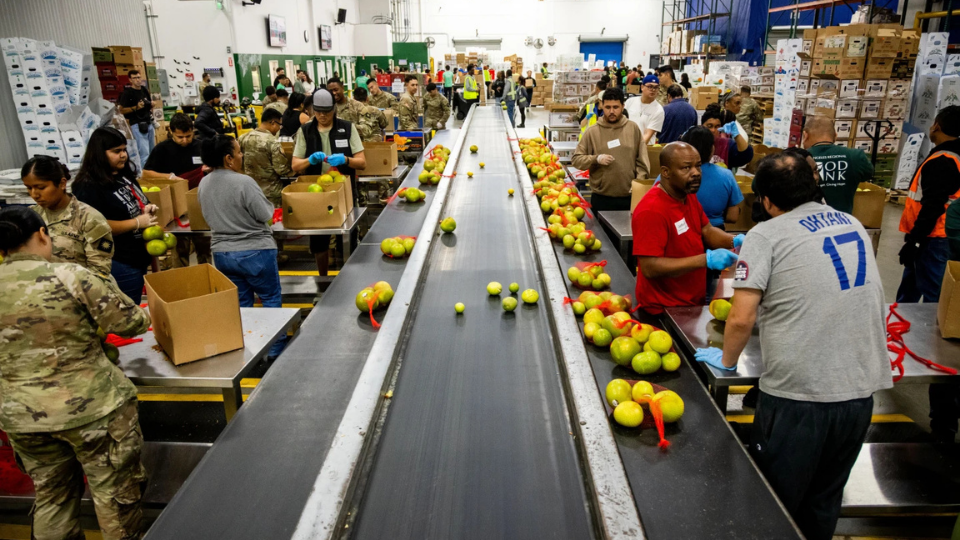
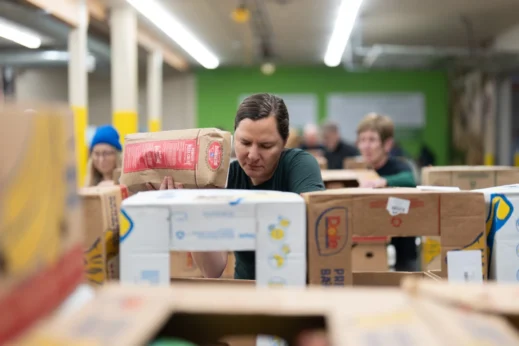
Meanwhile, advocates are also trying to arrange deliveries to food banks, pantries, and homeless shelters so families will have something besides leftover Halloween candy to eat when November rolls around.
There is a catch to all this fighting over food stamp cash: It isn’t very much, once you parcel it out week by week to 42 million people. The average food stamp benefit, paid via an electronic card recipients use, is $6.20 per person per day, the Food Research and Action Center reports. Before the coronavirus pandemic, it was five bucks per person daily.
A double Big Mac costs more than that.
The food stamp cash shortage is related to two partisan money bills. By party-line votes, lawmakers passed and Trump signed the first: The so-called “big beautiful bill,” the reconciliation law, which gave corporations and the rich a 10-year $4.5 trillion tax cut. To partially “pay” for that largesse, those same GOP lawmakers cut SNAP funds by $187 billion-$230 billion—depending on who’s counting—over the same decade.
The second partisan money bill is the temporary one to reopen the entire government, called a “continuing resolution,” or CR. Its approval would end the Republican-engineered shutdown, which stopped many government operations and spending. As of midnight on October 31, that halt includes food stamps.
The GOP-run House passed that money bill again on party lines. But it needs seven or eight Senate Democrats to join 52 of its 53 Republicans to pass there. The bill would actually fund food stamps, at higher levels, through November 21. All but three Democrats hold fast to the position they won’t agree to the CR unless it reverses the biggest cuts of all, against the poor and everyone else.
One of the two biggest cuts is the $880 billion to be yanked from 14 million Medicaid recipients over a decade. The other is the end of a tax credit, which 22 million Affordable Care Act/Obamacare users now receive to help make their insurance premiums affordable.
They’d lose the tax credit at the end of the year, and for many, their insurance, too. Their unpaid-for care would be shoved onto the rest of us, and everyone’s insurance premiums would skyrocket to pay that freight.
No wonder the Senate Democrats are holding out, and no wonder Trump, Rollins, and the GOP are blaming them—even though the Republicans control all the levers of power in D.C. And in an early-September hearing on food stamps, Rep. Brad Finstad, R-Minn., who chairs the subcommittee overseeing food stamps, claimed the program suffers millions of dollars yearly in fraud.
Meanwhile, Newsom and the governors are suing, the Democrats are pressuring and advocates of food stamps are sounding a clarion call to arms.
“Shutting off SNAP benefits will cause deterioration of public health and well-being,” the states’ lawsuit says. “Loss of SNAP benefits leads to food insecurity, hunger, and malnutrition, which are associated with numerous negative health outcomes in children, such as poor concentration, decreased cognitive function, fatigue, depression, and behavioral problems.”
Newsom was caustic about Trump, noting the president was on an extended trip to Asia. “While Donald Trump parades around the world trying to repair the economic damage he’s done with his incompetence, he’s denying food to millions of Americans who will go hungry next month,” Newsom said.
“It’s cruel and speaks to his basic lack of humanity. He doesn’t care about the people of this country, only himself.”
“Now more than ever, millions of families across the country depend upon the Supplemental Nutrition Assistance Program (SNAP) to make ends meet,” the Democrats wrote to Rollins.
The crafter of the letter has first-hand experience of how food stamps help kids. Rep. Jahana Hayes, D-Conn., the top Democrat on that food stamp subcommittee, is a National Education Association member who taught in Waterbury schools with high shares of poor kids.
“For far too many veterans, seniors, and children, SNAP benefits are the difference between having food or not,” the Democrats added. “Due to the government shutdown, they are facing crippling levels of uncertainty about whether they will be able to afford food next month.”
We hope you appreciated this article. At People’s World, we believe news and information should be free and accessible to all, but we need your help. Our journalism is free of corporate influence and paywalls because we are totally reader-supported. Only you, our readers and supporters, make this possible. If you enjoy reading People’s World and the stories we bring you, please support our work by donating or becoming a monthly sustainer today. Thank you!
CONTRIBUTOR