At the threshold of the imperialist era, when the revolutionary promises of the Enlightenment gave way to terror, war, and new forms of domination, contradiction—the irreconcilable tension between hope and terror—became central to art. This gave rise to a new aesthetics of terror, an existential expression of an age that shattered traditional meaning and confronted individuals with unprecedented violence and alienation.
Francisco de Goya (1746–1828) embodies this era to the highest degree. The son of a gilder and a mother from the lower nobility, Goya grew up in Zaragoza. After training as a painter and a study trip to Italy, he rose in Madrid to become the celebrated court painter to Charles IV. This social ascent gave him a unique insider’s perspective on the powers he would later criticize.
Goya’s series of etchings Los Desastres de la Guerra (The Disasters of War), created between 1810 and 1820, provides a uniquely concentrated artistic expression of the historical caesura of the Spanish War of Independence. Far more than a mere depiction of the events from 1808 to 1814, it explores and embodies the epochal terror that struck a society already shaken by the internal tensions of the Ancien Régime—conflicts over reform, economic fragility, and social polarisation. Against this backdrop, war appears as the culmination of a protracted crisis, continuously generating new horror, violence, and death. In a sequence of poignant plates, Goya translates this historical moment into a concrete physical and psychological reality: the objectively terrible aspects of history merge with the subjective experience of terror. Thus, a new visual language emerges, intertwining documentary precision with existential involvement, drawing viewers directly into the experience of a shattered world.
In the visual language of his aquatint etchings, violence is consistently de-heroized—a stance that has lost none of its urgency to this day. Goya deliberately breaks with the tradition of history painting to depict terror and retribution. Terror appears as the direct consequence of human action. He had already experimented with this revealing visual language in earlier works: in Los Caprichos (1799), he used satire and allegory to attack superstition, corruption, and the social ills of old Spain. The war, however, triggered in his work an immediate, almost documentary gesture of accusation that no longer encodes the horrific but presents it unsparingly before our eyes.
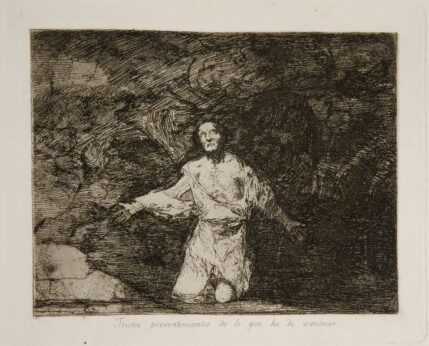
In Plate 1, “Tristes presentimientos de lo que había de acontecer” (Dark Forebodings) from Los Desastres de la Guerra, shadowy, chaotic, monstrous forms emerge in the dark clouds of the background. The sky is filled with a swirling turmoil, an intimation of profound terror—bat-like or demonic figures reminiscent of the artist’s Los Caprichos. The dark, blurred tonality created by aquatint evokes an advancing black fog threatening to engulf the central kneeling figure. The turbulent sky seems to foreshadow the atrocities depicted later: a nightmare vision that renders visible the psychological fear, anxiety, and the sense of impending doom hanging over the Spanish people. The kneeling, barely clothed figure in the foreground lifts its gaze toward the sky, as if imploring the threatening forces above. Like Christ kneeling in the Garden of Gethsemane asking that the cup pass from him, it embodies the fear of death and the deeply human desire to escape the approaching horror.
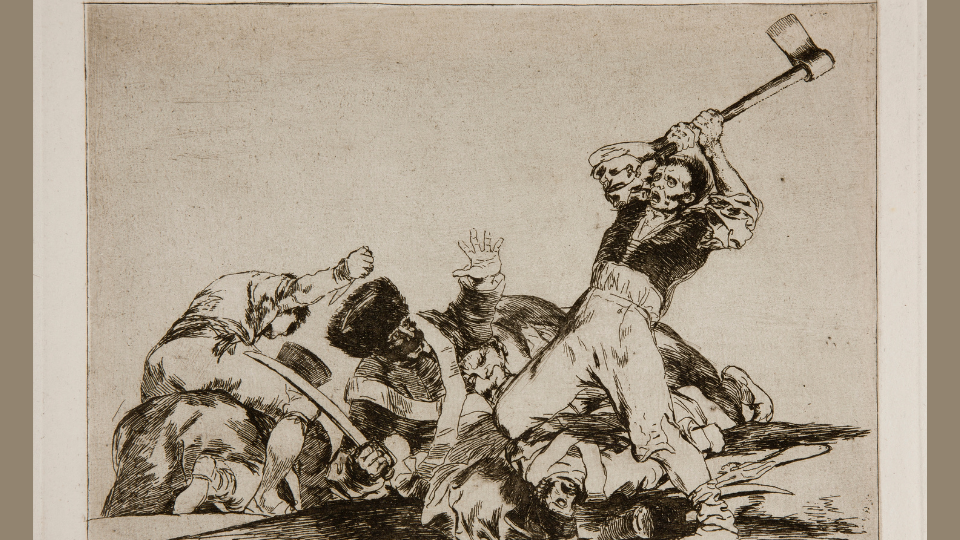
In Plate 2, “Con razón ó sin Ella” (With or Without Reason), Goya depicts a skirmish in which two peasants fight back against the soldiers’ bayonets with the simplest of weapons. While the individualized faces of the poorly dressed peasants are clearly visible, the uniformed soldiers remain anonymous, turned away from the viewer. One of the two Spaniards brandishes a homemade lance, the other, already bleeding, defends himself with a simple knife against the attackers. The motif of the rebel in a white shirt against anonymous foes is one Goya will repeat—most iconically in his painting The Third of May 1808. In Plate 3, “Lo mismo” (The Same), the situation has escalated: the peasants have gained the upper hand. Armed with a knife and an axe, they now slaughter the French soldiers, who have been wrestled to the ground, with equal mercilessness. This time, the face of the surrendering soldier is clearly and individually rendered; it dominates the center of the image. The Spaniard’s descending axe is about to strike him. The gaunt face of the peasant contrasts sharply with the soldier’s bearded one. Yet, he shows no mercy.
The following etchings depict women—some with infants in their arms—brutally killing French soldiers. In Plate 7, a woman stands among the slain as she ignites a cannon; in another scene, an older woman prevents the rape of a younger one by attacking a Frenchman with a knife. Rape, castration, humiliation, mutilation, hanging, shooting—Spanish soil strewn with corpses, scenes of horrific torture and utter helplessness. Much later, Frantz Fanon would describe this dynamic: experienced brutality generates counter-violence. Perpetrator and victim become ensnared in a spiral of violence that dehumanizes both sides. The radical force of Goya’s exploration culminates in images of absolute destruction—of suffering pushed to the point where the human becomes unrecognizable. A power of universal deformation becomes directly visible, almost tangible.
In the Desastres, Goya explores with equal intensity not only the horror of his era but also terror as a psychological reaction and existential condition. Violence, along with individual and collective shock, becomes in his work a pictorial method, expressed through immediately legible gestures and glances that not only confront viewers with cruelty but draw them into the emotional and moral vortex of the event.
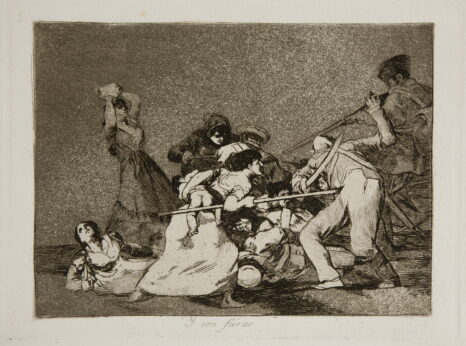
The point of departure is the suffering subject in the first plate, “Dark Forebodings.” It embodies existential abandonment, a motif that recurs throughout the cycle. Yet Goya disrupts the distance of detached observation through the strategic construction of a witnessing gaze grounded in personal perception. This becomes programmatic in Plates 44 and 45 (“Yo lo vi” – “I saw it”): the title asserts eyewitness testimony, making the artist—and implicitly the viewer—a direct witness to the panicked flight. Even more forcefully, the composition of Plate 26 (“No se puede mirar” – “One cannot watch”) seeks to provoke an identificatory response. The figures, arranged in a pyramidal grouping around a veiled mother holding her child, generate a powerful emotional pull. Kneeling or prostrate, they beg and pray that the bayonet tips emerging at the right edge of the image might spare them. No figure turns toward the viewer; the soldiers remain outside the pictorial space. This plate does not merely depict violence—it captures existential shock.
From Plate 48 onward, the focus shifts from scenes of combat to images of the Madrid famine. Plate 55 may serve as an example. At the center stands a group of starving figures in a desolate landscape. Dominating the composition is a skeletal man; beside him sits a child, emaciated to the bone; behind them crouches a middle-aged man, positioned at the child’s eye level, supporting it. All three direct their gaze toward the motionless body of a dead woman stretched out in the foreground—presumably the child’s mother. This configuration forms a right-angled, earthbound triangle that simultaneously constitutes the emotional core of the image: a “triangle of misery” whose downward closure embodies heaviness, stasis, and finality. The bodies are physically connected—the child supported, their proximity suggesting solidarity—yet their bond lies in shared annihilation. Deep, earthy shadows and the mottled surface of aquatint render the nearness of death palpable.
Opposed to this grouping stands a second, adjacent triangle. A comparatively well-dressed woman, her back turned to the viewer, forms the vertical axis. Her upright posture appears impenetrable. A younger man from the starving group looks up at her in astonishment, becoming the narrative hinge between the two spheres. The woman seems to move toward a small French figure at the left edge of the image; her trajectory and line of sight lead away from the center of suffering. Whereas the first triangle is earthbound, static, and marked by death, the second appears more dynamic—yet oriented toward a future that disregards the dying of her compatriots. Her light skirt catches the light, visually separating her from the starving group, which absorbs it. She detaches herself from the community, from the dark shadow—the comunidad—and turns, at least compositionally, toward the Frenchman positioned at the luminous edge as a possible vanishing point.
The title, “Lo peor es pedir” (“The worst thing is to beg”), sharpens the bitterness of the scene. Worst is not the necessity of begging without relief, but the erosion of dignity, solidarity, and national cohesion. In the superimposition of the two triangles – one dying and earthbound, the other turning away—Goya condenses the collapse of the social order, rendering visible not only death by hunger but the disintegration of the community itself.
The progressive intensification of subjective experience ultimately culminates in the nihilistic nadir of the entire cycle. Plate 69 (“Nada” – “Nothing”) marks a radical caesura. A half-decayed skeleton – both chronicler and victim – inscribes the word “Nada” on a sheet of paper. The composition is dominated by this skeletal figure, partially obscured by a coffin, leaving the word “Nothing” as its testament to posterity. In its left hand, the decaying body still clutches the beginnings of a wicker basket—a trace of former labor, a reminder of a once-productive life. Resting upon its forearm is a black-veiled figure, perhaps a grieving woman, yet arguably also an allegory of Spain itself. Behind her, faintly discernible, appear the tilted scales of Justice. In the darkest recesses of the image, clustered heads emerge from the shadows.
The first state proof in Boston proves crucial for a political reading of Plate 69, as it preserves a stage of the composition that Goya deliberately darkened in the final version. Here, the image remains clearly divided into two antagonistic halves: on the left, a brightly illuminated female figure with scales and a book, an allegory of reason, justice, and progress; on the right, impenetrable darkness populated by grotesque faces, embodiments of reaction and superstition. By almost entirely obscuring the luminous figure in the final aquatint—allowing her to survive only as a shadow—Goya visually enacts what the corpse in the foreground articulates with the word “Nada”: the light of reason is swallowed by political and spiritual darkness. The overturned and empty scales in the allegorical figure’s hand testify to the absence of justice in the postwar era.
The plate thus reveals itself as a historical indictment—a bitter reckoning with a world in which the aftermath of war did not usher in a more just order, but instead restored the old forces of reaction, extinguishing what remained of humanistic hope. It becomes a pictorial realization of “Nada” as a political verdict on the Restoration. The experience of absolute negativity and terror condenses into an iconic formula of a world stripped of meaning. The plate anticipates Caspar David Friedrich’s The Sea of Ice: it marks the endpoint of a historical logic in which political and humane ideals appear to have perished in the “nothingness” of despair and physical annihilation. Subjective terror here becomes absolute, culminating in a vacuum of meaning left following catastrophe.
After exploring physical annihilation and its subjective reverberations, the cycle takes a decisive turn: from a record of wartime violence, it becomes an indictment of the postwar world. The shift from personal to invisible, systemic violence within the consolidating bourgeois-restorative order finds its artistic articulation in Goya’s work. In response to this more abstract—yet no less destructive – form of domination, he turns to the caprichos enfáticos (“emphatic caprices”). Here, merciless reportage gives way to political allegory and satire. The contradiction, initially manifested in the cycle of battlefield violence, is now exposed and attacked as a structural principle of the reactionary state and ecclesiastical power during the Restoration under Ferdinand VII.
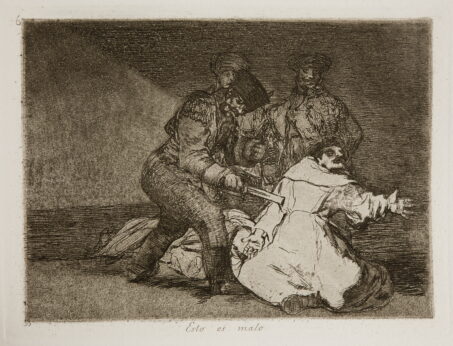
In Plate 74 (“Esto es lo peor!” – “This is the worst of all!”), a wolf, enthroned as judge, wields the pen. He writes: “Misera humanidad la culpa es tuya” (“Wretched humanity, the fault is yours”), a line Goya borrows from the Italian poet Casti. Through the device of animal fable, the new violence is unmasked as cynical hypocrisy, blaming the people for their suffering. The Church appears in the form of a servile monk who offers the inkwell to the wolf. The people surrounding them are utterly destitute. No less incisively, Plate 67 (“Esta no lo es menos” – “This is no less so”) attacks faith as an instrument of domination. A statue of the Madonna is borne aloft as a lifeless fetish: the liberated nation falls prey to a renewed oppression that mobilizes old symbols to secure its power. Goya’s critique is thus directed against the concrete political reaction that suffocated the progressive impulse which, during the occupation, had briefly found expression in the liberal Constitution of Cádiz (1812)—a fragile glimmer of hope wrested into existence by democratic forces.
Yet Goya’s work does not remain confined to accusation. In a remarkable dialectical turn, it develops a utopian counter-image out of the negation of “Nada.” The final plates respond directly to the desolation of Plate 69. In Plate 79 (“Murió la Verdad” – “Truth has died”), personified Truth—at once an allegory and a reference to the liberal constitution of 1812 – is buried by monks under a bishop’s blessing. Yet even in death, she remains a radiant source of light. This hope unfolds further in Plate 80 (“Si resucitará?” – “Will she rise again?”), where Truth appears as a luminous apparition that terrifies her bestially distorted adversaries. Resurrection is conceived here not in theological but in emphatically political and this-worldly terms.
Plate 82, “Esto es lo verdadero” (“This is the truth”), forms the programmatic conclusion of the series. In contrast to the preceding dark and allegorically charged compositions, a scene of unexpected brightness emerges. The resurrected Verdad appears as a grounded, almost peasant-like figure, associated with labor, fertility, and natural abundance.
Where many of the preceding plates are submerged in dark aquatint, a radiant center now opens. Linear rays emanate from the female figure in all directions, marking her unmistakably as Truth. She stands firmly upon the ground. Her simple dress recalls that of a young peasant woman. She appears youthful and physically present. Beside her stands an elderly farmer holding agricultural tools. Before them lie a full basket and a lamb, densely layered and plastically hatched—signs of tangible agricultural abundance and, at the same time, of renewal. Here, truth is bound to labor and to the earth as a site of production. The soil is no longer scorched as in the famine plates, but possesses weight and substance. The light radiating from the figure of Truth appears as a life-giving force that restores the land.
The young woman turns toward the old man as if in conversation: truth exists in dialogue with the people and in shared activity. The composition remains horizontally grounded; despite the graphically constructed rays, the figures are anchored in natural space. In contrast to Plate 79 (“Murió la Verdad”), where Truth is buried by the clergy, Plate 82 presents her return as an earthly, active force—a young, vital presence activating labor, fertility, and natural abundance. Truth resides in the productive life and solidarity of the people. This vision sketches a life beyond class society and emerges as the aesthetic and ethical consequence of Goya’s sustained engagement with terror.
Los Desastres de la Guerra reveals Goya as a precursor of modern artists and as a witness to imperial violence. In his work, a new artistic paradigm takes shape—an aesthetics of terror. Goya does not merely denounce historical violence; he elevates contradiction itself to the organizing principle of his art: hope and terror, liberation and renewed servitude, witnessing and powerlessness, documentation and vision stand side by side, unresolved. This tension is not reconciled but deliberately sustained. Hope is never entirely extinguished; it persists as a fragile possibility in the shadow of violence. Thus, Goya leaves behind more than an accusation—he articulates a mandate: in times of terror, art must not console; it must render truth visible.
In this stance, he points far into the future. The fusion of radical realism and symbolic condensation resonates in the work of Otto Dix (The War), Pablo Picasso (Guernica), Hans Grundig (his etchings employing animal allegories in response to fascism), Lea Grundig (War Threatens), and Käthe Kollwitz (Peasants’ War, War). In this sense, Goya is profoundly modern: an artist whose work arose from the contradictions of his time and continues to exert its force today.
We hope you appreciated this article. At People’s World, we believe news and information should be free and accessible to all, but we need your help. Our journalism is free of corporate influence and paywalls because we are totally reader-supported. Only you, our readers and supporters, make this possible. If you enjoy reading People’s World and the stories we bring you, please support our work by donating or becoming a monthly sustainer today. Thank you!
CONTRIBUTOR