

Not so long ago, in the pre-internet age, gay men developed cultures of connection to survive in the shadows of a hostile society—coded eye contact in parks, a look back when passing someone on the beach, lingering steps past a bar, subtle glances in a bathhouse. Such creative practices of pursuit have been around at least for as long as people have been living in cities, always adapted to the spaces and places of the day.
Cruising has always been about sex, but not only. It was about finding each other in a world that tried to deny our existence. It was risky, imaginative, and often joyful. It took place outside the logic of the market. By and large, there was no price to participate.
It also wasn’t easy, though. The danger of a run-in with police loomed large, and making an advance toward the wrong person invited potential violence. Beyond the hazards, it was also a lot of work. The thrill of the chase more often than not ended in the frustration of the failed hunt.
That’s why Grindr was so revolutionary when it launched in 2009. It brought the tradition of cruising into the smartphone era, with a location-based system that enabled men to instantly find potential partners nearby. In those early days, it was easy to use and eye-opening.
Previously, unless you happened to be standing in a gay bar or at a pride parade, you had no idea that, at least in urban areas, there are often dozens of others like yourself surrounding you at any given time. Showing you up to 100 men for free (or 200 for $2.99 a month), Grindr made the gay community visible and accessible in a new way, something that was especially impactful for those just coming out or exploring their identity.
Grindr was also an economic pioneer; it sparked a whole industry of dating and hookup apps which wasn’t just limited to the sexually subversive. A few years later, for instance, there was Tinder, the “Grindr for straight people,” and dozens more apps have sought to mimic its success among a variety of orientations and identities.
Pay to play
Fast forward to today, however, and it’s now gay common sense that the old Grindr is gone. Whereas users previously opened the app and found a grid filled with the faces (and headless torsos) of people they might like to meet, they’re now bombarded with intrusive ads, rampant bots, fake profiles, and restrictive paywalls that push them toward expensive subscriptions.
Want to open the app? Watch these three ads first. Want to see more than just 12 people? Sign up for “Grindr XTRA.” Want to know who looked at your profile or tapped you? Sure, it’s only $49.99 per month. Want to send or receive more than one pic at a time? That feature is only available to premium subscribers. It’s a clogged and frustrating experience that has transformed what was once a map of desire into just another effort to separate people from their money.
In conversations about Grindr’s decline on social media, journalist Cory Doctorow’s notion of “enshittification” frequently pops up. His analysis has shown that after an initial stage of great effort to attract an audience, tech companies transition toward practices that intentionally downgrade the user experience in pursuit of profit.

As Doctorow’s term suggests, the experience gets shittier for customers, who become a sponge to be wringed ever more tightly. It’s what has always happened once a company achieves monopoly status in a particular industry of the capitalist economy.
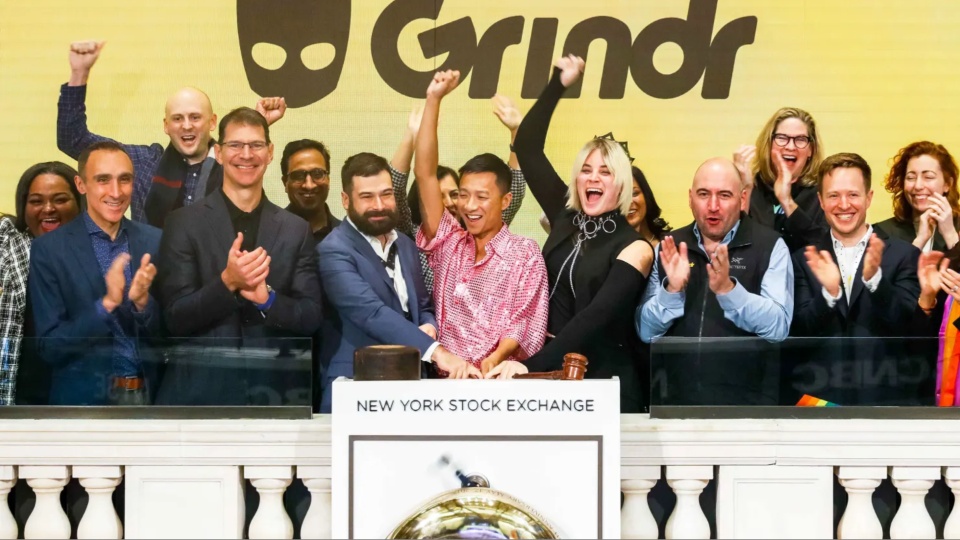
The year 2022, many users feel, is the point when everything started to visibly shift. That’s when Grindr went public on the New York Stock Exchange. After its IPO—or Initial Public Offering, which is the first time a company solicits investors on the stock market—Grindr’s focus rapidly pivoted from facilitating queer connection to maximizing revenue and satisfying investors.
The evolution was actually underway for several years before the IPO, though. The app went through a series of different hands. Ownership passed from the original developer to a Chinese video game company, Kunlun, in 2016 for nearly $250 million. Hoping to cash in on Wall Street, the new owner started beefing up product features while also placing more of them behind paywalls that steadily crept up in price.
Its hope of launching an IPO for Grindr in 2018 were scuttled, however, after anti-China sentiment among U.S. regulators made it impossible. Kunlun gave up and sold Grindr to a group of venture capitalists in the U.S. called San Vicente Acquisition LLC for more than $600 million. The group’s investment paid off; when the company finally debuted on the NYSE, it had an implied valuation of $2.1 billion.
Putting the squeeze on workers
At the same time Grindr’s new owners were enshittifying the app for users, they were also putting the squeeze on their workers. Like many companies in the tech sector, Grindr has long stuck to a no-strings-attached, employment-at-will relationship with its workers. But in 2023, a supermajority of its employees announced the formation of Grindr United, a unionization effort in conjunction with the Communications Workers of America.

They demanded a contract covering benefits such as remote work, trans-inclusive health care, and generous paid time off. They wanted clear paths for professional progression, wage transparency, annual cost-of-living pay increases, documented performance improvement plans when needed, layoff protections, and clear severance protocols.
Mostly queer people themselves, the workers also made demands on behalf of Grindr’s users. “We formed our union because we believe in a Grindr that puts people over profit,” Grindr United workers said at the time.
They wanted an app that prioritized “the humanity of its workers and users alike, and that builds the features our users have been asking for and need, specifically a verification system, unlimited blocks, and making sure your messages and pictures are not shared with any third parties.”
The company retaliated with a strict return-to-office mandate aimed at weeding out the far-flung staff. The “relocate or resign” ultimatum, Grindr United and CWA alleged, amounted to a mass layoff of the workers who had tried to organize. The union-busting ended up pushing out nearly half the company’s workers, and CWA filed unfair labor practice charges.

A National Labor Relations Board attorney argued before a judge in 2025 that the mandate was illegal retaliation. As of now, the case remains open, with many wondering whether the NLRB is slow-walking it thanks to the anti-union bias of the Trump administration. The union, meanwhile, has been trying to raise funds to support the fired workers, many of whom still haven’t found jobs—no surprise given the mass layoffs plaguing their industry.
Commodification of desire
What began as a tool catering to gay sexual needs has increasingly become a product shaped by shareholder desire. The quest for connection is now subservient to the demands of quarterly earnings calls and investor balance sheets. It’s a dom/sub relationship that’s producing devastating consequences for queer intimacy and collective life.
In February 2026, Grindr’s owners introduced a new subscription level called EDGE, which they claim is powered by gAI (gay artificial intelligence, pronounced “gay-eye”). The price to sign up is apparently a moving target, with users sharing screenshots on social media of monthly rates as high as $500.
According to a Grindr insider interviewed by Vox reporter Alex Abad-Santos, the gAI push is the vision of CEO George Arison, who came on board just before the IPO and wanted to reshape Grindr in the mold of other Silicon Valley tech companies.
Instead of making hooking up easier—Grindr’s original function—the company now markets algorithmic assistants and complex monetized “enhancements” that entrench the app in tech capital’s AI hype. These developments aren’t about queer liberation; they’re about selling something to Wall Street under the veneer of innovation.
As one user told Abad-Santos: “There’s a kind of feedback loop. It gets shitty. More people leave because it’s shitty, and they [Grindr] have to make it even shittier for the remaining users” to maximize revenue.
This commodification mirrors broader capitalist logics that turn social life into market transactions. Under capitalism, even queer sex—historically something political, counter-hegemonic, and communal—gets funneled into the circuits of value extraction.
Karl Marx and Friedrich Engels wrote in The Communist Manifesto that capitalism leaves “remaining no other nexus between man and man than naked self-interest,” nothing more “than callous cash payment.” The line captures what many Grindr users now feel, but it’s not the kind of naked self-interest they’re interested in when opening a sex app.
The backlash is real and visible. Monthly user numbers have flatlined. On the r/askgaybros Reddit forum, one user last fall sparked a major discussion when he pleaded with fellow gays to dump Grindr. “Can we all please collectively just move to a new app?” he asked in a complaint about the app’s usability. “The only reason Grindr is still used is because ‘it’s the app everyone is on.’ How about we all stop using it and it dies instantly?”
Alternative apps like Sniffies, which uses a map-based interface, are eating into Grindr’s market share, and even the mainstream media is taking note. A July 2025 New Yorker article raved about the upstart, inadvertently setting off police stings of public restrooms but also letting interviewees air their dissatisfaction with Grindr.
Analog cruising
Others, however, are returning to physical spaces, supplementing their digital search for sex and connection with forays into what photographer and writer Leo Herrera calls “analog cruising.” In his book by the same name, he offers tips for first-timers and rusty old-timers seeking to “get off the apps and into the streets.”
 Herrera says in-person cruising, like the kind typical of the mid- to late-20th century, requires attention, courage, mutual recognition, and negotiation around things like consent. It’s slower and more uncertain, but also more engaging.
“The last few years have been a perfect storm for the revival of ‘analog cruising,’ he told People’s World. “We are exhausted and distrustful of apps like Grindr, which have become social media platforms with very little regard to our privacy or even their own usablity.
“The recovery from the COVID pandemic and the MPox outbreak of 2022 gave us a new appreciation for our spaces and in-person interactions. PrEP, DoxyPEP, HIV undetectability, and the MPox vaccine have made us fear disease less and therefore created less stigma around cruising. And we are finding a new appreciation for our history, in which cruising and sexual liberation plays a massive part.”
He cautions, however, against idealizing the pre-app world. “Gay sex has always been commodified,” he told People’s World, “whether at the turn of the last century or through the vast network of bars and bathhouses.” It’s more a matter of acceleration.
“In the past few years, whether through media and tech like ‘Heated Rivalry,’ Grindr’s IPO, or social media sex supplement sales, we are seeing it being sold in ways it never has been before.”
As for Grindr’s transformation into an “AI-first” company, Herrera thinks time will tell how much substance there is behind the new features. “The big question is whether gAI is innovation or desperation,” he recently wrote.
Herrera and others frame the return of pre-digital practices not as nostalgia, but as resistance—a reclaiming of embodied connection in opposition to the alienation of capitalist platforms.
Return to reality
This revival resonates because many young queers are rediscovering the pleasures of person-to-person encounters ungoverned by corporate algorithms. It’s a grassroots pushback: seeking connection in bars, parks, bathhouses, and streets—spaces where desire is not logged, monetized, or sold back to us as “premium features.” And in that resurgence, one sees a critique of the sex-as-commodity logic that companies like Grindr represent.
Of course, none of this means the digital tools have no place in gay life. Grindr and other apps have long helped people in small towns and hostile regions find one another. That still matters. The issue is not the technology itself, but rather who controls it and for what purpose. Once a company is tied to the stock market, it must promise and deliver constant financial growth. That pressure shapes product design choices, with features designed to increase engagement and revenue but not necessarily to build community.
“Cruising is one tool in a giant arsenal of queer connection,” according to Herrera. “As we mature as a culture, we need to appreciate the many tools we have to be with one another and how these can help us navigate a world that is increasingly tech based and for-profit.”
From a Marxist perspective, the struggle over how queers meet and have sex is not trivial: It’s a frontline in the broader battle against the commodification of everyday life. Capitalism does not leave even the most intimate spaces and moments untouched. It absorbs something like gay sex, which was historically and often still is seen as deviant, markets it, and then restructures it around profit. What was once subculture becomes just another revenue stream.
If queer liberation and sexual liberation mean anything, they must include the freedom to relate to one another outside the logic of the market. Sex—and the ways we find it, no matter our identity or orientation—should not just be another asset class. It should remain a human encounter, shaped by desire rather than stock price.
We hope you appreciated this article. At People’s World, we believe news and information should be free and accessible to all, but we need your help. Our journalism is free of corporate influence and paywalls because we are totally reader-supported. Only you, our readers and supporters, make this possible. If you enjoy reading People’s World and the stories we bring you, please support our work by donating or becoming a monthly sustainer today. Thank you!
CONTRIBUTOR




MOST POPULAR TODAY

Trump’s catalog of constitutional crimes: Long and getting longer

Communist Jeannette Jara first in Chile’s presidential election, heads to run-off

Texas congressional candidates Frederick Haynes and Zeeshan Hafeez form alliance

Communist Councilwoman from Ithaca: Hannah Shvets defeats landlord candidate