

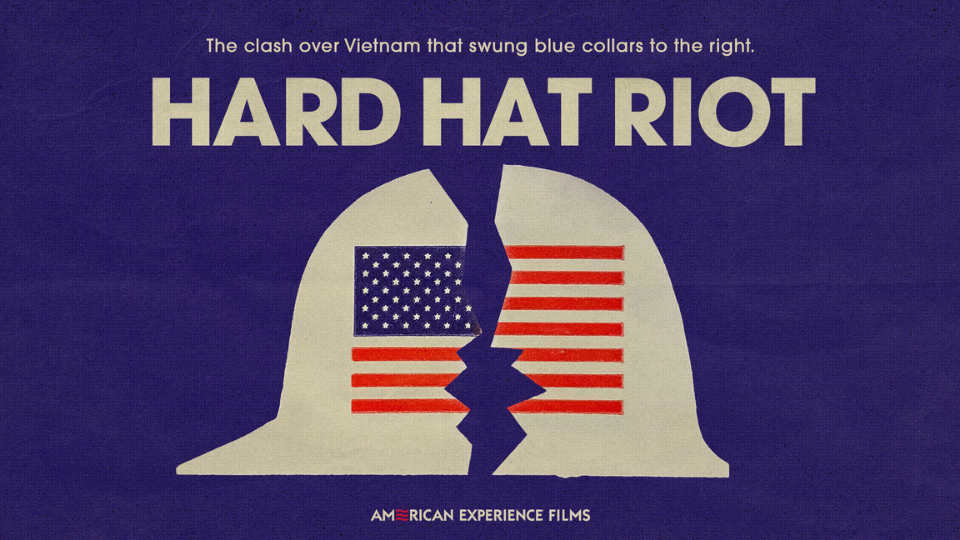
On September 30, the Public Broadcasting Service will screen its excellent new film Hard Hat Riot, a memorable entry in the award-winning American Experience series. This PBS series has been television’s most-watched history series, winning thirty Emmy Awards and virtually every other major broadcast award.
Director Mark Levin and his crew continue the fine PBS work in offering insight into recent American History. They immerse the viewers in how the tumultuous 1970s affected society, particularly the working class and college students, against the backdrop of anti-Vietnam War protests and the contentious presidency of Richard Nixon.
The film bristles with the energy of the times. Student activists around the country and in the streets of New York City organized huge demonstrations, particularly after Nixon’s illegal invasion of Cambodia and the National Guard’s killing of four young people at Kent State. Meanwhile, large segments of the non-college working class viewed these protests as the ungrateful acting out of the new privileged, upwardly mobile young. The film focuses on these two conflicting segments of American society.
Levin specifically contrasts the situation and reactions among New York City construction workers to massive college student demonstrations in the City. Workers felt confused and angry. They were abandoned by an economy steaming toward globalization, their work and social status devalued. The students had the opportunity to use higher education to attain new higher status as well express their anti-war idealism.
Hard Hat Riot makes the emotions that fueled these conflicts palpable through copious film clips from the early seventies and testimony from eyewitnesses. President of New York’s Building and Construction Trades Council, Steam Fitter William Abbate, Iron Worker Dennis Milton, and scores of other “hard hats” described how the working class felt left behind by New York City’s upper classes. New Mayor John Lindsay was emblematic of this growing split. He represented the vibrant, emerging, rich, and hip crowd that dominated rising New York culture and society.
Meanwhile, workers toiled to send their kids to higher education for a better life. Then saw their kids rejecting them and their values. The younger generation didn’t seem satisfied to graciously accept their golden tickets that their parents had often struggled to secure. They protested the Vietnam War, occupied buildings, tried to influence the government, and even burned the American flag.
But this clash was about more than generational differences or the pursuit of an illegal war against an ideology. The film shows how then-President Richard Nixon exploited these rifts for political purposes. Nixon consciously sought to win over the voters who had previously supported Democrats. Franklin Delano Roosevelt’s New Deal of the 1930s had been pitched to raise up workers battered by the Great Depression. Programs successfully offered economic relief, jobs, training, and extended rights to organize.
Hard Hat Riot demonstrates how Nixon used the schism between generations to break workers’ allegiance to the Democratic Party. It is probably beyond the scope of the film, though unfortunate, that it does not delve deeper into how workers could so easily be won over by the Nixon Presidency. Nixon, who vigorously fanned the flames of false consciousness, was not the first to use differences of class to sabotage the American democratic experiment.
There is certainly much to be learned from a deeper dive into Hard Hat Riot. Its applicability to today’s struggle to preserve democracy is invaluable. Even as the filmmakers have shared the insights of this film, President Donald Trump has cut government funding for PBS, making the production, distribution of such chronicles of our American History problematic at best.
If one is interested in supporting Public Broadcasting’s attempts to explore the important issues in American History, you are urged to contact Protect My Public Media to see how you can help restore and maintain this important service.
We hope you appreciated this article. At People’s World, we believe news and information should be free and accessible to all, but we need your help. Our journalism is free of corporate influence and paywalls because we are totally reader-supported. Only you, our readers and supporters, make this possible. If you enjoy reading People’s World and the stories we bring you, please support our work by donating or becoming a monthly sustainer today. Thank you!
CONTRIBUTOR




MOST POPULAR TODAY

Israeli military attempts to kill war correspondent Steve Sweeney
Strategic retreat or strategic pivot? The state of the Target boycott
Praising Trump’s war, monarchist forces hijack Iranian diaspora

Trump’s Postmaster General says USPS may shut down in a year

Why don’t the Haitian people rebel against their non-stop oppression?