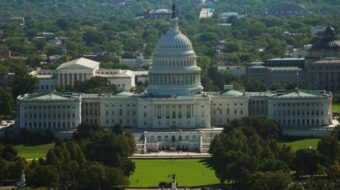
WASHINGTON—The highly ideological far-right Republican majority on the House committee that deals with workers issues and rights again engaged on Sept. 16 in one of its favorite sports: union-bashing.
This time, aided and abetted by a star witness, Greg Mourad, from the corporate-backed National Right to Work Committee, their target was unions in politics. The result was, as usual, a partisan and sometimes bitter fight. And never mind that Mourad got a key fact absolutely wrong.
House Education and the Workforce Labor subcommittee Republicans, led by chair Rep. Rick Allen, R-Ga., and Mourad, the RTW lobby’s vice president, charged international union leaders are politically out of touch with their members. Allen claimed almost half of the nation’s union members voted for Republican presidential nominee Donald Trump in 2024, including a majority of Teamsters. Public polls put the GOP share under 40%.
Allen also engaged in red-baiting, declaring unions support the Democratic Socialists of America, whose candidates have won some Democratic Party congressional primaries this year. Allen cited DSA “positions” for rent control, for defunding the police, and abolishing the U.S. Senate. There is something seriously and dangerously wrong, he implied, when the Democratic Party takes similar stances.
Mourad alleged union campaign finance committees, especially for the Teachers/AFT and AFSCME, devoted 99% of their campaign donations to Democrats.
And he charged the donations come from union members’ dues, offering two examples. By law, union members’ political contributions are voluntary. If workers whom unions by law must represent but who don’t want part of their dues to go to lobbying—not campaign contributions—can, on written request, opt out.
Not so with corporations, including the right-to-work lobby’s corporate backers, but Mourad didn’t admit that. The C-suite message to managers is: Kick in cash to corporate campaign finance committees or you’re toast.
Rep. Mark DeSaulnier, D-Calif., the panel’s top Democrat, retorted that Republicans are the ones out of touch and that their aim is to repress workers. “The real threats to workers are not unions but a rigged economy,” panel Democrats said in a statement.
“Trump’s economy is not working for workers,” DeSaulnier said. “Inflation has outpaced wage growth in recent months, and workers are taking home a smaller share of the economic pie than they have in decades.
“That is not an accident. That is the direct result of corporations and wealthy special interests wielding outsized influence over this administration and over Congress.” In this 2025-26 election cycle alone, corporate campaign spending has been $646 million so far,” he added, citing a Public Citizen study.
“Too often, Republicans in this Congress have sided with corporate interests over working families and that includes repeatedly attacking unions. Workers join unions so they can have a voice strong enough to be heard. You cannot lift up workers while tearing down the very organizations that represent them, protect them, and bargain on their behalf,” DeSaulnier continued.
“Being pro-worker requires acknowledging that unions are not outside forces—they are the voice of workers themselves.”
And so it went.
The session was typical of the House Education and the Workforce Committee—named Education and Labor before Republicans took control of the U.S. House in the Newt Gingrich-led electoral revolution of 1994. Until that landslide, Democrats ran the House for 40 straight years.
But the nastiness has only worsened since Donald Trump returned to the Oval Office last year and began his all-out war on organized labor, notably federal workers.
Right-to-work official Mourad said the solution for workers is to free every worker nationwide, not just those in federal, state, and local governments, from what he called “forced unionism” of paying dues for services and protections unions provide.
What he did not say, but what the RTW group’s real goal is—as another far-rightist told The Guardian years ago—to “defund the left,” by ensuring unions go broke. And then out of business and out of business’s hair.
As usual in House hearings, the minority party, the Democrats in this case, was allowed one witness while the majority, the GOP, got three. No union leaders were invited to testify. And for the Republicans, Right to Work VP Mourad was the extreme star of the show.
That left the defense of unions, their benefits to all workers, and their voluntary political contributions to DeSaulnier and to veteran George Washington University political scientist Adam Dean, author of two books on unions and their impact, with another forthcoming.
“Unions make sure workers they represent share in the benefits of economic growth,” Dean patiently explained. “Although economic theory predicts workers’ wages will automatically rise with productivity, in the real world we see wage growth lagging far behind productivity growth.”
Even Adam Smith, free market enthusiasts’ hero, admitted “this happens because workers have far less bargaining power than their employers, who can hold out in wage negotiations much longer than workers can,” Dean pointed out.
“My research shows unions can help solve this problem. In 28 industries across 117 countries…wages are more likely to rise along with productivity when workers have strong unions and well-protected labor rights.”
The corollary is nations—and individual U.S. states—with strong worker rights and strong unions have far less income inequality than other countries do, other factors being equal.
Income inequality, Dean did not have to say, has become a big political factor in the U.S. Politely, he also did not point out that states with the largest income and wealth gaps between the rich and the rest of us are right-to-work “red” states, such as Texas, Mississippi, and West Virginia.
“Labor unions often fight for policies that protect non-union workers, too,” Dean added. His example was recent United Farm Workers success that covers all of California farm workers and other outdoor workers, such as utility workers, and not just the 2% of California farm workers who are unionized, Dean said.
“My research compared deaths in California to neighboring states without heat standards and found California’s law was associated with a 33-51% reduction in heat-related deaths among outdoor workers.”
The hearing ended with no particular conclusions, and the parties hardened in their positions, but not before DeSaulnier, the California Democrat, made a pitch for enactment of the Protect the Right to Organize (PRO) Act, labor’s #1 priority in Congress. That law would help level the playing field between workers and bosses.
But it’s going nowhere in this Congress, especially in the Senate, thanks to corporate clout and campaign contributions.
No paywalls at People’s World
We hope you appreciated this article. At People’s World, we believe news and information should be free and accessible to all, but we need your help. Our journalism is free of corporate influence and paywalls because we are totally reader-supported. Only you, our readers and supporters, make this possible. If you enjoy reading People’s World and the stories we bring you, please support our work by donating or becoming a monthly sustainer today. Thank you!
CONTRIBUTOR