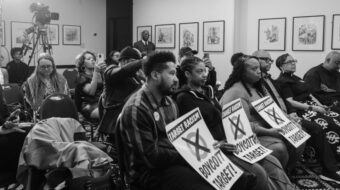
Everywhere I look, I see “Stop the War” or “No War” signs. In fact, I was wearing one around my neck just last Saturday. But activists should learn that there is a lot more to the fight than simple slogans.
Our anti-war slogans and literature should include providing good jobs in converted industries. “Stop war and provide good jobs for former military production workers!”—that’s an updated slogan worth considering.
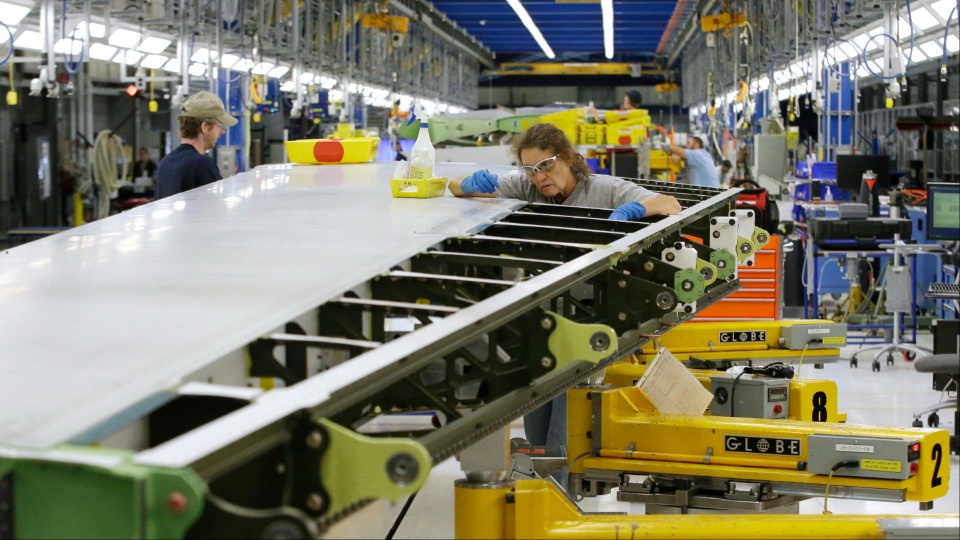
A lot of working people find themselves pushed to the wrong side of the fight for peace. They are workers in what’s usually called the “aerospace and defense” industry. Pieces of commercial aircraft pass by their work benches, but fighter planes and missiles are just as likely. The entire aerospace industry is quasi-government, partly helpful and often murderous.
There are a lot of workers in these sectors. The defense industry includes as many as 2.2 million jobs, including direct, supply chain, and induced positions. Even if you count only the workers directly employed in manufacturing, engineering, and maintenance, you’re still talking half-a-million to nearly a million workers.
They make comparatively decent money, but it’s not because of their products. It is because they organized into unions around World War II and are mostly organized today. The Autoworkers and the Machinists Union have most of them.
One could take a simple and selfish view of aerospace workers, and some of the people in my own area of North Texas do. They picket the aerospace sites with “No War” signs and literally ask the workers to quit their jobs. They equate these workers with police, arguing they belong in an entirely different class. Their products aside, it’s essential that we remember aerospace employees are workers.
Military production sites could and should be converted to peacetime uses. A few years ago, a few academics, including one at the University of Texas at Dallas, pushed “conversion” as a logical economic step for an advanced society. I recall that one favorite idea was to allow aerospace workers to build the bullet trains that are needed to make America technologically as up to date as, for example, Japan or China. Bullet trains use lightweight and strong materials, just as do airplanes and missiles.
If we are to have a better society, it will come about because the working class got organized. That would include aerospace workers along with the rest. They are workers, just like the rest of us, and they are suffering the same Trump-induced problems as the rest of us. As Shakespeare’s famous Jew says in The Merchant of Venice: “If you cut us, do we not bleed?”
As with all op-eds published by People’s World, the views expressed here are those of the author.
We hope you appreciated this article. At People’s World, we believe news and information should be free and accessible to all, but we need your help. Our journalism is free of corporate influence and paywalls because we are totally reader-supported. Only you, our readers and supporters, make this possible. If you enjoy reading People’s World and the stories we bring you, please support our work by donating or becoming a monthly sustainer today. Thank you!
CONTRIBUTOR