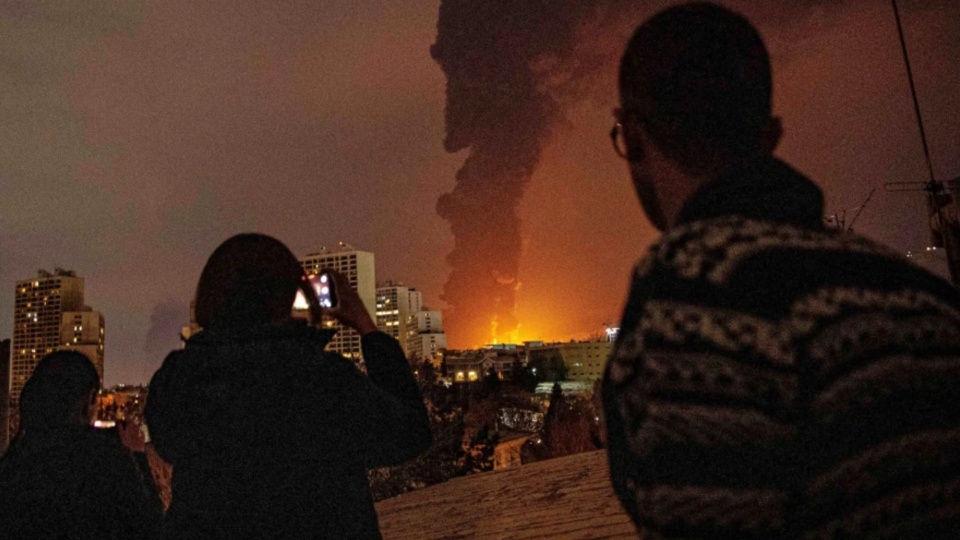
The claim that Israel dragged the United States into a war against Iran is an oversimplification of reality. In fact, this is a Western economic-imperialist war for hegemony and control over energy resources and transit routes for goods. This war intersects with Israeli interests in shaping a new Middle East, in which Israel seeks to establish its regional supremacy and fulfill its long-term strategic goals.
To understand what is happening today, it is not enough to see the events as a limited military confrontation between Iran on the one hand and Israel and the United States on the other. At the heart of the matter is a struggle over the shape of the global economic order and the question of who will control the energy and trade routes of the 21st century.
History shows that control of trade routes has always been one of the main keys to global hegemony—from the ancient Silk Roads to the sea routes dominated by the European empires in modern times.
In this context, one can understand what could be metaphorically called the “Biden Route.” Preceding Donald Trump’s assertive pursuit of a U.S.-dominated world, this is an initiative that sought to reshape the economic corridors in the Middle East to connect India, the Gulf states, Israel, and Europe.
The goal of the project was not only economic but also geopolitical: to establish Israel as a central node in the flow of trade and energy between Asia and Europe, and to keep the region within the framework of Western influence in the face of the rise of Asia and the Eurasian powers. The Trump administration continues to pursue this goal, but in a far more aggressive manner.
But this project has encountered a significant geographical and political obstacle: Iran. Iran is not just another country in the Middle East; it is a key geographical junction at the heart of the land routes connecting Central Asia, China, the Middle East, and Europe. The existence of a strong and independent country in this location makes it a key player in any regional economic equation.
On the other hand, there is the other project—the “New Silk Road,” which China is promoting as part of the “Belt and Road Initiative.” The goal here is to rebuild the historic land and maritime trade network between Asia and Europe via Central Asia and the Middle East. In this framework, Iran occupies a central place as a geographical bridge between East and West and as an important corridor for the transfer of energy and goods.
In other words, while the “Biden Route” and its revised Trump iteration seeks to divert trade routes through the Gulf and Israel, the “Silk Road” passes through Central Asia and Iran on its way to Turkey and Europe. Thus, the Middle East once again becomes an arena of struggle between two global economic projects.
This picture cannot be separated from the war in Gaza. The war there is not just a limited military conflict but an attempt to reshape the Palestinian reality. Its actual goal goes beyond the military conflict: It is an attempt to decide the Palestinian issue by reducing the presence of the Palestinian people as much as possible, pushing them into emigration or a daily struggle with survival, so that the Palestinian issue will transform from an issue of liberation and historical rights into a humanitarian-economic one.
Large economic projects require a stable environment in which to invest. Global trade routes do not operate in areas subject to open conflicts. Therefore, “quiet” is seen as a necessary condition for the success of any regional economic route. From this it can be understood that ending the Palestinian issue or marginalizing it is seen as one of the political conditions for the success of any new regional project.
In light of this, three main scenarios for the development of the current war can be imagined.
The first is a broad escalation. In this scenario, the war expands and also involves major international powers such as Russia and China, directly or indirectly. However, the likelihood of this is relatively low, as such a conflict could degenerate into a broad global conflict that none of the major players are interested in.
The second scenario is Iran’s weakening to the point of deep internal undermining or collapse, a situation that could open the door to regional and international interventions and perhaps even its division. However, the experience in Iraq and Libya shows that overthrowing states without a stable alternative often leads to lasting chaos rather than the stability that Western powers hope for.
The third scenario is that the war will ultimately harm the Western economy itself. Tensions in the Gulf and a threat to energy routes could lead to a sharp increase in oil and gas prices and damage to global energy and food supply chains. In a world already struggling with inflation and recurring economic crises, the continuation of the war could become a political and economic burden on the United States and its allies, pushing them to seek settlements or withdrawal.
Ultimately, what is happening today is not just a regional war but part of a broader shift in the international system. The world is going through a period of transition in which traditional Western hegemony is weakening and new powers are rising in Eurasia. At such historical moments, regions like the Middle East repeatedly become arenas of conflict between competing global projects.
But one truth remains unchanged in all these transformations: It is the people who pay the heaviest price. Wars waged in the name of security or stability are often a struggle for routes, resources, and markets. With one declining power determined to halt the rise of another, our region finds itself once again at the heart of a much larger global struggle.
Zo Haderekh
As with all op-eds and news analytical articles published by People’s World, the views represented here are those of the author.
We hope you appreciated this article. At People’s World, we believe news and information should be free and accessible to all, but we need your help. Our journalism is free of corporate influence and paywalls because we are totally reader-supported. Only you, our readers and supporters, make this possible. If you enjoy reading People’s World and the stories we bring you, please support our work by donating or becoming a monthly sustainer today. Thank you!
CONTRIBUTOR