
Is AI “Intelligence” or plagiarism software? By plagiarism, is meant not the use of AI that plagues teachers, that is, AI used by students to produce papers, the writing and subject matter of which they are largely unaware, but the larger question of whether AI itself is simply a massive plagiarism device, stealing the knowledge of the world, that is, plagiarism on a grand scale. The street crime of student plagiarism may be only a lower-level enactment of the suite crime of massive plagiarism that is AI.
AI and IP
We all know about the miracle of AI, supposedly the software that will revolutionize existence, make all our lives easier, and point the way to a brave new world. It is very important to understand that much of this is hype, selling, and boosting shares in a multi-billion-dollar industry that is the last best hope of Western capitalism, dictated by U.S. tech lords in Silicon Valley for the purpose of domination of the need for and profits from the digital economy. And it is important to lock up, make obscure, and keep behind closed doors the secrets of this industry so the IP (Intellectual Property), in this case the source code, of the industry is kept private and can generate endless profit.
What we’re finding out, of course, is that AI can be a useful tool but can’t supplant human understanding and knowledge. The first thing to understand about the hype is the name itself, Artificial Intelligence conceals the fact of what it is, “artificial” sweetening the fact that this is derived from a machine, and “intelligence” suggesting that this form can duplicate the reasoning of the human mind, which it cannot.
The economist Michael Hudson has suggested that a better, less hyped, name for the phenomenon would be Synthetic, or non-human, Correlation Analysis—since that is what it is doing, putting together massive amounts of data sometimes in erroneous ways that has given rise to the term “hallucinating,” where what AI returns makes no sense in terms of what has been asked. That more accurate description, synthetic correlation analysis, would not produce the billions of dollars of speculation now being poured into an industry that has yet to generate a single dollar in profits for any of the six major companies developing it. That is why there is so much talk of the “AI bubble,” since there is no widespread acceptance of AI as more than a market phenomenon.
The question for most analysts is not whether this is a bubble but rather when it bursts, what will be the impact, ranging from the milder Dot-com crash of 2000 to the 2008 crash, which nearly brought down the system.
If AI speculation in these six major companies were removed from the American economy, that economy would be at zero growth, that is, in a recession, a sign of how important this speculative bubble is and how disastrous it will be if that bubble bursts. Nividia, the company that makes the microchips necessary to power AI and which has seen its profits soar on one day to unprecedented heights in the market and then come crashing down to earth on the next day as investors become nervous about the hype, has also been accused of pumping up its own stock, not only through the now standard financial industry scam of buybacks where the company buys its own stock to boost its market valuation but also by investing in the companies that buy Nividia’s chips, and in that way boosting their stock and its own.
The locking up of the source code, the IP, behind the doors of these powerful companies, including Apple, Microsoft/Open AI, Amazon, Google, Tesla, and Oracle is also countered by the Chinese model of sharing source code in its AI DeepSeek, developed for less than five percent of what U.S. tech companies are spending and respecting the idea that this form of human interaction should be a global commons shared by all. Open source, that is, the abandoning of IP in the digital era, was the dream of many of the internet pioneers, cancelled instead in favor of privatizing this commons and locking up source code to increase stock value for investors and shareholders who have no interest in a global commons, only in global domination.
The Chinese model DeepSeek, by contrast, is developed within a Global South socialist economy and is the Global South equivalent, open to all, of the expensive American models. One of the ways costs are cut is by using open-source code and not having to go through the extensive legal costs of locking up that code, that IP. Last year, Chinese open-source AI models bounded past the American Big 6, accounting for 17% of all AI downloads.
This is to say nothing of how AI will be employed. It is being sold as a device to cut costs by cutting jobs, and it has already penetrated areas of middle-class employment; legal staffers, accounting, and multiple office jobs. The promise is that 30% of U.S. jobs could be replaced, and 60% significantly altered.
There is little debate on this aspect of the technology. In India, entry-level jobs in IT have been reduced by up to 25% by AI. The way the industry confronts this issue is by denying it, claiming that as many new jobs will be created as jobs lost. It’s a bit like the tobacco industry in the 1970s denying the cancerous effects of cigarette smoking.
In China, the way AI is developed is carefully controlled so it does not become a device for simply laying off workers, and so that it benefits those in need, such as senior citizens. The problem then is not the technology itself, but the way, the system under which, and the purpose for which it is being developed. In the West, AI is foremost a profit- making technology that will aid in reducing costs, i.e., laying off workers, though it is sold as enhancing medical procedures, etc. It can do this, but that is a secondary goal behind the profit-making one. In China, AI is being developed to enhance the lives of workers in society as a whole.
How to train your AI dragon
Now we come to the second crucial aspect of AI and IP, and that is how AI is being constructed. It cannot reason. What it can do is absorb a massive amount of data and correlate that data, sometimes in meaningful ways, sometimes not. This has given rise to a characterization of the technology as “plagiarism software,” since it is being fed massive amounts of data from as many sources as the companies can muster, with often the companies just stealing this source material from which they will then profit.
The New York Times is currently suing OpenAI, which partnered with Microsoft to create its Microsoft Pilot program, charging that the company used millions of Times articles without paying a penny for them. This large-scale theft goes unremarked by the AI companies.
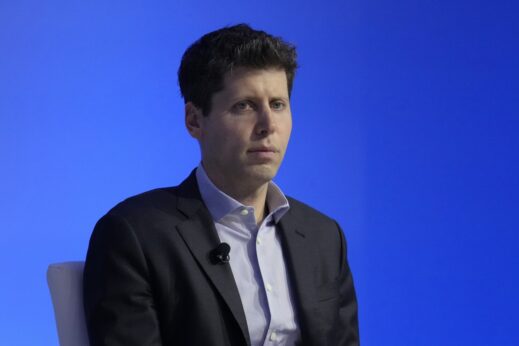
There are further nefarious uses of AI, equally prominent in the entertainment industry. The actress Scarlet Johannsen criticized OpenAI for using an approximation of her voice as she crafted it in the film Her to create its female voice, Sky, its version of Siri and Alexa. The company had approached the actress and asked to use her voice, but she refused, so they used an AI approximation. Johannsen claimed that her husky, sexy voice is her creation, which she worked on developing over the course of her acting career, and the company had to withdraw the voice. Johannsen has a valued place in the Marvel Universe as The Black Widow, a deadly assassin, and she was asked if OpenAI president Sam Altman would make a good Marvel villain. Altman is famous for surviving a revolt led by OpenAI workers, upset by his imperious rule, and then privatizing more aspects of the company. Would he be a good Marvel villain? She replied, “I guess, maybe with a robotic arm.”
Needless to say, the last actor’s strike was all about protecting actors, whose voice and mannerisms are their IP, from having each stolen by these companies. A more insidious use of AI IP was uncovered by the writers in their strike. Here, the goal of the streamers and studios is to have AI write the first draft of a script and then only hire writers to come in afterwards and edit it. The property then would belong to the studio, generated by its AI. The writers cancelled out this use, but no doubt it will emerge again in the upcoming contract negotiations this year, and it shows how the technology is envisioned to be employed by the companies as a way of regaining control of the writers’ share of IP based on their scripts.
This attempt to reclaim IP from the writers and even to duplicate actors’ bodies and voices is active in the music industry as well. The top Country Music song in 2025 for two weeks, “Walk My Walk,” was generated by AI and indicates again that the record companies are also attempting to eliminate human interaction and claim the IP proceeds for themselves. These are battles and issues the entertainment unions all must confront.
Not to mention the deskilling of a workforce necessary for their elimination, and there is a notable example in the music industry. The producer Timbaland, who has an AI-created song (“Glitch X Pulse”) by an AI artist (TaTa Tatumi), says that “Basic skills have diminished as digital music evolved. “You don’t have to know how to play chords. You’ve got a chord machine. People aren’t making drum loops because they’ve already got drum packages you just drag and drop.” With AI, this deskilling proceeds to the point where “musicians” no longer need to know how to play music.
Of course, the AI battlefield is shifting constantly, and that, as Shoshana Zuboff says in The Age of Surveillance Capitalism, is the point. One goal of the tech industry is to, as they describe it, “innovate” so fast that no government regulation or union negotiation can keep up. This is a huge challenge for both.
The leader in AI regulation, in maintaining the IP integrity of artists, has been Europe, but the Trump administration is attempting, in its tariff negotiation with the EU, to halt this regulation, as impinging on the profits of American companies.
The goal of Silicon Valley and their Wall Street investors in this form of fin-tech, the melding of the financial and technology industries, is to create a new Wild West, where rules, regulations and unions are off the table as these digital pioneers shoot it out to see which gunfighter will survive with nary a care given to the innocent bystanders, that is, the rest of us, caught in the crossfire.
As with all news-analysis and op-ed articles published by People’s World, the views reflected here are those of the author.
We hope you appreciated this article. At People’s World, we believe news and information should be free and accessible to all, but we need your help. Our journalism is free of corporate influence and paywalls because we are totally reader-supported. Only you, our readers and supporters, make this possible. If you enjoy reading People’s World and the stories we bring you, please support our work by donating or becoming a monthly sustainer today. Thank you!
CONTRIBUTOR