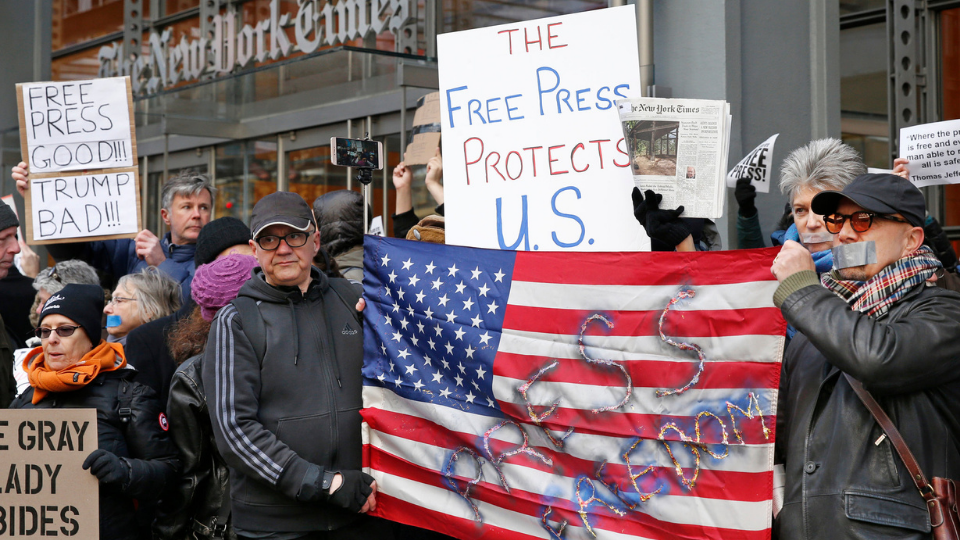
Former Supreme Court Justice Hugo Black once wrote in an opinion on the 1971 case New York Times Co. v. United States:
“In the First Amendment, the Founding Fathers gave the free press the protection it must have to fulfill its essential role in our democracy. The press was to serve the governed, not the governors. The government’s power to censor the press was abolished so that the press would remain forever free to censure the government. The press was protected so that it could bear the secrets of government and inform the people.”
In recent years, there has been an attack on the freedom of the press to dissuade journalists from carrying out this task. On Jan. 6, a national town hall addressed this issue, with organizers citing a rise in authoritarianism threatening free speech and the future of the news industry.
Sponsored by The National Writers Union, NABET-CWA, The NewsGuild-CWA, PEN America, Reporters Without Borders (RSF), Freedom of the Press Foundation, and the National Association of Black Journalists, the town hall featured a number of journalists and working media professionals speaking on recent attacks on individual journalists, censorship, hostility from those in power in the U.S. government, labor struggles, and the need to “Trump-proof” newsrooms for continued independence.
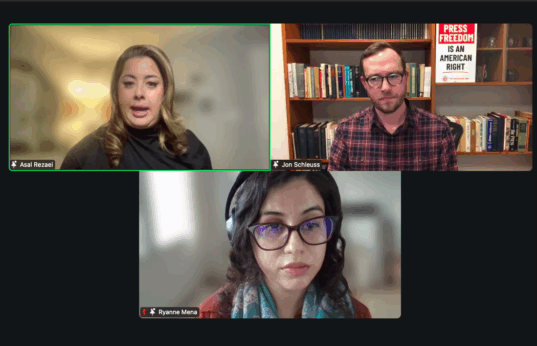
Taking place on Zoom and moderated by TNG-NewsGuild President Jon Schleuss—who had a sign stating “Press Freedom is an American Right” hanging in his background—the town hall was described as being for “readers, journalists, and the general public—a clarion call in a time of crisis.”
Concerns for safety at protests have grown among the public as incidents of violence by ICE (Immigration and Customs Enforcement) agents and police officers against those participating in the demonstrations and the news media that cover them continue to be reported.
According to the U.S. Press Freedom Tracker, there have been 170 reports of assaults on journalists in the United States in 2025, with 160 of them at the hands of law enforcement.
Having experienced this violence firsthand, reporters Asal Rezaei and Ryanne Mena spoke at the town hall about the dangers journalists face on the job amid rising social unrest.
Rezaei, an assignment reporter for CBS News Chicago (WBBM-TV) known for her coverage of protests and the George Floyd trial, was the victim of a masked ICE agent firing a pepper ball into her car in September of last year. The incident occurred while she was on assignment covering demonstrations near the Broadview ICE facility.
While retelling the ordeal, she described how she was coughing and throwing up for hours afterwards. And while she’s come to expect pepper balls and rubber bullets when covering live demonstrations and protests—and had been covering the demos at the facility numerous times—she explained that the ICE agent fired the shot into her car when there was no active demonstration happening, and she was simply driving around the facility to see if there was anything going on.
“I covered the George Floyd trial and the protests that happened during that, I was there in Kenosha [Wisconsin] when the Kyle Rittenhouse shooting happened,” Rezaei said, “I’ve been hit in the face and had welts on my body when covering a protest, so I expect it. But there was no expectancy with just doing a drive-by.”
When CBS Chicago reached out to the Department of Homeland Security (DHS) about the assault, they were given the standard answer that the media should anticipate the possibility of being hit with projectiles when covering protests. When the network clarified that no active protest was happening at the time, Rezaei said that DHS then denied the incident occurred, and, when pressed further, they claimed that the reporter had “failed to obey command.”
Rezaei’s case would become part of a larger and currently active lawsuit by the members of the press in Chicago, charging that reporters were being targeted by federal officers while reporting on the Broadview ICE facility.
Ryanne Mena, a reporter for the Los Angeles Daily News, explained how she was assaulted twice by federal agents during protests that took place last summer against federal immigration raids in and around Los Angeles.
The journalist was covering protests in the city when she was shot in the leg with a pepper ball bullet by federal officers. The next day, during another demonstration, she was shot in the head with a crowd-control munition, suffering a concussion.
Mena and several other journalists sued DHS and DHS Secretary Kristi Noem, stating that “DHS’s excessive and indiscriminate use of force against journalists, observers, and protesters has prevented people…from exercising their constitutional rights.”
While it was noted in the town hall that journalists are usually taught not to be the subject of a story, both Mena and Rezaei felt that journalism and the stakes were too important to remain silent.
“People should know when journalists are being attacked by their own government,” Mena asserted.
When addressing the question of whether it would seem less “objective” to call out the attacks on freedom of the press, or whether it was “wrong” for journalists to report on themselves, Rezaei stated, “It’s not my job to tell you [the public] something is un-American. It’s my job to show you. That’s more powerful [than editorializing].
Mena added, “It’s important for us to stand up for our job and our colleagues.”
Under the topic “Facing authoritarianism in the newsroom,” several media workers noted that when journalists aren’t dealing with physical dangers covering stories, they still face exploitation, union-busting, and censorship on the job from bosses and owners.
Former writer and digital producer at Bon Appétit Alma Avalle spoke about Condé Nast’s shuttering of Teen Vogue and the subsequent firing of its staff.
Avalle described how Teen Vogue had pivoted to being a more politically engaged magazine since Donald Trump’s first term in the White House. “The joke around the internet was to call the magazine ‘Comrade Teen Vogue,’ because it provided serious journalism to everyone, and took the rise of American fascism seriously.” Avalle noted that the “tides in our [news] industry have shifted,” and it is facing “active hostility” from the current White House administration.
Regarding the firing of 80% of Teen Vogue’s staff, she attributed it to Condé Nast not wanting to draw Trump’s ire—which, she said, management mentioned to staff just days before the layoffs.
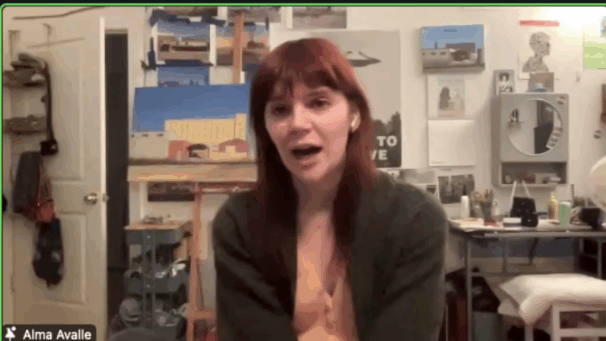
When Alma and others went to the Condé Nast office to ask questions and demand answers regarding the firings, they soon found themselves illegally terminated for alleged “policy violations.” She believes she was also targeted for being a union activist.
“Stripping resources [like the firings] from this work is a way to censor this work,” Alma said.
Connecting the stifling of the press to the fight for security and union representation, Steve Mellon, a journalist who was part of the strike at the Pittsburgh Post-Gazette, noted that exploitation, union-busting, and draconian working conditions imposed by management pose another threat to freedom of the press.
“The company thought they could break federal labor law without impunity,” Mellon noted. In reference to the news staff of the Pittsburgh Post-Gazette, deciding to go back to work on Nov. 24 following a court win against the owners of the publication, the veteran journalist stated, “It’s possible to fight back and win.”
Yet the struggle continues: Shortly after the news staff celebrated this victory, Block Communications, the owners, announced they would close the publication, ending its 240-year history.
Mitchell Grummon, the publisher of The American Prospect, emphasized that, to “Trump-proof” newsrooms against censorship and retaliation when bringing news to the public, financial independence is key. “Who pays your bills?” Grummon said. “Don’t give hostile regimes any ways to harass and to attack.”
In closing out the town hall, Schleuss announced that future events would be held to continue the discussion and encouraged the public to “stand with us. Stand with journalists across the industry.”
Attendees were also urged to sign the petition “Defend the Free Press and Protect the First Amendment” that calls for the halting of “authoritarian efforts to seize control of the media.”
We hope you appreciated this article. At People’s World, we believe news and information should be free and accessible to all, but we need your help. Our journalism is free of corporate influence and paywalls because we are totally reader-supported. Only you, our readers and supporters, make this possible. If you enjoy reading People’s World and the stories we bring you, please support our work by donating or becoming a monthly sustainer today. Thank you!
CONTRIBUTOR