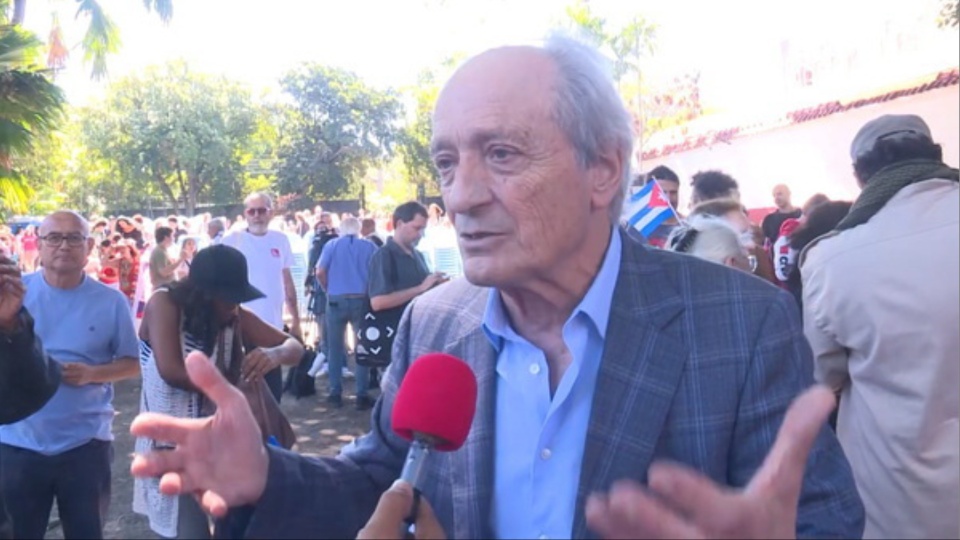
The Nuestra América Convoy, an international solidarity caravan for Cuba, arrived late last month. On March 20, hundreds of representatives from more than 30 countries were officially received by Cuban officials. They brought several tons of food, medicine, and humanitarian aid. “The Caravan was a symbolic initiative to show the Cuban people that they are not alone,” explained Swiss doctor Franco Cavalli. In the interview below, published in Rebelión, Cavalli discusses the current situation in Cuba. Further information on him as well as the work of his group, mediCuba-Europe, can be found below.
Question: You have just participated in the Nuestra América Caravan, your most recent visit among the many you have made to Cuba over the past 40 years. What is your perception of the current situation?
Franco Cavalli (FC): What Cuba is experiencing is a veritable medieval-style siege, much like when, in the Middle Ages, invaders would block the entry of grain and the supply of water to the cities they sought to conquer, using hunger and thirst as weapons against the besieged defenders.
Cuba is facing a national energy crisis which, in the last days of March, has plunged the country into near-total darkness on two occasions. This energy crisis is the result of this brutal phase of the U.S. oil embargo, carried out as part of what President Trump defines as his objective: “To conquer the island and do with it as I please.” This arrogant attitude violates all the basic rules of international law and the sovereignty of states.
Question: How are local authorities responding to this very complex situation?
FC: The Cuban government’s response is clear. It has stated that the army is preparing for a possible U.S. attack but also that they are willing to sit down at the negotiating table to discuss the matter, as they do not want a conflict with the United States. I visited four hospitals: They are preparing for a possible attack and planning how patient care would be handled in such a scenario.
Suffocating blockade
Question: That energy crisis means an additional increase in the pressure already being exerted against the Caribbean nation.
FC: Indeed. For 65 years, Cuba has suffered under a suffocating economic blockade—the longest in history that any country in the world has endured. But now the situation has worsened: there is a total siege; the U.S. Navy won’t let a single liter of oil in. (A Russian oil tanker arrived in Matanzas, Cuba on March 31.)
The fuel produced on the island, in fact, covers only 40% of needs—primarily for generating electricity—but it is too dense and unusable for vehicles. The country is facing a near-paralysis in both production and basic services. Especially with Chinese aid, it is now—perhaps a little late—making an exceptional effort to install massive solar panel farms.
In a couple of years, Cuba will surely be much less dependent on oil. Washington knows this, which is why it is now implementing this extreme energy blockade.
Question: Can you describe what you saw during your recent stay?
FC: The situation is eerie. If things go well, people get four hours of electricity a day, while at night everything is shut down, as if in a real war zone. Traffic is reduced to a minimum, tourism has disappeared, and factories are operating at minimal capacity or are shut down.
Cubans, as a result of virtually non-existent public transportation, are forced to walk ten kilometers a day to get to their workplaces, while those who work in hospitals often sleep there. Not to mention the schools, which, in this case, provide only the most essential services.
Those who can receive remittances from abroad are installing solar panels. For $1,200, you can buy one with enough capacity to meet a family’s basic needs. The small and medium-sized businesses selling these panels are making huge profits.
Question: What are people saying about this situation?
FC: It’s not easy to discuss the situation with “the average Cuban,” given that they are very busy trying to find food and ways to survive. Some medical colleagues with whom I spoke told me that people are exhausted and on edge, and that they are expressing very mixed reactions.
There are some who, even though they aren’t particularly supportive of the government, insist they won’t surrender to the Americans. Others maintain that “nothing can be worse than what we’re going through now.”
Dialogue on the horizon
Question: In the last days of March, the Cuban government affirmed its willingness and openness to a respectful dialogue with Washington. How do you assess that position?
FC: I believe the government is open to dialogue and to economic openness in particular, which I would describe as “Vietnam-style.” This involves allowing investment and purchases in Cuba by Cubans living in the United States, facilitating foreign investment, and liberalizing the domestic market. From my discussions with some national political figures, I got the impression that they are not willing to accept political impositions.
Question: Given your deep knowledge not only of Cuba but also of Central America and its political and historical processes, do you think there is a real possibility for dialogue and negotiation that could prevent any military option that would have disastrous consequences?
FC: If there is no international pressure (from the European Union, Spain, China, Russia, the Vatican, Mexico, Brazil), I am quite pessimistic. The situation in Iran complicates matters for Trump.
Since he needs to win the midterm elections in November, an attack on Cuba is a possibility. It’s important to remember that his right-hand man, Marco Rubio, is of Cuban origin (his family emigrated to the United States before the Revolution), and his electoral base consists of Cubans in Miami. And Rubio plays a decisive role in policy toward Cuba.
Breaking the blockade
Question: In this extremely complex situation, what significance did the Nuestra América Solidarity Caravan have?
FC: The Caravan brought tons of humanitarian aid to Cuba—food, medicine, and solar panels—by both sea and air. Despite the dramatic situation facing the island, enthusiasm was enormous among the nearly 700 participants (150 from the United States).
The Cuban people are exhausted, and the people we met during our stay expressed their immense gratitude for the aid provided by the Caravan. The question, however, remains: How much longer can Cuba hold out under these extreme conditions that are now affecting the very survival of daily life in the country?
I want to emphasize that our presence showed to Cubans that they are not alone in terms of solidarity among peoples. This is very important, symbolically, for the population itself. But it is also a signal to the outside world, to the international community.
There was this other essential element: The presence of many young people in our caravan made the direct connection between support for Cuba and the reality of Palestine. That youthful presence is a fundamental element, as it embodies hope and the future. Until now, solidarity has been carried primarily by us—people of a certain age who experienced the revolution almost from its inception, who were politically shaped by Che Guevara as our role model. These new generations prove that we have a solid succession with a promising future.
I must say that, from my previous trip last December, I had returned to Switzerland with a deep sense of concern about the objective situation I encountered on the island. Today, although the situation is even more difficult, I return with greater confidence, seeing also that, just as the difficulties grow, this renewed solidarity continues to increase.
I cannot deny that many Cubans are sad. They say: “We have sent doctors to help many countries fight the Ebola epidemic and COVID; thousands of Cubans died in Angola fighting colonialism. And now no government is speaking out against this criminal attempt to suffocate Cuba; not even [Spanish Prime Minister] Pedro Sánchez.” (Convoy Nuestra América – Junt@s con Cuba – YouTube).
Question: Now that you’re back from your recent stay in Cuba, what do you think are the top priorities for international solidarity in that country?
FC: It’s essential to step up our outreach efforts: The mainstream media reports little or negatively about Cuba. It’s true that the Cuban government has committed mistakes, such as disproportionate investments in luxury hotels for international tourism, given insufficient attention to agriculture, and not dealt with delays in the solar energy development plan. But there is no doubt whatsoever that the embargo is, by far, the main cause of this dire situation.
Trump, already during his first term, had included Cuba on the list of state sponsors of terrorism. This had a massive impact, including on financial transactions with Cuba. We have felt this in Switzerland, where in many cases we have been unable to make transfers for entirely legal cooperation projects.
That is why, I insist, public opinion must play a very important role at this juncture. International solidarity, moreover, must massively step up food and medical aid and resources for installing solar panels.
W.T. Whitney Jr. edited a machine translation of the Spanish version of the interview.
Who is Franco Cavalli? What is MediCuba-Europe?
Swiss physician Franco Cavalli is a medical superstar. Now retired, he was head of medical oncology at a hospital in Bellinzona, Switzerland, President of the Swiss Group for Clinical Cancer Research, founding editor of the leading oncology journal in Europe, and former president of the International Union Against Cancer.
This author or co-author of more than 500 scientific articles and four books has had an “impact on research and treatment that cannot be understated.” Cavalli is president of the Foundation for the Institute of Oncology Research and Chairman of the Scientific Committee of the European School of Oncology.
In 1985, he founded the Association of Medical Aid to Central America. Serving in the Swiss Parliament, “he was the Socialist group leader.”
Franco Cavalli has presided over mediCuba-Europe since he founded the entity in 2011. As a collective of dozens of European aid organizations, mediCuba-Europe has supplied Cuba with raw materials for drug manufacturing, a wide range of cancer medications, and supplies and drugs necessary for both medical research and cardiac care. The organization supports medical education in Cuba, including the Latin American School of Medicine. It funds alternative energy sources for healthcare institutions.
Medicuba-Europe’s striking political orientation shows in a recent “Urgent Appeal,” which begins:
“The neocolonial aggression of the government of the United States against Venezuela constitutes an act of piracy aimed at stripping the country of its natural resources and revives the Monroe Doctrine, which views Latin America as its backyard and sphere of domination. The objective remains the same: to dominate the world as an empire, enrich magnates and transnational corporations, and eradicate any hope of building a more just world….
“Our particular solidarity is with Cuba and its population, a country subjected to an imperial blockade for more than 60 years and attacked on economic, military, political, and sociocultural fronts. The blockade and aggression against Cuba undermine the dignity and hope of peoples everywhere, demonstrating that, for imperialism, the idea that ‘another world is possible’ is unacceptable.”
We hope you appreciated this article. At People’s World, we believe news and information should be free and accessible to all, but we need your help. Our journalism is free of corporate influence and paywalls because we are totally reader-supported. Only you, our readers and supporters, make this possible. If you enjoy reading People’s World and the stories we bring you, please support our work by donating or becoming a monthly sustainer today. Thank you!
CONTRIBUTOR