RIVERSIDE, Ill.—Heated debates surrounding book bans, censorship, and the defunding of public libraries continue to make headlines. A new report by EveryLibrary details organizational efforts nationwide to defend the right to read, support sustainable library funding, and strengthen public access to information.
The group considers the work critical to combating what they consider the “Trump Project 2025 agenda” that has included “censorship, funding erosion, and unprecedented political interference.”
The nonprofit national organization’s Annual Impact Report outlines efforts to support local library ballot measures, campaigns to return books to shelves, and legislative activity tied to the right to read, while also documenting the broader policy and political environment affecting libraries nationwide.
They have noted that these are unprecedented times for libraries, as there has been an onslaught of “political pressure, financial threats, coordinated book-ban campaigns, staffing cuts, and ballot measures that determine whether communities gain (or lose) essential library services.”
EveryLibrary, founded in 2012 and described as an organization dedicated to defending the First Amendment rights of library users across the United States, also highlighted its Fight for the First campaigns, which support local organizing efforts related to book bans and censorship, including work to restore access to challenged collections.
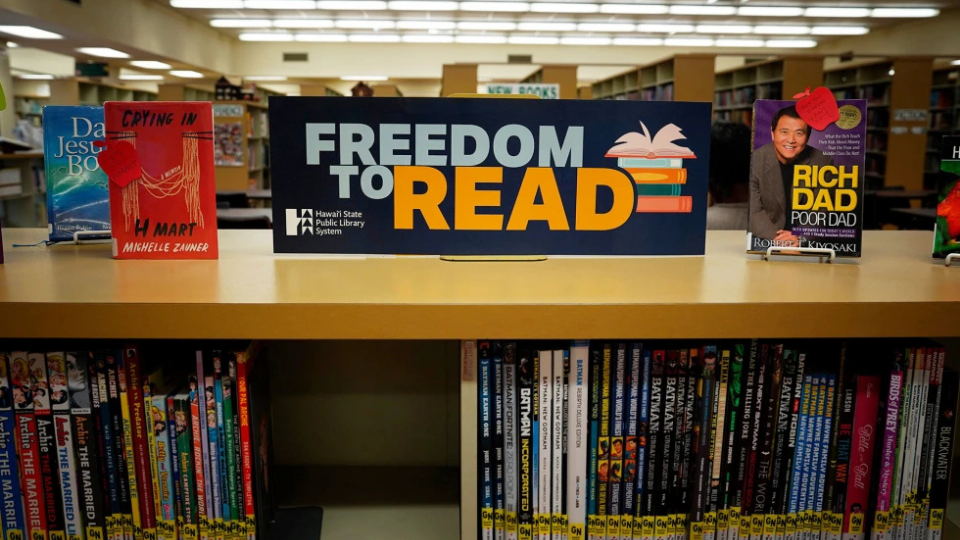
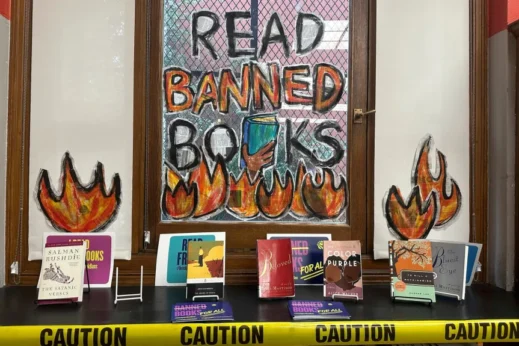
Since 2021, 23,000 books have been banned in public schools nationwide. As cited by the writers’ advocacy group PEN America, in the 2024-25 school year, there were a recorded 6,870 instances of book bans. Three states, Florida, Texas, and Tennessee, “won” the title of top three states when it came to book bans this past year. 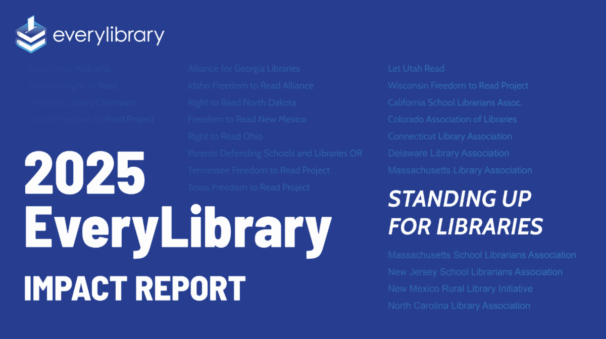
Recently, the Alabama Library Board voted to stop readers under the age of 18 from reading books that address “transgender procedures, gender ideology, or the concept of more than two biological genders.”
EveryLibrary joined with a number of other advocacy groups—including Read Freely Alabama, PEN America, and Alabama Transgender Rights Action Coalition—in condemning the vote results, asserting that the broad language “would likely result in any books with trans representation—regardless of their age-relevance—moved to adult sections of public libraries in Alabama.” The joint statement explained that “the language in the code change does not define ‘gender ideology,’ a vague, undefined term often used as an anti-LGBTQ+ dogwhistle.”
The EveryLibrary report details this censorship and erosion on the federal level. It points to President Donald Trump’s attempt to close the Institute of Museum and Library Services, his firing of the Librarian of Congress and the Archivist of the United States, and what they consider the “institutionalized censorship at Department of Defense K-12 schools and military academies.”
The report notes that across the states, “Texas criminalized librarianship, Alabama instituted anti-LGBTQ collection rules, South Dakota nearly closed its state library, and the 5th Circuit said the First Amendment no longer applies in three states.”
“Throughout these challenges and in pursuit of new opportunities, we have remained consistent in our focus on the Constitution and the rule of law,” Executive Director and EveryLibrary Co-Founder Chrastka stated in a letter accompanying the report.
When it came to opposing what they called “Trump Project 2025 Agenda for Libraries, Archives, and Museums,” EveryLibrary highlighted how it led the national response to the Trump administration’s targeting the independence of the Institute of Museum and Library Services, the Library of Congress, the National Archives, and the Smithsonian Institution.
The report states that through rapid-response organizing, public education, and congressional engagement, more than 250,000 Americans took action to “oppose executive overreach and defend these cornerstone institutions.”
The report explains how they “connected federal threats directly to local consequences, helping communities understand how national policy decisions shape what happens in their schools, libraries, and cultural institutions.” The org stated that this kind of work “positioned libraries at the heart of a broader struggle over democracy, history, and free expression.”
In election wins and public library funding, EveryLibrary reported involvement in 10 library ballot measures across nine communities, winning eight campaigns. The organization reported that these election wins secured over $3.8 million in new and renewed annual funding for library operations, collections, services, and staffing.
In 2025, EveryLibrary reported helping write, advance, and pass new Right to Read legislation in Colorado, Connecticut, Delaware, and Rhode Island. Colorado’s Freedom to Read Act, which was signed into law by Governor Jared Polis last May, creates safeguards against book bans in public school libraries. Additionally, the law, also titled SB25-063, will prevent discriminatory policies and protect librarians from retaliation.
As political division and social unrest rise, it’s no surprise libraries are at the center of the fight for democracy. The American public library originated in the idea of giving everyday working people access to knowledge, as for most of human history, libraries were often private and reserved for the wealthy and nobility. The Boston Public Library, established in 1848, became the first large free municipal library in the United States and the first public library to lend books.
Since that time, libraries have been not only places to borrow books but also become a source of high-speed internet (something nearly 24 million Americans still lack), refuges during extreme weather, and points to access many other community services.
When it comes to the defense and the prolonging of this legacy, EveryLibrary’s report frames 2026 as a pivotal year for libraries and reading nationwide. It points to the national political environment, ongoing state and local policy battles, and the 2026 midterm elections as key factors that will have a heavy impact on library funding and public access to information.
“We have a choice to make as a country this year, and I want to make sure that EveryLibrary is involved in educating and activating the public about what we believe,” Chrastka wrote.
The organization encourages library supporters nationwide to get involved in the 2026 efforts to defend the right to read and strengthen sustainable funding for libraries by volunteering and taking part in ongoing local, state, and national campaigns.
The full report is available here.
We hope you appreciated this article. At People’s World, we believe news and information should be free and accessible to all, but we need your help. Our journalism is free of corporate influence and paywalls because we are totally reader-supported. Only you, our readers and supporters, make this possible. If you enjoy reading People’s World and the stories we bring you, please support our work by donating or becoming a monthly sustainer today. Thank you!
CONTRIBUTOR