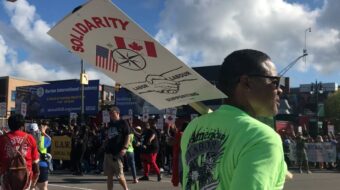
MINNEAPOLIS—The 30th AFL‑CIO Constitutional Convention, which wrapped up here Wednesday, was a step towards strengthening labor’s fight back against the anti-worker Trump regime and building working-class unity. Delegates reelected President Liz Shuler and Secretary‑Treasurer Fred Redmond, welcomed the Service Employees International Union back into the fold after two decades, and set ambitious organizing goals for the mid-term elections and new union organizing.
The spirit of solidarity was also proclaimed in several important resolutions passed at the convention.
One affirmed that fighting racism, sexism, homophobia, and xenophobia is central to economic justice and trade union dignity. Another demanded a pathway to citizenship and denounced the mass deportation agenda and ICE terror by the Trump regime. A third laid out an industrial policy, called for guardrails on artificial intelligence, and recognized the need for new jobs in climate‑resilient infrastructure. A fourth declared healthcare as a basic right, demanded single-payer healthcare, and defended the Occupational Safety and Health Administration from corporate attacks.
And in a sharp rebuke to a Democratic governor, the convention condemned Virginia’s Gov. Abigail Spanberger—a former CIA agent—for vetoing collective bargaining legislation for public workers she had promised to support. Virginia’s ban on public sector bargaining, the resolution correctly noted, is inextricably tied to the state’s history of segregation and racism.
All of this reflects a labor movement that is increasingly willing to take on the billionaires and the political establishment.
However, not all passed resolutions showed a strong determination to confront the billionaire class, while other critical resolutions that would have done so were not taken up at all. For example, there was total silence on how the administration’s Cuba policy harms workers both at home and abroad.

The resolution on shipbuilding, for example, submitted by the Machinists (IAM) and backed by the Steelworkers (USW), which aims to revitalize the nation’s struggling shipbuilding industry was problematic in some ways and did not contribute much to international working-class solidarity.
Rebuilding the nation’s shipbuilding industry itself is not the problem, of course. No one can reasonably disagree with labor’s determination to see that happen. And it is clear that the workers who build and repair vessels in U.S. yards need good-paying union jobs with cargo moved on U.S. flagships rather than on foreign-flagged ships that allow lower pay and poorer working conditions.
The problem with the passed resolution is that it blames the industry’s decline on China’s “predatory trade policies” rather than on the profit-driven actions of major capitalist interests. These corporations enrich themselves by exploiting hostilities between world powers—specifically the U.S. and Europe on one side, and China and Russia on the other. In contrast, peaceful relations would pave the way for millions of clean energy and other peace economy jobs. The passed resolution fails to tackle the problem that every dollar spent on military budgets creates far less wealth and employment than a robust, peace-based economy.
The enemy of U.S. workers is not China. In fact, the U.S. and China and the workers of both countries share urgent common interests: preventing catastrophic climate change, stopping the spread of nuclear weapons, and building global peace and security based on international law. These are challenges no single nation can solve alone.
An AFL-CIO resolution echoing these concerns would have been far better than one that echoes Chamber of Commerce talking points pushing a language of zero-sum competition, rather than one of working-class internationalism and peace.
Another resolution on global peace passed at the convention took several good positions. For instance, it reiterated the federation’s demand for an immediate and permanent ceasefire in Gaza, a halt to arms transfers “that may violate international law,” and a Palestinian state based on relevant UN resolutions. It also targeted transnational monopolies and the billionaire-backed ultra-right forces around the world for weakening the rights, dignity, and living standards of workers everywhere.
Cathy Drummond, USW Region 9 Director, during the floor debate said, “Working people everywhere deserve dignity, democracy, peace, and a voice in shaping their future. Corporations operate across borders and supply chains across continents.
“That reality demands that workers stand together—not just locally or nationally, but globally. The labor movement has always been strongest when we have stood united. This resolution recognizes that an injury to one is an injury to all.”
Another really positive development was when Baldemar Velázquez from the Farm Labor Organizing Committee (FLOC) delivered a passionate indictment of the capitalist trade policies that drive migration.
“We cannot keep having trade policies that displace people in countries for the benefit of Wall Street investors,” he said.
“Under NAFTA, we displaced two million corn families in Mexico—then blamed them for coming to our border. We have to create policies that reverse the old Monroe Doctrine and stop investing in other countries for the sole benefit of billionaires in North America.
“We have to give all workers of the world the right to pursue life, liberty, and happiness.”
The resolution also called for an end to the U.S.-Israeli war, both in Iran and Lebanon, against the interventions in Venezuela and elsewhere, and demanded that the sovereignty of Canada be respected. It rejected the consolidation of power by “authoritarian and oligarchic forces” globally, and stood with workers and the labor movements around the world who are resisting. These are necessary positions, and the labor movement deserves credit for taking them.
But the same resolution also vaguely expressed “solidarity with Ukraine” without any clarity on what exactly that meant. Nor was there any mention of Russian workers who are also deeply impacted by the war. On the floor, this point was not discussed.
Unions cannot ignore that in 2014, the Trade Unions House in Odesa, Ukraine, was set ablaze by far-right, neo-fascist militants. Dozens of people died. In the years that followed, the Ukrainian government has systematically weakened union rights. Martial law, imposed after the war with Russia, has been used to restrict strikes, mass protests, and collective bargaining. In 2025, the government raided the House of Trade Unions in Kyiv, arrested the president of the Federation of Trade Unions of Ukraine, and confiscated union property.
Another issue was the resolution’s uncritical embrace of the Solidarity Center, which it described as an organization that helps workers “build independent unions.” The Solidarity Center is the direct successor to AFL‑CIO foreign policy institutes that, in the Cold War, worked to undermine communist and socialist‑led unions around the world—often with funding from the CIA and the National Endowment for Democracy. For example, in 2002, the Solidarity Center received NED funding to help promote a coup against the elected socialist government of Hugo Chávez in Venezuela.
But overall, despite the problems, the labor movement that met in Minneapolis is seemingly stronger than it was four years ago. It is more diverse and unifying, more targeted against monopoly capital, and more willing to stake its political independence. That is progress.
The challenge now is to make more of that progress at the international level too and deepen the fight for peace. As a labor movement, we cannot claim to stand against racism at home while embracing anti-China xenophobia abroad. We cannot champion democracy in the workplace while ignoring the deeply undemocratic history of some of our own institutions and alleged U.S. allies. And we cannot talk about peace while preparing workers to see their counterparts in other countries as their enemies.
It needs to be continuously emphasized that the real enemy of all workers is the billionaire-backed, ultra-right forces that are destined to wipe the trade unions and all movements against exploitation and oppression, completely out of the picture.
As with all op-eds published by People’s World, the views expressed here are those of the author.
We hope you appreciated this article. At People’s World, we believe news and information should be free and accessible to all, but we need your help. Our journalism is free of corporate influence and paywalls because we are totally reader-supported. Only you, our readers and supporters, make this possible. If you enjoy reading People’s World and the stories we bring you, please support our work by donating or becoming a monthly sustainer today. Thank you!
CONTRIBUTOR