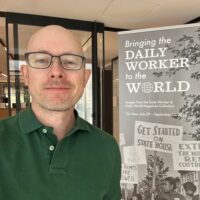
C.J. Atkins: I’m sitting down with Eric Gordon, longtime People’s World staff writer, now retired, who’s broken out into some new avenues for his writing. Eric, how are you, and what have you been doing in your retirement?
Eric A. Gordon: Well, it hardly feels like I’m retired! I did take a wonderful trip to Turkey in September. We visited archeological sites, museums, and met a lot of carpet makers and sellers. I felt drawn into a whole centuries-long history of connoisseurs enchanted by the stunning variety and depth of Turkish carpets as these dealers spread out their gorgeous, handmade wares. And in case you weren’t aware, Istanbul is truly one of the great cities of the world, so fascinating!

Sounds terrific! I recall so many of your “travelogues” that we published, that always brought out the social history of the places you found yourself—Scandinavia, Colombia, Bolivia, the Soviet Union, and elsewhere.
Well, writing is still very much a part of who I am, what I do. I have a couple of projects going now that I think would be of interest to readers. One that I want to share now, and the other—the publication of my 1969 master’s thesis, if you can believe it—that I hope to talk about with you a little later on, when it comes out.
I’m all ears, as soon as you’re ready. But let’s get on with the first project.
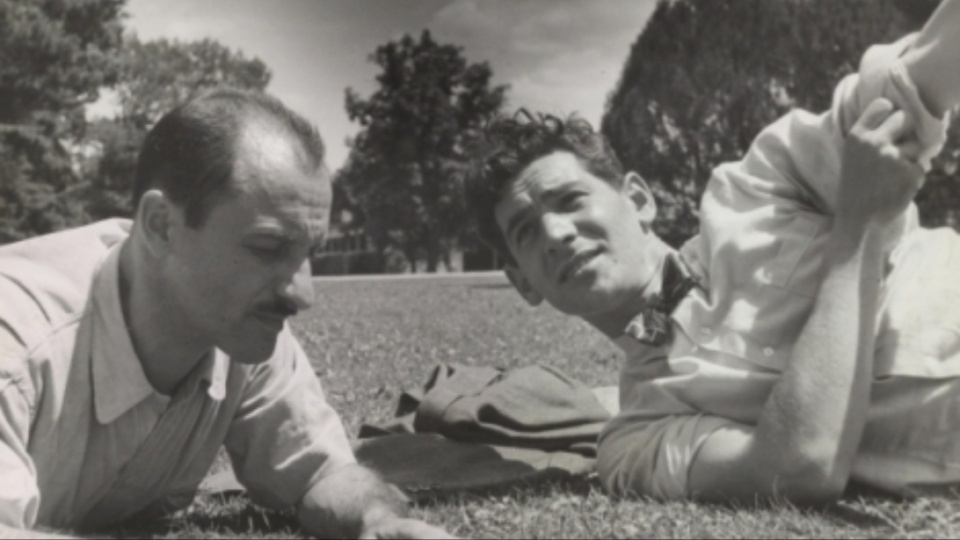
You may recall that I wrote a review of the biopic Maestro, about Leonard Bernstein, that focused on his relationship with his wife, Felicia Montealegre. As his fiancée, Felicia knew all about his homosexuality, and one of the agreements they made was that he keep it on the downlow for the sake of the marriage. There’s a scene where his oldest child confronts him about the rumors she’s heard, and he flatly denies them as so much gossip and lies. I almost bolted out of my seat at that because in my one interview with Bernstein about his close friend and fellow composer Marc Blitzstein, I realized, even at the time, that he was lying to me.
Really? About what?

For one thing, what political influence Blitzstein had on Lenny; for another, the romantic partner Marc had in the immediate postwar years whom Lenny also knew but denied knowing; and about how much, or how little, Lenny did for Marc’s memory after his sudden death in 1964. I remember coming away from that interview—the one chance I’d have to discuss Blitzstein with him—feeling that apart from a couple of anecdotes, I got almost no information or insight from him. In fact, he used up some of our allotted time on irrelevant things, like having his housekeeper prepare a chicken salad sandwich for me that would just eat up precious minutes.
Do you think Lenny and Marc themselves were lovers at any point?
Honestly, I was too discreet to go there, but there were many other people I interviewed who believed it was the case. Maybe over time, if I’d gotten to know him better, Lenny might have opened up about that, perhaps off the record. I didn’t press the issue, and anyway, that wasn’t so critical for me to know.
So, you nearly bolted out of your seat in the theater…and then what?
Well, the film came out shortly before Christmas 2023, and I took to my desktop and banged out a scene depicting that interview, bringing out how reticent Bernstein was to discuss or reveal anything of substance to me. It wasn’t an exact transcript, of course, but as much a fantasy as a report. I introduced Julia, the housekeeper, as a third character, and the chicken salad sandwich is part of the story. A few days later, with my girlfriend Lori, we read it to a small book group of hers, and they loved it, suggesting maybe it could use a second act.
A follow-up interview?
Yes, but not with Lenny. At the time I met him, I was about 80% through the manuscript. And then, when I was about 95% done, the postwar lover I’d been looking for from the start suddenly, almost miraculously surfaced. A fellow named Bill Hewitt, who was alive and pretty well out on Long Island, not far from New York City, where I was living. So, we met, and he and his wife are characters, with me, in the second act.
Did he remember Lenny?
Oh, yes, quite vividly. That whole New York gang of composers, musicians, writers, actors, directors, all hung out together in those years, and Bill was very much present, as Marc’s partner. He felt it was simply impossible that Lenny would not have remembered him—in fact, he told me he’d had sex with Lenny himself, and also, during a hiatus in the courtship with Felicia, with her too!
Aha! The real nitty gritty!

Really! But what struck me was that Lenny’s and Bill’s recall of events was so different, so divergent. And maybe Bill got carried away a little with his memories of Marc. After all, that period was the most exciting time of his life, and perhaps he’d be prone to a little exaggeration. And that got me thinking that the play I was writing was not at all a documentary but a commentary on truth, on point of view, on what we choose to remember, what we choose to conceal, perhaps what we choose to invent. Is Bernstein a reliable source? Is Bill? And is the playwright?
The playwright? You mean yourself?
Definitely. There’s a lot of factual material in the play, but also dialogue that’s totally out of my imagination. Ultimately, the play is about the biographer as protagonist, not about his subject, Marc, nor about the other characters. It’s partly the reason that in the play I name the biographer Edward Winnow, and it’s Bernstein who observes that it’s Edward’s job to “winnow” out fact from fiction. And actually, I introduce some personal material into the play, which takes place in New York in the late 1980s at the height of the AIDS crisis, so that figures into the characters’ lives too.
Right, we can’t forget those times. So, what’s happening with the play?
I had a big birthday party almost a year ago—a “millstone” number—and used it as a benefit for People’s World. I raised over $5,000! And as a gift for my guests, we had a reading of the play, Call It Day. I played both Lenny and Bill, casting that I insist on as a requirement for any production, because I want the same actor in both roles, partly as a tour de force for the actor playing such different characters, but more importantly, to show how factuality, truth, point of view, can be so wispy, so unreliable, so subjective. My young friend here, Erik Gersovitz, who’s a trained actor, played the Edward Winnow part. I remember introducing the play to my audience of 50 or so, saying they might be witness to the very last iteration of a work never to be heard from again—or it might one day reach Broadway!
So…which is it?
Somewhere in-between. I sent the play to a few people for comment, one of them David Hunt Stafford, the director of Theatre 40, a small company here whose work I appreciate very much, and which I often reviewed in People’s World. He was vaguely aware of Blitzstein as a composer and lyricist for The Cradle Will Rock and for his off-Broadway translation/adaptation of The Threepenny Opera. And he’s accepted it into their reading series.
Congratulations! Next stop, Broadway!
Thanks. I’m afraid that’s still a pipe dream. But still, I’m very excited that a wider audience, not just of my friends, will have a chance to weigh in on it. I don’t know yet which actors David has invited into this reading, some I might recognize from his Theatre 40 stable, but the date is Tuesday, Nov. 18, at 7:00 pm. After the reading, there’ll be a brief Q&A.
They ask a donation of $10, with all proceeds going to Beverly Hills Unified School District. The reading takes place at Theatre 40’s main venue, The Mary Levin Cutler Theatre (1st Floor), 241 S. Moreno Drive, Beverly Hills, CA 90212. The theatre is on the campus of Beverly Hills High School, with ample free parking in the structure next to the theatre. They don’t take reservations for these readings.
I’ll be doing some promotional work for the reading, so if anyone’s thinking of attending, get there early, because it’s a small theatre. It’s my dream that if the audience likes it, maybe they’ll advance to a full production. But I guess I’m getting ahead of myself. See you on Nov. 18th!
Thanks, Eric. I’m so pleased that Call It Day has stirred up this level of interest. Good luck with it. But you know, as we’ve been talking, it occurred to me that in the world of politics, especially, some of these same phenomena are in full evidence—distortion, lies, feints, distraction, puffery, misrepresentation, posturing, avoidance, censoring, erasure. What you’re addressing, I think, goes far beyond the particular story you’re telling.
Of course. Thanks for making that point. I hope the audience picks up on that too!
We hope you appreciated this article. At People’s World, we believe news and information should be free and accessible to all, but we need your help. Our journalism is free of corporate influence and paywalls because we are totally reader-supported. Only you, our readers and supporters, make this possible. If you enjoy reading People’s World and the stories we bring you, please support our work by donating or becoming a monthly sustainer today.
CONTRIBUTOR