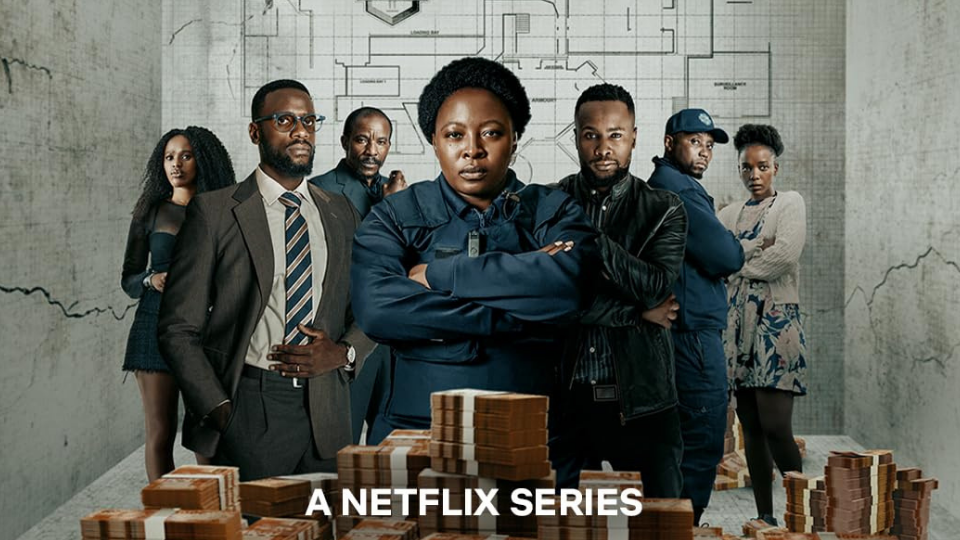
The Netflix series Marked begins with a bang, an armored car robbery from the point of view of the female driver, Babalwa, who eludes the robbers amidst a hail of gunfire. The series, after its Netflix-mandated 15-minute opening to grab the audience, is all uphill from there until the last few minutes when it manages to betray its genre, its lead character, and all of its mostly progressive political leanings.
The series has an acute sense of the rich and poor in Johannesburg. Babalwa’s daughter will die of cancer because her mother and her ineffectual church-deacon father cannot afford the 1.2 million required for the operation, with hospital fees being piled on and including 100,000 for the anesthesiologist. The besieged mother goes to the local gangster Baba G for help, and looking out over the ruins, he laments that in the ghetto of Soweto they eat cabbage while in the affluent sections of the city “they eat caviar.”
Babalwa (Lereto Mvelase, who voiced the character in both Zulu and English versions) and her husband are devout Christians, but when they go to their pastor to ask for money and a fundraising campaign, he refuses, telling them to “just have faith.” She then goes to her boss at a company appropriately named Iron Heart and asks him to loan her the money, shouting angrily at him and gesturing around his lavish office that “Every day I put my life on the line for you so you can live like this.” She is surrounded by money-grubbing upper-level employees at the company, one of whom, Rachel, when she realizes that Babalwa may be planning a heist, immediately blackmails her for a percentage. 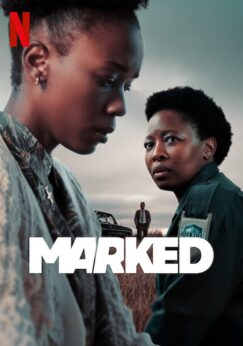
The female driver proves her resourcefulness and ingenuity in a number of areas, teaming up with the bastard son of the original gangster after he is killed, recruiting church congregants as her gang, including an indebted shopaholic with a penchant for new clothes, and ingeniously not allowing her armored car partner to take the blame for the robbery. Finally, she decides that she will leave her do-nothing husband for her more understanding partner, telling the pious husband, “I’ve been righteous all my life, and what has it gotten me?”
There has been a shift in the heist film of late such that, in earlier instances the thieves all die tragically or land in jail (The Asphalt Jungle, Rififi, The Lavendar Hill Mob) but in more contemporary moments, two of which feature equally down-on-their luck African-American female thieves (Set It Off and Steve McQueen’s Widows), as well as the popular Netflix series Money Heist, one or several of the thieves gets away with the loot. As times are harder and harsher and inequality worsens, these iterations of the genre suggest the audience is more interested in cheering on those who would rob from the rich than in going along with the old adage “Crime does not pay.”
Unfortunately, in the end, Marked sells out both its resolute African female lead and its audience. By the merest sleight of hand, a moment of whimsey where one character has a complete makeover that is completely out of character, an intervention that is less divine that deux ex machina, the series in its final moments reverses its polarity and presents an act of faith that makes its heroine appear to be not independent and able to risk anything to save her child but rather bereft of and, as a conservative Biblical reading reveals her to be, “Yee of little faith.” The ending instead brands her as having crossed a mercenary line, going too far even if her goal was to save the life of her daughter, threatened as much by a high-priced medical system as by the cancer which is destroying her body.
There are some potential commercial explanations both for the overtly political thrust of most of the series as well as the conservative ending. Netflix is no longer—if it ever was—in the business of, as its former CEO says, speaking “truth to power,” boasting series after series whose content instead is “pure entertainment.” For every Marked, there are five Wednesday-like programs—the streaming service’s Adam’s Family teen exploitation series.
However, Africa has the fewest Netflix subscribers of any continent and on that continent the streamer has a serious rival in Showmax, which, though partly owned by right-wing Comcast’s NBC Universal, still features local content that is of necessity grounded in its place, perhaps forcing Netflix in a big-budget series such as Marked designed to bring in new subscribers to, as they say, “keep it real.”
On the other hand, the ending, in what is otherwise a stellar teleplay in part by the Zimbabwean writer Sydney Dire, the South African actress Wendy Gumede and Charleen Ntsane, which moves the genre forward, may be either a capitulation to the streaming service nervousness about offending religious viewers or a capitulation by the creators and the streaming service to local censorship.
Fortunately, the final fifth of the last episode does not cancel out what is otherwise an extraordinary seven and four-fifths of an action series. The heroine of Marked takes her place alongside other heist heroines, substituting for their more profit-oriented motive—though the result of their own downtrodden social circumstances—the care and compassion of the protagonists of the maternal melodrama from Stella Dallas to All About My Mother, who always placed their child first.
We hope you appreciated this article. At People’s World, we believe news and information should be free and accessible to all, but we need your help. Our journalism is free of corporate influence and paywalls because we are totally reader-supported. Only you, our readers and supporters, make this possible. If you enjoy reading People’s World and the stories we bring you, please support our work by donating or becoming a monthly sustainer today. Thank you!
CONTRIBUTOR