

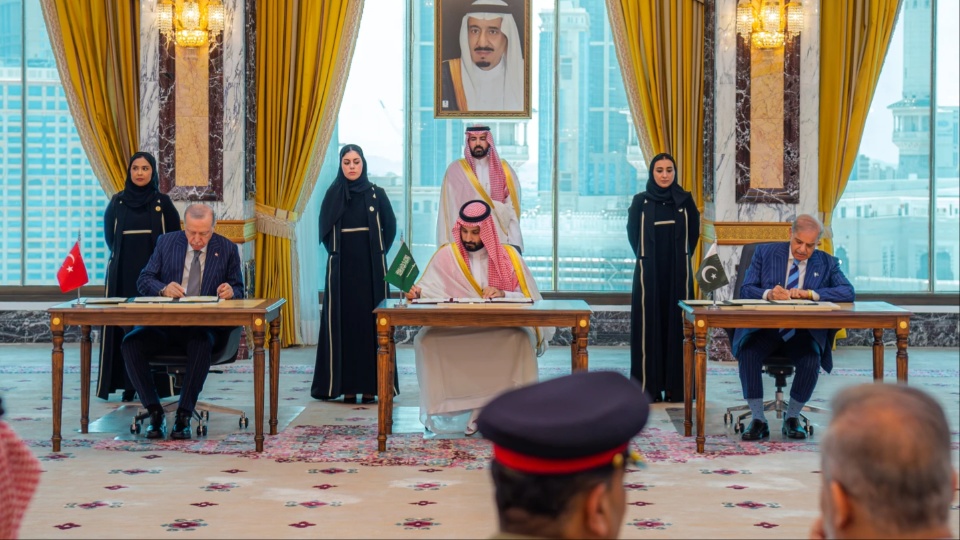
On Aug. 7, Saudi Arabia, Turkey, and Pakistan established a military alliance that many experts are saying could reshape power across West and South Asia. Signed in Mecca by Saudi Crown Prince Mohammed bin Salman, Turkish President Recep Tayyip Erdoğan, and Pakistani Prime Minister Shehbaz Sharif, the agreement declares that an armed attack against any one of the three countries will be considered an attack against them all.
Some in the corporate media were quick to reach for familiar labels. The pact was described as an “Islamic NATO,” and more specifically as a “Sunni NATO” constructed to confront Iran. At face value, the comparison makes sense. All three founders are Muslim-majority states, Pakistan possesses nuclear weapons, Turkey has NATO’s second-largest military, and Saudi Arabia supplies enormous financial resources.
But a deeper look at the Mecca Alliance’s structure shows that the comparison is less appropriate than it initially appears.
The alliance has no NATO-style integrated command or standing force. Its members have different relationships with Iran, Israel, China, and the United States. Iran may be one object of its deterrence, but the Islamic Republic’s government has also discussed regional collective security with its founders and could conceivably participate in a wider framework. And an alliance partly driven by fear of Israel’s expanding wars cannot be understood simply as an anti-Iran front.
The Mecca Defense Alliance is more accurately understood as an effort by three regional powers to gain room for maneuver, as confidence in the U.S.-dominated security system collapses. While it contains a real element of regional autonomy, it should not be seen as “the Global South” asserting itself against U.S. hegemony. The autonomy it creates is for monarchs, military establishments, and capitalist arms industries, all of whom have close ties with U.S. imperialism. It is not a victory for anti-imperialism or popular sovereignty.
Less than a month after the signing, the three countries’ foreign ministers, defense ministers, and senior military commanders met in Istanbul to begin turning the declaration into an institution. On Aug. 31, they formally adopted the name Mecca Defense Alliance and agreed to establish a permanent secretariat in Saudi Arabia, initially led by a Pakistani secretary-general for a three-year term. They also promised joint military activities, closer coordination among their armed forces, and expanded cooperation in weapons production and military technology.
The complete treaty, however, has not been made public. No integrated military command, standing multinational force, common budget, or automatic procedure for entering a war has been announced. There is still no public definition of what kind of attack would activate the agreement or what each member would then be required to do. Pakistan’s possession of nuclear weapons gives the alliance an added aura of deterrence, but there is no evidence that its government has extended a nuclear guarantee to either Saudi Arabia or Turkey.
The three states nevertheless possess military and economic resources that could become highly complementary. Saudi Arabia supplies money, political influence, and a strategic position linking the Persian Gulf, Red Sea, and wider Arab world. Its oil installations, ports, desalination plants, and ambitious development projects have also become increasingly vulnerable to missiles, drones, and a widening regional war. The gulf monarchy wants additional protection without depending exclusively on the United States, which many believe failed to shield its allies in the region from the consequences of the U.S.-Israel war against Iran.
Turkey contributes one of the region’s largest armed forces, experience acquired through NATO, and a rapidly expanding defense industry producing drones, missiles, warships, and electronic warfare systems. The country gains Saudi investment and access to much larger markets while Erdoğan can present Turkey as the center of a more autonomous Muslim security system, in keeping with his neo-Ottoman Empire rhetoric.
Pakistan brings a large and experienced military establishment, decades of defense cooperation with Saudi Arabia, and the Muslim world’s only nuclear arsenal. In return, it gains investment, energy cooperation, arms contracts, and recognition as a provider of security rather than simply an economically dependent state.
This material division of labor matters more than the language of Islamic brotherhood, even as their foreign-policy goals diverge over Iran and Israel.
The pact emerged during the U.S.-Israeli war against Iran and after Iranian missiles and the actions of Iran-aligned forces exposed the vulnerability of Gulf infrastructure. Saudi Arabia unquestionably wants stronger deterrence against Iran, Iraqi armed organizations aligned with Tehran, and Yemen’s Houthis.
But describing Mecca simply as a “Sunni NATO against Iran” obscures the other half of the picture. Israel’s wars and attacks across Gaza, Lebanon, Syria, and Iran have shown regional governments that the U.S. either cannot or will not restrain its closest ally. The Mecca agreement gives Saudi Arabia an alternative to the argument that Arab security can only be achieved through normalization with Israel and integration into a U.S.-Israeli regional system.
This doesn’t mean that the alliance is an anti-Israel resistance front. None of the three governments has demonstrated a willingness to go to war to liberate Palestine. Turkey remains a NATO member, and Saudi Arabia continues to maintain extensive ties to the U.S. military-industrial complex. The gap between condemning Israeli aggression and materially confronting it remains enormous.
Iran’s ultimate relationship with the alliance is still unresolved. Reports that it had been formally invited to join were denied by Iran’s Foreign Ministry, but officials did confirm proposals had been made for discussions with the three members on regional collective security.
Turkish Foreign Minister Hakan Fidan has since said that the alliance was designed to expand and is open to regional states that respect sovereignty, territorial integrity, and non-interference. Iran says it has no reason to regard the pact as directed against it and has welcomed the idea of security organized by regional states rather than foreign powers.
Fidan explicitly described the Mecca Alliance as complementary to Turkey’s existing alliances, including NATO, rather than a replacement for them. Saudi Arabia remains structurally dependent on U.S. weapons, maintenance, and intelligence. Pakistan, meanwhile, balances its close relationship with China against continuing ties to Washington. President Donald Trump publicly welcomed the pact and celebrated regional states taking greater responsibility for their own defense.
The U.S. may therefore lose some control over regional decision-making while still benefiting from its partners assuming more of the cost of defending the same energy routes, governments, and capitalist property relations protected by U.S. power for decades. The alliance is not subordinate to Washington nor is it a break with imperialism. It expresses the independent ambitions of the regional ruling classes operating inside a world system still heavily dominated by U.S. military and financial power.
The new alliance’s immediate beneficiaries are likely to be arms manufacturers, military officer corps, energy and shipping interests, and governments seeking greater domestic legitimacy and international bargaining power. Its costs are likely to include higher military expenditure, additional foreign deployments, and still greater military influence over civilian policy.
The Communist Party of Turkey warned that military alliances bring war rather than security and that Erdoğan will market new commitments through nationalism, neo-Ottoman imagery, sectarianism, and appeals to national defense. Following the Istanbul meeting, the TKP-associated newspaper soL argued that Fidan’s description of Mecca as complementary to NATO exposed its underlying alignment against Iran and Russia.
That warning about militarization is justified, although the alliance should not be reduced to instructions issued from Washington. Saudi, Turkish, and Pakistani capital possess their own interests and regional ambitions. Greater independence from the United States is desirable, but independence exercised by monarchs, generals, and defense conglomerates does not automatically mean progress.
The Mecca Defense Alliance shows that the old U.S.-directed order is weakening. While that creates possibilities for progress, it also creates opportunities for the region’s ruling classes to buttress their own power. A region less subordinate to Washington would be a welcome development, but a region divided among new military blocs, monarchies, arms manufacturers, and competing regional powers would not.
We hope you appreciated this article. At People’s World, we believe news and information should be free and accessible to all, but we need your help. Our journalism is free of corporate influence and paywalls because we are totally reader-supported. Only you, our readers and supporters, make this possible. If you enjoy reading People’s World and the stories we bring you, please support our work by donating or becoming a monthly sustainer today. Thank you!
CONTRIBUTOR


MOST POPULAR TODAY

Warnings sound: Trump ready to stage what amounts to a full-fledged coup

Grenada marks 40 years since the assassination of revolutionary leader Maurice Bishop

Workers walk: Almost 100K California employees struck for a day


Redistricting leader Louise Lucas indicted as Trump’s revenge campaign widens