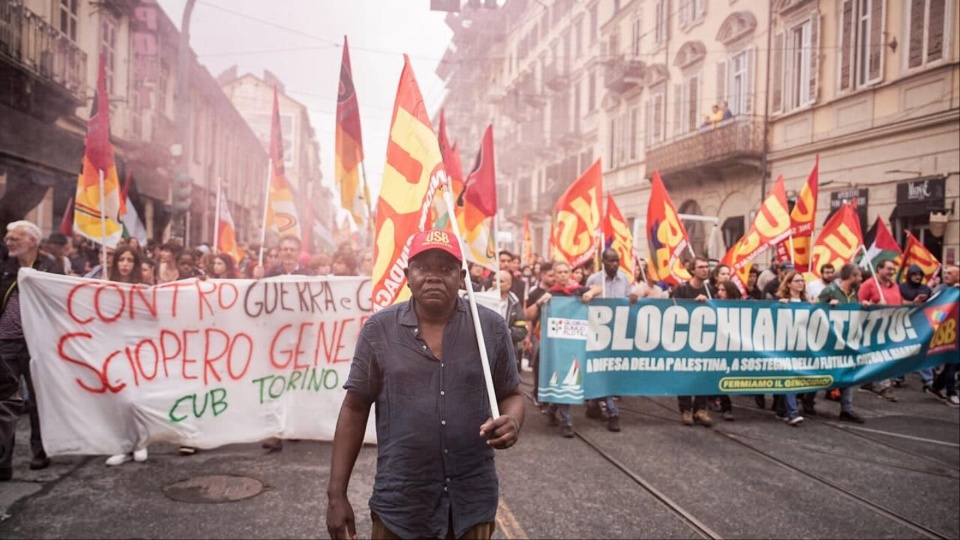
Dockworkers across Europe and the Mediterranean are preparing for a coordinated strike action on Oct. 30, marking the second International Day of Action of Dockworkers, initiated by the World Federation of Trade Unions (WFTU).
Organized under the framework “Ports for Peace–Jobs with Dignity,” the action ties opposition to imperialist war to the everyday demands of not only port workers but those in every industry. These include contracts with real wage gains, job security, shorter hours, and enforceable health and safety standards.
The October action builds on a prior one from February, where dockworkers undertook strike activity in 20 ports across seven different countries. Additionally, this past May, unions representing 35 ports met in Istanbul and formed a coordination network which now spans more than 40 ports across the Mediterranean and Europe, with trade unions from France, Greece, the Basque Country, Turkey, Morocco, and Italy taking part.
The WFTU framed the call as a necessary response to a moment when dangerous conflicts are multiplying and beginning to converge with one another, with the main flashpoints being in Ukraine and the Middle East. The federation also pointed to Israel’s ongoing assault on Gaza and the West Bank, carried out with U.S. backing and the political cover of the E.U. and NATO, alongside its escalating attacks on Iran and Lebanon.
Strip away the war propaganda, the WFTU argued, and what’s left is capitalism’s drive to control new territory and resources, including trade corridors, energy supplies, and strategic infrastructure.
“Imperialist wars are not a departure from the ‘normal’ functioning of the capitalist system,” the WFTU said. “They are the continuation of exploitation and competition by other means.”
Working people everywhere inevitably pay the price for these wars. Untold billions go to weapons manufacturers and the war economy while austerity measures are carried out, the federation said, including squeezing wages, social spending cuts, and healthcare and education being privatized. They also pointed to increased working hours being implemented in several countries—13-hour days, seven-day workweeks—as exploitation deepens.
On the one hand, ports, railways, airports, and transport hubs are key links in moving both weapons and troops. There, workers are pressured to be “cogs in the war machine,” the federation said.
On the other hand, transportation workers sit at a key chokepoint in the global supply chain, which means a coordinated work stoppage can halt military cargo in ways other forms of protest can’t.
The WFTU said the docks aren’t the only leverage point, however. Shipyard crews, metalworkers, rail workers, and those in energy, telecommunications, and logistics move goods through the same supply chains that link the ports to military bases, also giving them an important role.
The federation also plans to target the nature of dockwork itself. Along with opposing privatizations and the spread of subcontracted and temporary labor, the workers in the ports also face the implementation of new technology, including automation and AI, which are being used to cut jobs to increase corporate profits.
The WFTU argued that technological progress should mean shorter hours and better lives, not bigger profit margins for a handful of conglomerates. New technology, they said, can be used to reduce the physical toll of dock work and shorten the work week.
As noted in a recent UNITE HERE report on new technology in the workplace, the key to positive change is workers’ ability to win the power to shape its usage and direct it towards their collective interests.
The Ports for Peace action on Oct. 30 is just one part of a bigger movement by the working class against the growing threats of war and its costs being pushed onto ordinary working people. Other actions are being planned around the world, including in the U.S., to promote peace and cooperation instead of war and destruction.
“The peoples have nothing to gain from wars and the antagonisms of the imperialists,” the federation said. “They are called upon to pay for profits, wars and the consequences of a new capitalist economic crisis, to sacrifice themselves for interests that are alien to their own.
“From port to port, in every workplace and sector, from country to country, workers are sending the message that they will not choose between the camps of their exploiters, will not become cogs in their war machine, and will not sacrifice their lives and rights for the profits of the monopolies.”
No paywalls at People’s World
We hope you appreciated this article. At People’s World, we believe news and information should be free and accessible to all, but we need your help. Our journalism is free of corporate influence and paywalls because we are totally reader-supported. Only you, our readers and supporters, make this possible. If you enjoy reading People’s World and the stories we bring you, please support our work by donating or becoming a monthly sustainer today. Thank you!
CONTRIBUTOR