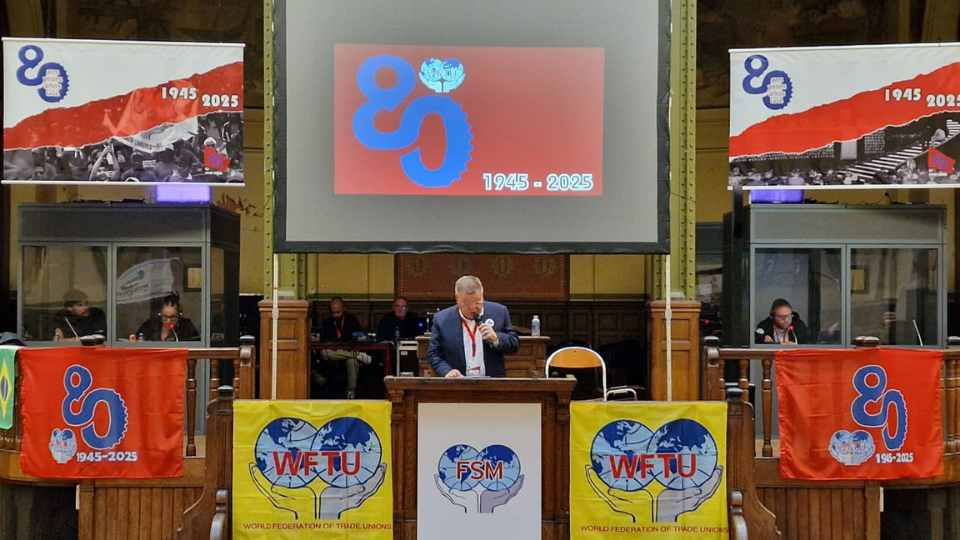
PARIS—Fueled by a massive strike that gripped this city, trade unionists from over 100 countries gathered this past weekend to celebrate the 80th anniversary of the World Federation of Trade Unions (WFTU). The workers who gathered here reaffirmed their commitment to a class-struggle unionism that stands in stark opposition to war, imperialism, fascism, and the exploitation of human beings and the planet.
For the hundreds of delegates—from Chile to China, spanning countries in Africa, North America, Europe, and in between—the event was both a tribute to a heroic past and a rallying cry for the fights ahead.
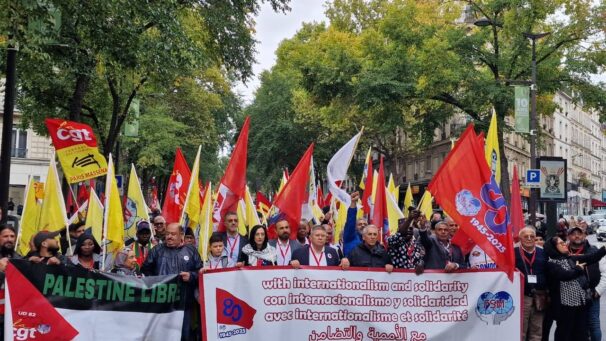
The festivities opened with a vibrant march through the streets of Paris, a sea of red and yellow WFTU flags, colored smoke, banners from trade unions across the globe, and clenched fists representing the international working class in motion. The energy on the ground was more than pride in celebrating the militant history of the longest living international trade union federation. It was clearly fueled by the need for a militant workers’ organization to meet today’s threats to democracy and working-class welfare around the world.
The WFTU is committed to being that organization for the international working class, including solidarity strikes in Italy with the Gaza Sumud Flotilla that also happened on Friday, as well as the week prior, and a previous general strike in France last month.
WFTU President Mzwandile Makwayiba (South Africa) opened the evening program with reminders of the labor federation’s history and its commitment to anti-imperialism as a central mission for working-class liberation. Honorary President George Mavrikos (Greece) followed by emphasizing the fundamental rights won throughout history, guaranteeing the right to organize and collectively bargain.
General Secretary Pambis Kyritsis (Cyprus), in his keynote address, grounded the WFTU’s birth in the tumultuous anti-fascist struggle of the 20th century, a history detailed in People’s World’s previous coverage. The federation was founded in October 1945 from the ashes of World War II—a direct product of the working class’s central role in defeating the fascist horror.
“The founding of WFTU did not occur out of the blue,” Kyritsis stated. “On the contrary, the preceding decades were one of the most turbulent periods in human history, marked by significant economic and social processes and world-historical events.”
“Undoubtedly, the most important of these was the Great October Revolution of 1917, which changed the course of history and brought the working class to the forefront of history,” he said.
“And of course, the fresh air of the great anti-fascist victory brought with it hope and the demand for a new world of peace, democracy, and social justice.”
He quoted the WFTU’s first General Secretary, Louis Saillant, who called the federation “a child of unity for unified struggles of the workers against fascism, against exploitation by the monopolies, for the liberation of all the colonies and for better living conditions for the working class.”
This unified, class-oriented movement immediately drew the ire of capitalist powers. Kyritsis detailed how, when attempts to manipulate the WFTU failed, capitalist-imperialist centers, led by the U.S., with complicit labor “leaders,” engineered a split.
“In 1949, with the active role of the CIA… with the willing participation of European Social Democracy… they proceeded to split WFTU,” Kyritsis said, leading to the creation of the International Confederation of “Free” Trade Unions. “Of course, they were only free from their commitment to the working class and its struggles, but there is no doubt that they were completely dependent on the multinational monopolies and imperialist centers of the time.”
This historical schism, exacerbated by McCarthyite purges in the U.S. that expelled militant unions from the CIO and pushed militant rank-and-file members further from the decisions of their complicit leaders, defined the Cold War landscape for labor. Yet, the WFTU endured, supporting liberation struggles from Vietnam to South Africa and helping to cement foundational International Labor Organization conventions on workers’ rights.
The collapse and overthrow of the Soviet Union in the 1990s presented a grave new challenge for the international workers’ movement. “The attack by reactionary forces was harsh, all-out, and multi-leveled,” Kyritsis acknowledged. But, he emphasized, the federation was rebuilt from its 2005 Congress in Havana, emerging with “clear positions and uncompromising insistence on its anti-imperialist, anti-capitalist, and anti-fascist character.”
Today, the WFTU represents 110 million workers in 134 countries. A People’s World correspondent was in attendance and reported that the assembled delegates were impassioned and clear-sighted about the role of the labor movement in the struggles against fascism and imperialism, for workers’ rights, and towards a worker-led society.
“The speeches ranged from the WFTU must be a global force for collective bargaining rights to the WFTU must make the fight against capitalist exploitation and imperialism central to its mission,” the delegate observed. “Of course, these are not mutually exclusive.”
But one issue stood out at the celebration that provided a unifying focus for all those in attendance: Palestine.
“The hypocrisy, cynicism, and inhuman behavior of imperialism are being revealed before the eyes of humanity,” Kyritsis thundered to applause. “The massacre and genocide of the Palestinians in Gaza continue unabated… There is a deliberate and organized plan to displace and exterminate the Palestinians from their land.”
He drew a sharp contrast with the other labor federation, the International Trade Union Confederation (ITUC), which he accused of maintaining a cowardly silence. “WFTU has every right to be proud because it has stood by the Palestinian people from the very beginning… But not everyone in the International Trade Union Movement has the right to feel proud.”
The General Secretary concluded by linking the past to the present, invoking the spirits of martyred trade unionists who, he said, marched with them in Paris. “80 years is only the beginning,” he declared. “WFTU is a child of necessity… Because alone, we are weak and vulnerable. But together, we are a powerful force.”
“Solidarity and internationalism are our weapons,” Kyritsis concluded. “Political, social, and trade union struggles are our choice… with the unshakeable conviction that the future of humanity cannot be capitalist barbarism and that another world is possible.”
For the international union delegates leaving Paris, the message of the anti-fascist, anti-imperialist struggle that gave birth to the WFTU eight decades ago continues today, and the class-struggle-oriented labor federation is ready for the fight.
Click here to watch the WFTU 80th Anniversary Documentary Film
We hope you appreciated this article. At People’s World, we believe news and information should be free and accessible to all, but we need your help. Our journalism is free of corporate influence and paywalls because we are totally reader-supported. Only you, our readers and supporters, make this possible. If you enjoy reading People’s World and the stories we bring you, please support our work by donating or becoming a monthly sustainer today. Thank you!
CONTRIBUTOR