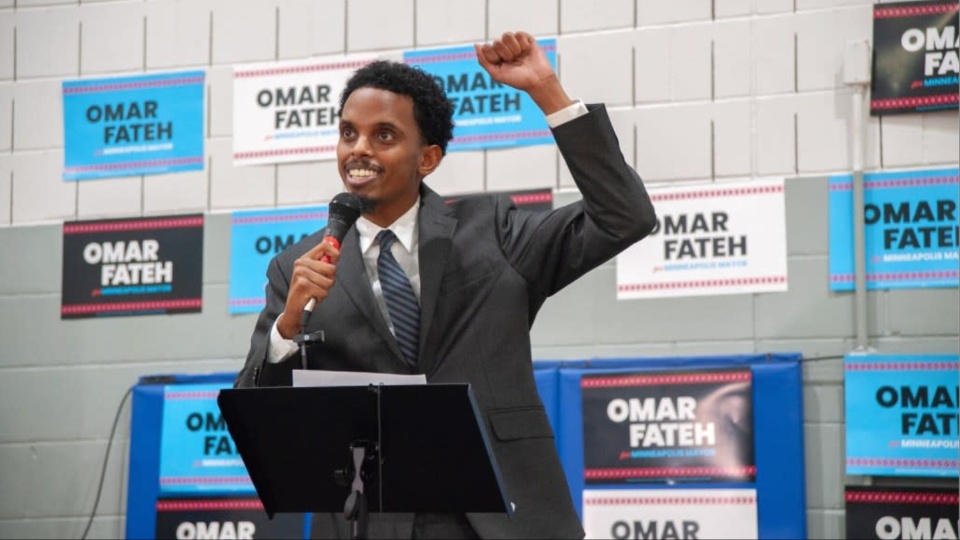
MINNEAPOLIS—After more than 12 grueling hours inside the Target Center, the Minneapolis Democratic-Farmer-Labor (DFL) Party made history on Saturday, July 19, endorsing State Sen. Omar Fateh for mayor—the first such endorsement in a Minneapolis mayoral race since 2009. He beat out two-term incumbent Mayor Jacob Frey in the endorsement contest at the DFL convention.
The mainstream media has taken to calling Fateh the “Minnesota Mamdani,” drawing parallels between his campaign and that of Zohran Mamdani, who recently beat former New York Gov. Andrew Cuomo in the Democratic mayoral primary in New York City. The two millennial-generation Democratic Socialists are changing the image of progressive politics, both having edged out establishment figures with long political careers.
Fateh was the first Somali American and Muslim elected to the state senate in 2020. During his two terms, he has chaired the Higher Education Committee and made a name for himself as the lead sponsor of a plan to make college free for families who make less than $80,000 a year.
As was the case in New York, affordability is the central theme of Fateh’s platform. A renter himself, he says that his job as a state senator and possible future mayor is to serve the needs of working people.
“We’ll shovel sidewalks, build shelters, and finally re-open public spaces,” he pledged on X recently. “I’m here to fight for the people this city’s left behind.”
But scoring the endorsement at the DFL Party convention was a fight in itself, and it wasn’t a victory easily won. It came despite—and in direct defiance of—a desperate, anti-democratic effort by Frey and his supporters to derail the endorsement process.
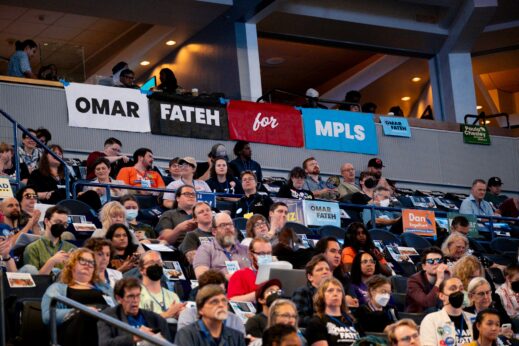
In scenes that felt more like a Trump rally than a Democratic convention, Frey’s camp accused convention organizers Saturday of rigging the vote, challenged the integrity of the ballot system, harassed delegates, and attempted to break quorum by staging a coordinated walkout.
Text messages sent from Frey’s campaign during the convention told delegates and alternates to leave, claiming the process was “over and not representative.” But it wasn’t over, and it was representative—just not of Frey’s base.
One of the day’s first events was a Q&A session for the mayoral candidates, where the sharp contrast between the campaigns became immediately clear. Frey was loudly booed after dodging a question about Mark Hanneman, the officer who killed Amir Locke and was recently promoted to head the department’s use-of-force training. He also drew backlash when he claimed to support a labor relations board despite having vetoed one as mayor.
Frey has lost the support of many progressives and labor activists in the city, especially thanks to his record-setting string of vetoes in the past year. He’s killed several measures passed by city council, including a minimum wage for rideshare drivers, a charter for the aforementioned labor relations board, a Gaza ceasefire resolution, and a statement protecting student protesters from retaliation.
Delegate harassment was a theme throughout the day. Trans delegates were harassed while using the restroom, to the point where DFL leadership had to notify the convention that “this kind of bigotry and hate is not allowed here.”
The Target Center itself added to the sense of exclusion many delegates felt. The venue charged $1,100 for organizations and campaigns just to rent a table, banned outside food, had overpriced concessions, and enforced zealous security processes—due to the assassination of Melissa Hortman—which resulted in a delayed start to the convention.
Later, leadership addressed the convention again, clarifying that delegates must be allowed to freely move in and out of the Target Center, an announcement prompted by a member of Frey’s campaign staff harassing delegates trying to leave before the first round of mayoral voting by blocking the exit and asking for their voting code, a secret code used to access delegates’ ballots.
Eventually, though, roughly 600 delegates cast votes in the first round. Fateh emerged as the frontrunner with 43.85%, followed by Frey at 31.54%. Other candidates, including Rev. Dewayne Davis, Jazz Hampton, and Brenda Short, were eliminated under DFL rules requiring 20% to advance to the second ballot. None of the eliminated candidates endorsed either of the two remaining contenders, but chants of “Endorse! Endorse!” broke out as pressure mounted.
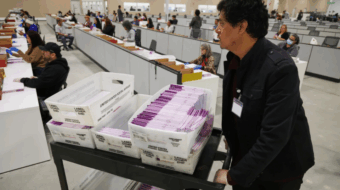
Concerns about the electronic voting system surfaced when delegates didn’t receive email confirmations that their ballots had been cast and counted. One delegate questioned the results from the mic, asking, “Can we really trust the result?” and was met with loud boos. Convention officials clarified that all votes were being received and confirmed and that the tech lead had to leave due to a medical emergency, which was the cause of some of the technical issues.
The convention then made the decision to switch to paper ballots for the second round of mayoral candidate voting and park board voting. That’s when Frey’s campaign really made its move.
Facing likely defeat, Frey’s team tried to deny quorum by urging their delegates to leave the convention before the 10 p.m. voting cutoff—but they didn’t have the numbers. Due to time constraints, the convention switched processes, following a motion by Minneapolis Councilmember Aisha Chungtai, from a paper vote to a vote by credentials. Delegates were asked to vote by raising their credentials badge.
Fateh won the endorsement, securing the support of well over 60% of the delegates who remained in the hall. Immediately after his win was certified, Fateh posted a statement online declaring that he was “incredibly honored to be the DFL-endorsed candidate for Minneapolis Mayor.” He said the delegates’ decision was “a message that Minneapolis residents are done with broken promises, vetoes, and politics as usual. It’s a mandate to build a city that works for all of us.”
Frey’s campaign released a sharply different message: “This election should be decided by the entire city rather than the small group of people who became delegates, particularly in light of the extremely flawed and irregular conduct of this convention. Voters will now have a clear choice between the records and leadership of Sen. Fateh and Mayor Frey. We look forward to taking our vision to the voters in November.”
On the following Monday, Frey’s campaign filed a challenge to the results with the Minnesota DFL Party.
Labor issues and activists were central to the entire day in both the mayoral and park board contests. Energy sparked by last summer’s park worker strike and subsequent union-busting fueled labor-backed candidates Michael Wilson, Tom Olsen, and Amber Frederick to win the at-large park board endorsement.
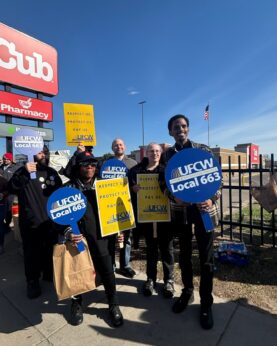
Many of the same labor-aligned delegates who supported Fateh also pushed forward two resolutions late in the night. The first called on the City of Minneapolis and the Park Board to divest from any companies complicit in the genocide in Gaza. The second supported an ordinance to ban the use of lasers over the Mississippi River to protect bird sanctuaries.
Saturday’s event wasn’t just a typical party convention; it was a fight over who will control the future of Minneapolis and the DFL. Frey’s campaign deployed procedural tricks, fear tactics, and Trump-style rhetoric. But a multiracial, working-class coalition—a representation of the future of Minneapolis and the change from a majority white population—held the floor and stood behind Fateh.
Fateh’s win wasn’t just a rejection of Frey—it represented a changing Minneapolis. His base consisted of renters, Somali and Latino immigrants, students, and multiracial working-class voters from every ward in the city. Frey’s support came largely from older, white homeowners. The split in the room was undeniable.
As one exhausted but energized delegate put it while leaving the arena: “They tried to break us. They lost.”
It won’t just be the Frey campaign that Fateh will have to contend with, though. The right wing nationally is joining the offensive against him, with commentators like Charlie Kirk of Turning Point USA calling his endorsement win an “Islamic takeover.” Racism and Islamophobia are being used to split voters, with extremists like Kirk branding Fateh as proof of the need to “stop all third world immigration.”
The general election will take place on Tuesday, Nov. 4, 2025. The people of Minneapolis will now decide whether they want four more years of failed leadership or something new.
We hope you appreciated this article. At People’s World, we believe news and information should be free and accessible to all, but we need your help. Our journalism is free of corporate influence and paywalls because we are totally reader-supported. Only you, our readers and supporters, make this possible. If you enjoy reading People’s World and the stories we bring you, please support our work by donating or becoming a monthly sustainer today. Thank you!
CONTRIBUTOR