The “right” to a union is a hollow promise if the bosses can simply run out the clock. This is the lesson being taught to the 11,000 unionized Starbucks workers who, years after their historic votes to organize a union, are still struggling for a first contract. This corporate stonewalling, led first by CEO Howard Schultz and then Brian Niccol, is a classic union-busting tactic. It exposes a fundamental truth that workers trying to organize their shops know all too well—the legal right to collective bargaining means very little without the power, or political will, to enforce it.
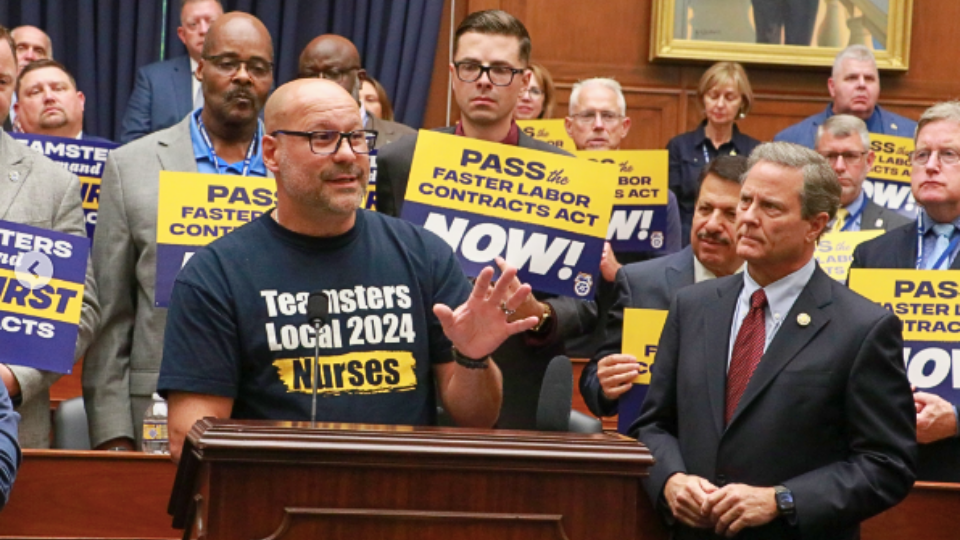
A new bipartisan bill, however, aims to shift this balance of power. The Faster Labor Contracts Act (FLCA), introduced by Representative Donald Norcross (D-NJ) and Senator Josh Hawley (R-MO), would make these delay tactics much harder for corporate management. The FLCA would amend the National Labor Relations Act to impose a strict timeline on negotiations, mirroring a key provision from the larger Protecting the Right to Organize (PRO) Act.
This delay is not unique to Starbucks. Just ask Amazon Labor Union or the countless other workers who organized a union, yet still work without a contract. On average, new unions spend 458 days fighting just to get a first contract—a staggering amount of time that drains worker resources and morale. Starbucks Workers United (SBWU) has spent over 450 days on strike, a direct response to management’s refusal to bargain in good faith. The company’s strategy is a textbook example of how the capitalist class uses procedural delays to undermine labor.
Specifically, the FLCA would force management to the table within 10 days of a successful union vote. If no agreement is reached within 90 days, negotiations would go to federal mediation. Should that fail, a three-person arbitration panel would settle the contract. This process is designed to ensure new unions secure a contract far faster than the current, protracted average.
The legislation garnered significant support from union leaders. International Brotherhood of Electrical Workers (IBEW) President Kenneth W. Cooper stated, “Workers who courageously rally their brothers and sisters to organize and join a union deserve a chance to get a speedy first contract without a fight…These bills provide an opportunity to level the playing field for working people.”
“When passed, the Faster Labor Contracts Act will put working families in this country back at the center of the American economy,” said Teamsters President Sean O’Brien.
Yet, the bill faces some criticism from within the labor movement. Some rank-and-file members worry that binding arbitration—where a government panel imposes a contract—could undermine their voices in negotiations, “which is the whole point of the union,” Joshua Arnold, a Boeing worker and Machinists (IAM) shop steward, argued in the Congressional hearings on the bill.
However, proponents of the bill argue that the FLCA’s arbitration clause is a crucial tool. Labor lawyer Tascha Shahriari-Parsa argues that the current system forces unions to battle over whether the company is bargaining in “good faith,” rather than the contract itself. In fact, he argued, arbitration would actually give workers fighting for a first contract more leverage rather than simply “undermining the voice of the rank-and-file.”
“The threat of arbitration gives workers leverage, pressures both sides to reach agreements, and tends to result in higher wages,” he wrote. He points to data from British Columbia, where a similar law results in only a tiny fraction (0.05%) of contracts being imposed by an arbitrator, because the threat alone pushes employers to settle.
Even supporters like Shahriari-Parsa acknowledge the FLCA is a step, not a solution. The broader Protect the Right to Organize (PRO) Act is still needed to address the many other weaknesses in U.S. labor law. In a letter to Congress, AFL-CIO Director of Government Affairs Jody Calemine urged support for the FLCA while emphasizing that the PRO Act is the ultimate goal to “ensure workers’ freedom to organize and collectively bargain.”
This legislative push comes at a critical juncture. Today, less than 10% of the U.S. workforce is organized—a dramatic decline from its peak of over 30% in the 1950s. Yet, as Calemine highlighted, “60 million Americans say they would join a union—if they could.”
Laws like the FLCA and the PRO Act are not just procedural tweaks; they are mechanisms that can help the efforts to organize the unorganized sections of the working class, rebuild class-based institutions and power, as well as challenge the unchecked dominance of the capitalist class by removing one of their mechanisms to break the trade unions.
We hope you appreciated this article. At People’s World, we believe news and information should be free and accessible to all, but we need your help. Our journalism is free of corporate influence and paywalls because we are totally reader-supported. Only you, our readers and supporters, make this possible. If you enjoy reading People’s World and the stories we bring you, please support our work by donating or becoming a monthly sustainer today.
CONTRIBUTOR