
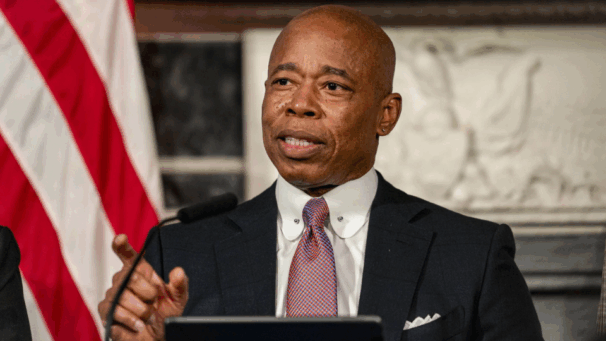
NEW YORK —It says something about the lack of clout of outgoing New York City Mayor Eric Adams that the city council spent its December 4 session overriding his vetoes by huge margins—including two vetoes of pay equity bills.
“These are common-sense bills to protect the lowest-income New Yorkers from rent increases, advance gender and racial pay equity, and improve the city’s contracting process to remove obstacles for nonprofits,” said council Speaker Adrienne Adams, D-Queens, in the council’s press release.
“They never should have been vetoed, and the council is once again prioritizing New Yorkers by enacting them into law when the mayor will not.”
One Adams veto the council overrode was a bill by Councilmember Tiffany Cabán, D-Bronx, to require private employers with more than 200 employees working in the City to submit a pay data report to a designated agency to improve pay transparency.
The other veto lawmakers overrode, from Majority Leader Amanda Farias, D-Bronx, mandates a city agency—to be selected—“conduct an annual pay equity study on private employers with 200 or more employees to evaluate the extent to which any pay disparities are based on gender, race or ethnicity.
“Eric Adams decided to use his last weeks in office to betray all women on behalf of big corporations,” said Cabán. “His veto of the Pay Equity Package is” a betrayal “of the working class, and especially of Black and brown women, who suffer the most from pay inequity. I am proud to override his bid to impress the billionaires he soon needs a job from.”
That’s a thinly veiled reference to reports that Adams, who traded support for anti-worker and racist GOP President Donald Trump’s anti-migrant policies for a Trump regime decision to drop an indictment of the mayor on widespread federal campaign finance charges.
The deal prompted speculation that Adams, who even then faced overwhelming pre-primary rejection by the voters in this year’s mayoral election, was angling for a coming job with Trump’s government. Trump, now a Florida resident, was a longtime Big Apple resident and big giver to politicians.
“This historic pay equity package will require large employers to report pay data and mandate rigorous, public analysis,” added Cabán. “We have been talking about the gender pay gap for decades, but without knowing how it breaks down from job to job, industry to industry, corporation to corporation, we can’t know how best to tackle it.
“These bills are about accountability and equity for New Yorkers, especially the women and people of color who have been underpaid and undervalued for generations.”
Majority Leader Farías’s bill, which the council also passed over an Adams veto, would require a city agency to conduct an annual pay equity study on private employers with 200 or more employees to evaluate the extent to which any pay disparities are based on gender and race or ethnicity. No agency was named, leaving the decision up to strongly pro-worker incoming Mayor Zohran Mamdani.
Adams’s veto “was an attempt to set back the very communities that have been short-changed for generations: Women, Latinas, and BIPOC New Yorkers who continue to face disproportionate barriers in access, equity, and opportunity,” Farías continued. “This bill was designed to address those gaps. I remain committed to advancing policies that reflect the realities of the communities most impacted and ensuring they receive the fairness and investment they have long been denied.
“Inequity cannot be the status quo in New York City.”
One other Adams veto, which the council overrode, could have a national impact, too. It establishes a city Office of the Census, with the task of educating and preparing New Yorkers for the next U.S. Census scheduled for 2030. Its key goal: To ensure every New Yorker is counted.
The census is important for two reasons. One is because its numbers determine congressional and state legislative representation for the following decade. The other is that, historically, the census has undercounted people of colorsin major metro areas, especially New York.
As a result, in the last census, undertaken in 2020. During Donald Trump’s first term, residents were missed in heavily Democratic and majority-minority areas of the city.
That in turn cost New York City—and New York state—a congressional seat. Census figures showed that had census-takers found just 84 more people in the Big Apple, the state’s U.S. House delegation would have stayed at 27 members, rather than dropping to its current 26.
We hope you appreciated this article. At People’s World, we believe news and information should be free and accessible to all, but we need your help. Our journalism is free of corporate influence and paywalls because we are totally reader-supported. Only you, our readers and supporters, make this possible. If you enjoy reading People’s World and the stories we bring you, please support our work by donating or becoming a monthly sustainer today.
CONTRIBUTOR