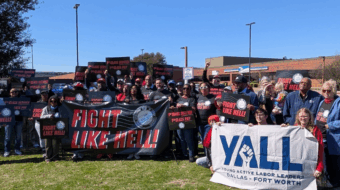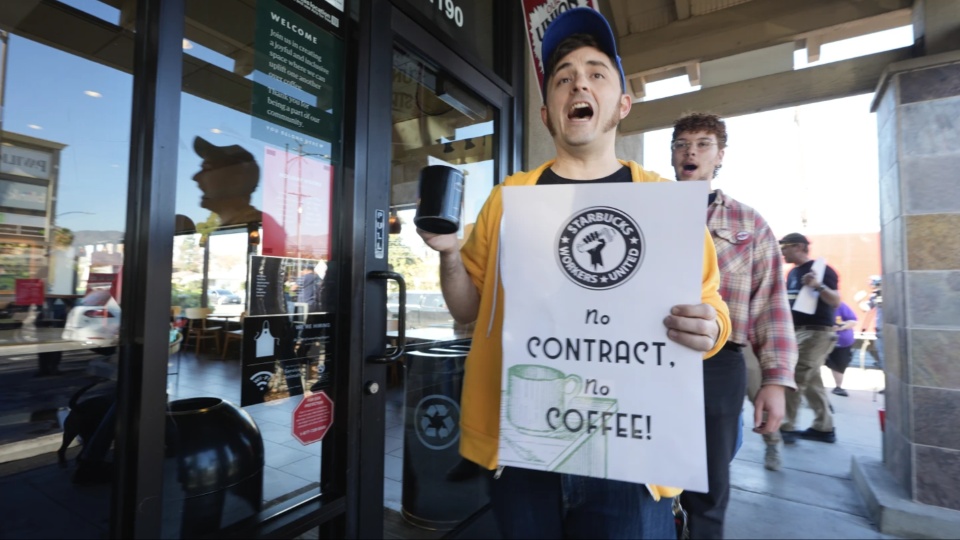
SYLMAR, Calif.—Even as talks drag on between anti-union Starbucks management and workers at 640 of its stores nationwide, the monster coffee chain can’t resist antagonizing its workers and continuing to break labor law.
And the saga of what happened more than three years ago at the Starbucks store in Sylmar, Calif., not only illustrates the coffee giant’s animosity towards its workers and unions, but also casts a spotlight—as if it’s needed—on the multitude of problems with U.S. labor law.
Talk about “justice delayed is justice denied”—The case of the Starbucks workers in Sylmar is a case study.
The antagonism occurred when the Sylmar workers tried to vote in 2022 to join Starbucks Workers United, a Service Employees sector which has helped workers organize the other stores.
But the firm’s law-breaking—including threats to withhold raises, coercive interrogations, and an outright firing of a top pro-union worker—was so outrageous that the workers lost the vote in mid-2022. They filed an unfair labor practices (ULP) complaint and won a ruling against Starbucks from National Labor Relations Board (NLRB) Administrative Law Judge Ira Sandron in December 2023.
That isn’t the end of the story, though. Now the whole mess in Sylmar is in federal appellate court in New Orleans, one of the most-conservative courts in the U.S., dominated by Donald Trump-named judges.
The original National Labor Relations Act of 1935 says it is U.S. policy to have workers organize both for improving their lot and for protecting themselves against bosses. But FDR’s Labor Secretary, Frances Perkins, and Senate sponsor Robert F. Wagner, Sr., D-N.Y. assumed employers would obey the law, breaking it only in rare instances.
So to encourage peaceful settlements, penalties started low and have stayed low. The assumption hasn’t changed, but 90 years of employer hatred of unions for their workers shows it’s flat wrong.
When bosses break the law, they do so intentionally, often with a wink-wink-nod-nod from hired “persuaders”—union-busters—who tell them of the law’s weak penalties: Small fines, we-won’t-do-it-again notices. Maybe a rerun election.
It costs a company much more to endanger a species under environmental law or to violate someone’s civil rights than it does to break a worker’s rights under labor law. And in labor law cases, the company—the employer—does so intentionally, and doesn’t give a damn.
Organized labor has tried at least three times since 1977 to fix the flaws and lost every time due to corporate clout, campaign contributions, and cascades of lies about “labor bosses.”
Labor’s latest try, the Protect the Right to Organize (PRO) Act, foundered in the then-Democratic-run Senate in 2021. Two “independents” beholden to corporate interests, Joe Manchin of West Virginia (fossil fuel firms) and Kyrsten Sinema of Arizona (banking) abandoned it. Manchin wouldn’t vote to change the Senate’s filibuster rule to allow a vote on the PRO Act. Sinema just plain shut up.
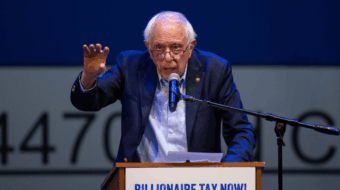
Without Manchin and Sinema, sponsoring Senate Labor Committee Chairman Bernie Sanders, Ind-Vt., couldn’t round up the needed majority to force a floor vote on the PRO Act.
But back to the Sylmar case itself.
Toothless laws
Administrative Law Judge Sandron issued a cease-and-desist order to Starbucks. Sandron ordered the firm to announce it broke labor law, post a notice that it did so, and to promise not to break it again. Net back pay for fired workers was imposed as a penalty. No fines. No court orders. Sandron did order a rerun election at Sylmar.
What the board didn’t do was to say the firm’s law-breaking was so rampant nationwide and outrageous that the cease-and-desist order should be nationwide, too. NLRB member David Prouty joined his colleagues on the overall ruling, but he would have extended the mandatory reruns to cover all Starbucks stores.
The company’s “numerous unfair labor practices nationwide were more than sufficient to establish” the coffee chain’s “propensity to violate the act.” Its “recidivism necessitated a broad cease-and-desist order,” Prouty stated.
But even more than the rerun votes, the biggest problem with the NLRA, weakened over 90 years, may well be “justice delayed is justice denied.”
Starbucks tried a multitude of tactics to halt the balloting in advance of the vote. And while ALJ Sandron ruled for the Sylmar Starbucks workers, his decision came down a year and a half after the firm broke the law, due to the backlog of cases at the NLRB. There is no indication if the harmed Sylmar workers have found other jobs, were reinstated, or are even with the company at all.
The second problem is in remedies, or lack of them. The Sylmar case occurred before then-NLRB General Counsel Jennifer Abruzzo, a Joe Biden appointee and NLRB’s top enforcement officer, convinced the board to increase the penalties against firms which broke labor law by illegally disciplining or firing workers.
The penalties were, at most, just net back pay.
Abruzzo and the board decided penalties should include not just back pay the firm owed the workers—minus whatever earnings they garnered while waiting for the board to rule—but also reimbursement for spending they had to undertake to keep themselves and their families alive.
That included repaying the workers who had to buy their own health insurance or run up credit card debt to pay the rent or auto loans and for job hunting expenses.
Those new penalties hit companies harder in the wallet. But the board made them prospective, not retroactive. Making them retroactive would have covered the Sylmar Starbucks workers. Now even the larger penalties are in doubt.
When the Trump regime took over again, it fired Abruzzo. Her successor, Acting General Counsel William Cowen, announced the new and higher penalties would take a back seat to settling unfair labor practices cases quickly, given the board’s backlog. If that means lower fines and lesser penalties, so be it.
The PRO Act would have made it much easier for the NLRB, after ruling firms broke labor law, to get court orders—injunctions—against further unfair labor practices. Cowen, in another memo, limited injunction requests.
All this is on top of the fact that Republican-passed changes to the National Labor Relations Act, coupled with court rulings, turned organizing, winning union recognition elections, and achieving first contracts, often the toughest hurdle for workers, into a long and veritable obstacle course.
Which is how the case of the Sylmar Starbucks workers took three years to even reach a hearing at the Fifth U.S. Circuit Court of Appeals in New Orleans.
Sylmar specifics
Key issues in Sylmar were heavy workloads, especially at closing time, and Starbucks’ usual low pay. Workers David Ramirez and Jason Untaran reached out to Starbucks Workers United, and Ramirez started talking union to the other baristas. They quickly picked up support.
Starbucks responded by cutting hours for the leaders, slashing their pay, and offering benefits to workers at non-union stores but withholding them from stores, including Sylmar, where workers were organizing. It also staged “captive audience” meetings, which workers were forced to attend, under threat of discipline. Bosses also told workers that if they didn’t like Starbucks’ pay, they could leave.
“The message was still that if employees unionized, Starbucks would refuse to provide the increased support” they sought, including a promised pay hike. That is “a threat or implication the employer will take some action to render union support futile,” the NLRB said in its court filing.
“As the board has long recognized, when an employer responds to expressions of union support by inviting dissatisfied employees to quit, employees will understand the employer “considers engaging in union activities and continued employment essentially incompatible.
“When that message comes from a manager who has the power to terminate employment, employees reasonably hear a ‘veiled threat of discharge,’” the NLRB told the appeals court. The tactics worked. The Sylmar workers lost the recognition vote, and immediately afterwards, on July 1, 2022, Starbucks illegally fired Untaran.
His final “crime” besides union advocacy? Untaran had arranged a meeting between the Sylmar baristas and their local congressman, Democratic Rep. Tony Cardenas, who then issued a strong statement on social media supporting the organizing drive.
Except for the meeting with Cardenas, Starbucks’ tactics against the Sylmar workers are identical to its labor law-breaking elsewhere. They’re also similar if not identical to the tactics anti-worker bosses at any industry use against union organizing drives.
“Substantial evidence supports the board’s finding that Starbucks repeatedly violated” labor law “by coercing employees in the weeks before a union election,” Sandron wrote. He ordered a rerun election, under the condition that Starbucks not break labor law again.
“In one-on-one conversations with” workers Edison Sosa, Untaran, and Ramirez, “Starbucks unlawfully threatened to pause new benefits because of the union campaign and rescind existing benefits if employees chose union representation.
“Starbucks also told” pro-union worker Barbara Pichardo Panegas “that union representation would be futile and invited her to quit rather than seek improvements through collective bargaining.
“With the courts’ approval, the board has long found such statements coercive. The board also reasonably found…that Starbucks unlawfully interrogated Untaran when it pried into union sentiments he previously kept private, under circumstances that heightened the question’s coercion.
“Substantial evidence also supports the finding that Untaran’s discharge” broke labor law. “Starbucks discharged him shortly after his public union activity, citing misconduct for which similar employees received lesser discipline. Accordingly, the board reasonably inferred Starbucks” fired him because he was a lead organizer.
All this broke labor law, Judge Sandron ruled. But—also typical in labor law cases—Starbucks went to court, forcing the NLRB to defend its ruling and the workers. That’s prolonged the Sylmar workers’ case by almost another year.
How to win?
The labor movement has engaged in a long campaign to close the corporate-created loopholes in the National Labor Relations Act. The PRO Act would remove most of the company- and court-created hurdles to union organizing and bargaining.
It also would mandate arbitration if firms fail to settle on first contracts with their workers—as Starbucks has failed to settle with the 640 unionized Starbucks stores nationwide since workers and Starbucks Workers United achieved their first breakthroughs, in and around Buffalo, N.Y., almost three years ago.
And it would increase the fines for labor law-breaking to $50,000 for a first offense and $100,000 for subsequent offenses.
All this leaves unions and workers with what seems to be a futile campaign for labor law reform. Which means, some labor scholars say, that it’s time to switch tactics. Forget the PRO Act, they contend. Forget the NLRB’s convoluted processes. Hit the streets, en masse, just as the labor movement did in the 1930s—before the National Labor Relations Act passed.
Take risks, just as workers did during the Great Depression. Force change, from the bottom up.
But this time, as a recent session of unionists in Chicago showed, don’t do it alone. Round up wide community support, organization by organization, worker by worker, house by house. And then—and only then—undertake mass marches for worker justice.
We hope you appreciated this article. At People’s World, we believe news and information should be free and accessible to all, but we need your help. Our journalism is free of corporate influence and paywalls because we are totally reader-supported. Only you, our readers and supporters, make this possible. If you enjoy reading People’s World and the stories we bring you, please support our work by donating or becoming a monthly sustainer today. Thank you!
CONTRIBUTOR