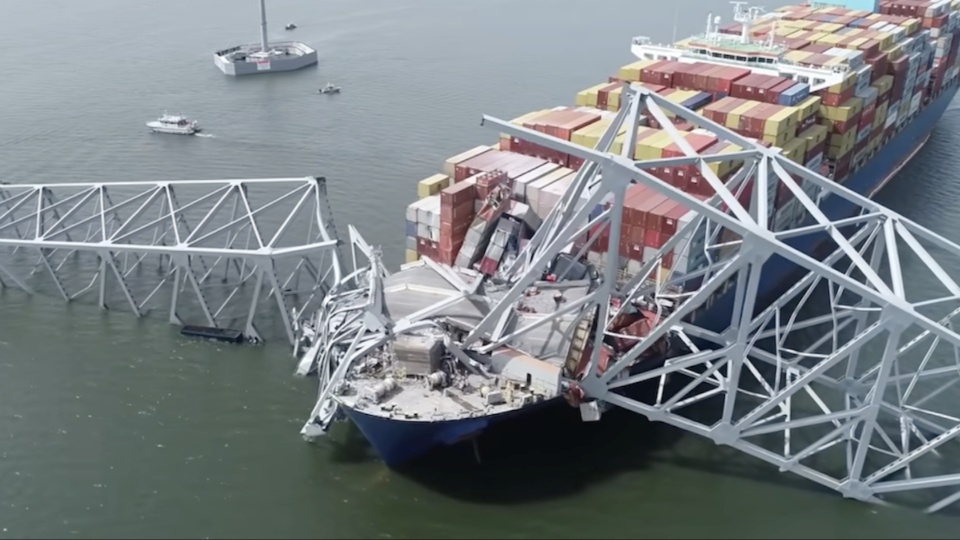
WASHINGTON (PAI)—A loose wire which led to two electrical blackouts and complete loss of power for engines and steering propelled the fully loaded cargo container ship Dali into Baltimore’s Francis Scott Key Bridge, on March 26, 2024, the National Transportation Safety Board says.
In its final report on the crash, which sent the 48-year-old bridge plunging into the Baltimore ship channel, killing six workers, the board warned that dozens of other bridges around the U.S. face the same hazard the Key Bridge did: Inadequate protection around their piers from today’s super-long and super-heavy cargo carriers.
“Our investigators routinely accomplish the impossible, and this investigation is no different,” said NTSB Chairwoman Jennifer Homendy. “The Dali, at almost 1,000 feet, is as long as the Eiffel Tower is high, with miles of wiring and thousands of electrical connections. Finding this single wire was like hunting for a loose rivet on the Eiffel Tower.
“But like all of the accidents we investigate, this was preventable. Implementing NTSB recommendations in this investigation will prevent similar tragedies in the future.”
The investigation’s appendix lists 68 vulnerable bridges which could suffer the same fate if a Dali-like cargo carrier crashes into one of their key piers. The 68 include bridges built before modern protection standards were adopted—such as New York City’s Brooklyn Bridge and San Francisco’s Golden Gate Bridge—and those which need updating to meet modern safety specs.
The bridges that need updating, some of them critically, include New York’s Verrazano Narrows Bridge, the Chicago Skyway’s Calumet River Bridge, and both spans of Maryland’s Chesapeake Bay Bridge, which connects the Eastern Shore to the rest of the state, five Delaware River bridges in the Philadelphia area, and the George Washington Bridge connecting New York and New Jersey. Another is the Newark Bay bridge in New Jersey.
Five bridges spanning the Delaware River in the Philadelphia area are also listed, as is New York’s George Washington Bridge. Including that bridge and the Brooklyn Bridge, 13 of the vulnerable bridges are in New York state alone.
“The Maryland Transportation Authority,” which built and owned the Francis Scott Key Bridge—“and many other owners of bridges spanning navigable waterways used by ocean-going vessels, were likely unaware of the potential risk that a vessel collision could pose to their structures. This was despite longstanding guidance from the American Association of State Highway and Transportation Officials recommending that bridge owners perform these assessments,” NTSB said.
“The NTSB sent letters to 30 bridge owners identified in the report”—owners of the most critical bridges—“urging them to evaluate their bridges and, if needed, develop plans to reduce risks.”
The report absolves the Dali crew of responsibility for the crash itself. Indeed, in a long interview with the navigator, he described his desperate efforts to turn the Dali away from the bridge’s central pier. But the ship had lost power and slammed into it.
That’s where the responsibility of the ship’s owner, Grace Ocean Private, Ltd., enters the picture, the NTSB said. It was responsible for inspecting the ship and its wiring before it left the Port of Baltimore.
“If infrared thermal imaging, an inspection technique that allows inspectors to identify possible points of failure in electrical components not visible to the human eye, had been used to inspect the Dali’s high-voltage switchboard connections as part of the vessel’s preventative maintenance program, the loose Wire 1”—the wire that failed—“may have been identified,” NTSB said.
“The low-voltage bus powered the low-voltage switchboard, which supplied power to vessel lighting and other equipment, including steering gear pumps, the fuel oil flushing pump and the main engine cooling water pumps. Loss of power to the low-voltage bus led to a loss of lighting and machinery (the initial underway blackout), including the main engine cooling water pump and the steering gear pumps, resulting in a loss of propulsion and steering.”
The engines failed when the blackout hit, NTSB said.
“Loss of power to the low-voltage bus led to a loss of lighting and machinery—the initial underway blackout—including the main engine cooling water pump and the steering gear pumps, resulting in a loss of propulsion and steering. As a result of our investigation, we identified four safety concerns that, while not causal to the initial underway blackout, were related to preventing a loss of propulsion and recovering steering and vessel electrical power following a blackout.” One was low cooling water pressure.
Without propulsion or steering, the Dali, under its momentum coming out the harbor, drifted and slammed into the bridge’s main Pier 17, bringing the whole span crashing down on the ship and into the channel.
The crew was able to save lives in the final seconds before the crash by alerting shore authorities, who closed the bridge to vehicle traffic just before the ship hit it. But eight workers, performing pavement repairs on the bridge deck at 1:29 am, plunged into the river. All, like many other road workers, were migrants from Latin America. Two survived, but six died.
Families of at least four of the dead sued the owners of the Dali last year in federal court in Maryland, but also told the press then that they not only wanted damages for the loss of their loved ones, but to force both the maritime industry and bridge construction firms into action to make the bridges safe.
The families, their lawyers, the pro-Latino advocacy and aid group Casa de Maryland, which arranged that initial press conference, posted no immediate comments on the NTSB report. Nor did unions, including the International Longshore Association local, which established an emergency fund for their families and to aid its members who lost work when the crash closed the ship channel for weeks.
At that press conference, Carmen Luna, widow of one of the workers who died, stated, “We hope that no one else has to suffer in this tragedy like we have. Justice means preventing future tragedies.”
A cargo carrier had hit the bridge pier once before, three years after it opened. But a diagram in the NTSB report showed that carrier, the Blue Nagoya, was much older, much, much smaller and barely caused a dent in the pier. Including its containers stacked above its main deck and its superstructure, the Dali was so high it barely made it under the 185 feet between the bridge deck and the water level.
“The Dali is 10 times the size of the Blue Nagoya,” the NTSB reported laconically.
We hope you appreciated this article. At People’s World, we believe news and information should be free and accessible to all, but we need your help. Our journalism is free of corporate influence and paywalls because we are totally reader-supported. Only you, our readers and supporters, make this possible. If you enjoy reading People’s World and the stories we bring you, please support our work by donating or becoming a monthly sustainer today. Thank you!
CONTRIBUTOR