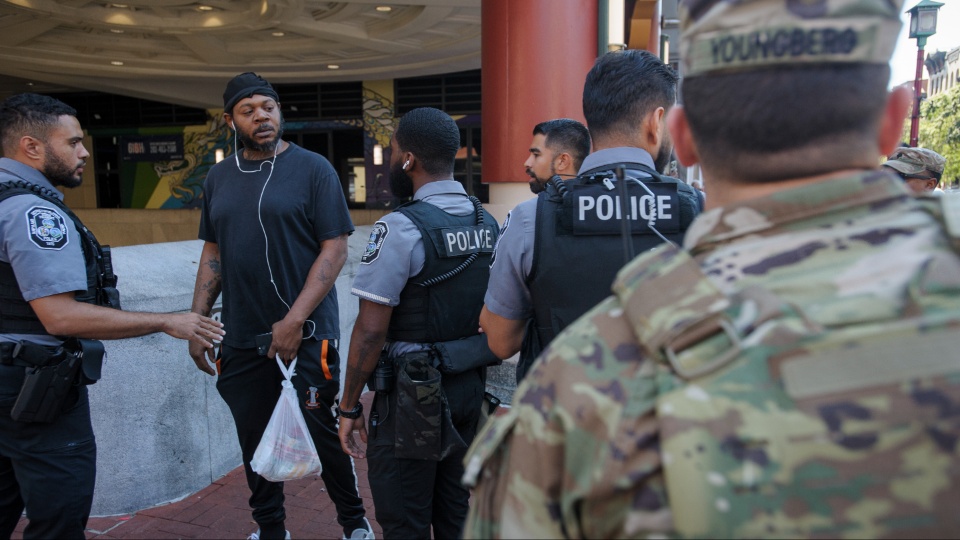
The formal end to the federal occupation of the District of Columbia supposedly took place on Sept. 10, 2025, but military troops and the surge of federal law enforcement remain on the streets.
Mayor Muriel Bowser, after the Trump emergency declaration expired, stated that the Metropolitan Police Department (MPD) would no longer collaborate with federal immigration enforcement, seemingly caving to pressure from her constituents.
Her directive on post-occupation collaboration with federal law enforcement was not rescinded, however, when she made this announcement. Nor was the police chief’s order to officers to collaborate with immigration enforcement. National Guard troops, meanwhile, are to remain stationed at Metro train stops and federal parks through at least the end of the year, though South Carolina recently brought its soldiers home.
One of the demands of the Free DC Project—the local campaign to defend Home Rule from Trump and MAGA attacks—is for the occupation to fully and truly end, which means terminating Metro Police Department (MPD) collaboration with federal law enforcement (in particular, immigration enforcement: ICE, Homeland Security, Customs and Border Protection, Enforcement and Removal Operations) and expulsion of the troops from the District.
Part of this demand is to return MPD to full local control, which means putting it under the direction of the D.C. government, taking orders from the mayor and police chief.
While the occupation may have formally ended and the mayor has claimed that MPD is no longer collaborating with federal immigration enforcement in line with the Sanctuary Values Act, the truth is that MPD is still openly collaborating with immigration enforcement. Local community members have seen it, and video footage has been shared across social media.
So, the question remains: Has the occupation really ended?
If yes, then why is MPD still collaborating? This makes the ultimate case for not only D.C. Statehood but also for community control of the police to ensure further accountability of the D.C. police and to give the people a say in policing policy in our city.
To remind readers, community control of the police is the demand to put the issue of police accountability directly in the hands of the people and neighborhoods whom officers are supposed to serve and protect. In practice this means passing a municipal policy that would create a police control/accountability board led by civilians with the power to:
- Hire/fire police officers
- Control the police budget
- Negotiate police union contracts
- Set police policy
- Investigate misconduct
In D.C., there are Citizen Advisory Councils (CACs) that exist in each police district, which serve as a police complaint board. They have zero teeth, though, with no real accountability mechanisms. Often, the CACs merely serve as a soundboard for white homeowners to complain about petty crimes or for neighbors to submit general complaints. Generally, they don’t result in any police policy change.
Under a real “civilian police accountability council” (CPAC), however, the police department and its officers would be directly accountable to the board and not solely the superintendent or chief. This would shift the balance of forces from the local government directly to those who have been elected to this council by the voters.
Currently in D.C., residents have to submit a Freedom of Information Act (FOIA) request to find out if there is any law being broken by the police chief or the mayor. That makes it incredibly difficult for residents to keep an eye on what law enforcement or their superiors are up to. Then, of course, there are the obvious violations, such as MPD officers wearing masks to hide their identity and collaborating with federal immigration enforcement.
A CPAC would be able to investigate these officers’ violations and strengthen municipal policy to break all collaboration with federal immigration enforcement and the military. This would no doubt be Trump and the GOP-controlled Congress’s worst nightmare. Instead of having a collaborationist mayor in control of the D.C. police, the force would instead be under the scrutiny and control of a D.C. community-elected CPAC.
The D.C. Police Union, part of the Fraternal Order of Police, has been in the pro-MAGA and anti-D.C. Home Rule camp for a long time. D.C. Police Union leader Gregg Pemberton has also covered for his officers that collaborated with fascist forces that came to D.C. on and before January 6, 2021, like the Proud Boys, to participate in the Trump-led coup attempt. Pemberton has also supported the repression of local Black Lives Matter movements in the District.
A CPAC would have the power to break the union contract or negotiate it in a way where the communities who are impacted by police are more represented.
Community control would still have difficulties when it comes to jurisdictions and relations with the federal parts of the District, like those controlled by the National Park Service. This is why D.C. Statehood is so important. Together with community control of police, it would grant so much more autonomy D.C. residents and increase more local control.
The Empower Communities for Public Safety (ECPS) law that was passed in Chicago in 2021 led to the development of all-elected local district councilors in each police district in addition to a city-wide commission (which is partially elected and partially appointed by the mayor. D.C. could take this as an example, by radically reforming its current ineffective CAC system and actually holding police officers accountable for breaking police policy and setting forth a non-collaborationist policy.
MPD officers should be held accountable for their collaboration with a fascist consolidation of power and with an administration that wants to completely rule over D.C. Community control would be a good first step in that direction, putting power directly in the hands of the people who have been terrorized by this military occupation and the surge of immigration raids and federal law enforcement.
The District is suffering, and we need a real response with real solutions that are going to protect our most vulnerable community members. This means struggling for local political power over policing and public safety policy to ensure that this occupation ends and that another one never happens again.
As with all op-eds published by People’s World, the views expressed here are those of the author.
We hope you appreciated this article. At People’s World, we believe news and information should be free and accessible to all, but we need your help. Our journalism is free of corporate influence and paywalls because we are totally reader-supported. Only you, our readers and supporters, make this possible. If you enjoy reading People’s World and the stories we bring you, please support our work by donating or becoming a monthly sustainer today. Thank you!
CONTRIBUTOR