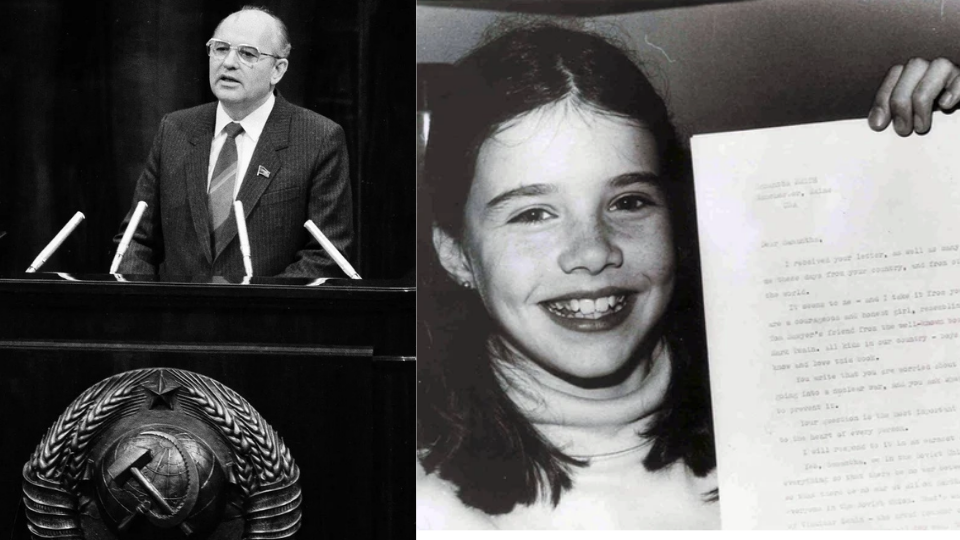
Retired People’s World Editor Timothy Wheeler reflects on the ever-present danger of imperialism and a historic moment in the USSR in 1988 with Soviet leader Mikhail Gorbachev and the grieving mother of a young activist.
I was assigned by the People’s Daily World (PDW) to fly to the Soviet Union to help Carl Bloice, our Moscow correspondent, cover the Reagan-Gorbachev summit, May 29-June 2, 1988.
As the PDW’s Washington Bureau Chief, I had been covering “Reagan Doctrine” wars nonstop since he took office. A year earlier, July 1987, I had a choice seat in the Senate Caucus Room listening to the strutting Lt. Col. Oliver North brag about his orchestration of the Iran-Contragate war in Nicaragua and El Salvador. Contrary to portrayals of Reagan as an aging, befuddled, drug-store cowboy unaware of the Iran-contragate, North said Reagan was eager to know all the details of the sale of shiploads of TOW missiles and other advanced Pentagon weaponry to Iran ordered by Reagan himself.
North told Reagan how he laundered the profits through secret Swiss bank accounts to buy weapons for the contras in Central America, the Congo, Angola, and other war zones around the world. Millions of innocent people died. It was in flagrant violation of the Boland Amendment and other Congressional bans.
It was steaming hot in Moscow and I was staying at the October Hotel reserved for Communist Party members. It had no air conditioning but fortunately the double windows could be opened to let in a breath of cool air on Moscow nights. It was eight hours time difference so I suffered insomnia. Luckily, I had brought with me Mikhail Gorbachev’s recently published book, Perestroika.
I read it avidly since I couldn’t sleep. I came to a passage in which Gorbachev explained just how central “Peaceful Coexistence” is to Soviet foreign policy. V.I. Lenin first enunciated “Peaceful Coexistence” as the cornerstone of Soviet foreign policy, calling it a “special form of the class struggle.”
But, wrote Gorbachev, “Peaceful Coexistence” in the epoch of nuclear weapons is so crucial, the Kremlin leaders decided to abandon this formulation, to renounce Lenin’s wording that it is a special form of the class struggle.
I underlined Gorbachev’s words and wrote in the margin: “I disagree.”
In those days, we argued that the emergence of the USSR and other socialist revolutions, coupled with the powerful “nonaligned nations” and mass peace movements, had, taken together, tipped the “balance of forces” in the world against imperialism. If these forces united, they could block the intrinsic drive of imperialism toward world war. But above all, we must never forget that we face an aggressive imperialism, intent on conquest, determined to destroy any force that stood in its way, the USSR first of all.
The next morning, Carl and his chauffeur and interpreter picked me up and took me to the spanking new high rise hotel where our comrade Jim Steele, a leader of the Young Communist League (YCL) was staying while the lumbago in his back was treated. Jim’s hotel was air-conditioned and offered a breathtaking view of Moscow from the 15th floor.
I had brought Gorbachev’s book with me and read the passage aloud to Jim and Carl.
Both Carl and Jim told me I had to “get with the program,” that sixty years had lapsed since Lenin formulated foreign policy for the USSR. In effect, I was living in the past, hidebound, dogmatic!
Ironically, that afternoon, I was assigned to cover a meeting Gorbachev had scheduled in one of the largest auditoriums in the Kremlin with more than 1,000 grassroots peace activists who had come from every continent to press the demand for world peace, nuclear disarmament, an end to all forms of imperialist wars, neo-colonial exploitation, and oppression.
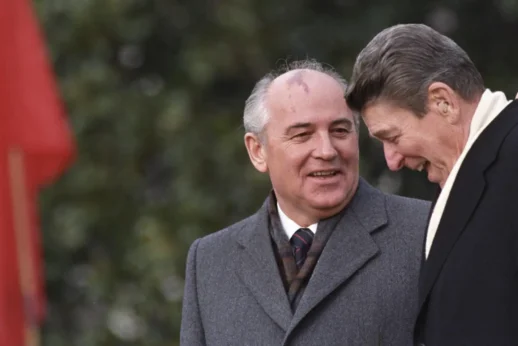
Gorbachev spoke to the crowd, all of us wearing headphones so we could listen to the interpreter translate his message. I was nodding in agreement as I took notes: We are in a struggle to end the Cold War, Gorbachev said, to end the nuclear arms race, win worldwide peaceful coexistence. That is the meaning of the Intermediate Range Missile Treaty, which he and Reagan were scheduled to sign.
The crowd erupted in a thunderous standing ovation.
Then the Soviet hosts invited guests to line up at the microphone to ask questions and make brief comments. Nearly 100 people formed a line that reached back up the center aisle and along the back of the auditorium. The questions and comments flew, and Gorbachev answered.
Then suddenly he halted. He gestured toward a slender, handsome woman waiting near the end of the line. He called out to her in Russian, and the interpreter translated: “Are you Jane Smith?”
She nodded. “Yes…I am”
“Please,” said Gorbachev. “Come up to the front.”
And Jane Smith came to the front.
“Thank you for being here,” said Gorbachev in a quiet voice as if speaking to her personally and not to the crowd. “Are you all right? Is there anything we can do to help? Just say it, and we will do all we can.”
Jane Smith nodded and replied that yes she was OK. She had founded the Samantha Smith Foundation in honor of her daughter and husband, who had died in a tragic air crash two years earlier.
Said Gorbachev, “Samantha was so beautiful, so wise beyond her years, so eloquent in her call for world peace. When she and her father died, our entire nation was in mourning, especially the youth.”
Jane Smith was nodding. “We are organizing visits of American youth to the USSR and Soviet youth to the U.S. We need friendship between the U.S. and the Soviet Union,” she said.
A hush had fallen over the vast crowd as Gorbachev and Jane Smith spoke, everyone leaning forward trying to hear this quiet conversation.
We all knew the story: At age 10, Samantha Smith of Manchester Maine, had written a letter to Soviet leader Yuri Andropov in November 1982 asking him if he thought a thermonuclear war would destroy life on earth. Andropov had answered Samantha in April 1983. Everyone must work to end the arms race and prevent World War III, Andropov wrote.
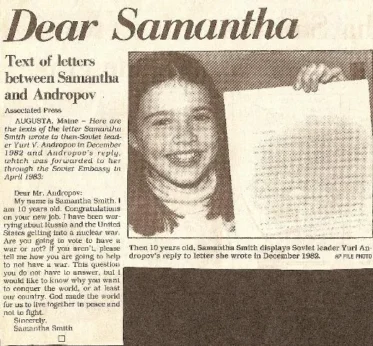
He invited Samantha to come to the Soviet Union with her mother and father. They did in the summer of 1983. She went to the Artek youth camp, met with Soviet youngsters her own age, made a whirlwind trip across the USSR, speaking out for U.S.-Soviet friendship. She was such a beautiful young girl, so bright, and eloquent that she was a media sensation, interviewed, videoed, by the U.S. Soviet and world media.
The Disney Corporation produced a TV show, “Samantha Goes to Washington,” in which Samantha interviewed candidates for the U.S. presidency in the 1984 election, including Senators George McGovern, John Glenn, and the Rev. Jesse Jackson.
She and her father were on a plane flying back to Maine from another TV show she was scheduled to perform in when the plane crashed, killing everyone on board August 25, 1985. I was so moved by her life and death, I wrote a poem in her memory:
“Let us walk through the forest of Samantha’s death/And hear singing in the tops of Androscoggin pines/ Her epitaph: We are meant to live! Not to fight and die..:”
I still disagree with those lines in Gorbachev’s book. He and too many people in the Soviet Union forgot they were up against enemies—domestic and foreign—intent on destroying the USSR. They forgot the class struggle, forgot the fascist enemy that 25 million of them died to defeat in World War II.
Yet I will never forget Mikhail Gorbachev’s kindness and humanity toward a grieving mother. He saw in Samantha Smith’s initiative a path toward world peace.
We hope you appreciated this article. At People’s World, we believe news and information should be free and accessible to all, but we need your help. Our journalism is free of corporate influence and paywalls because we are totally reader-supported. Only you, our readers and supporters, make this possible. If you enjoy reading People’s World and the stories we bring you, please support our work by donating or becoming a monthly sustainer today.
CONTRIBUTOR