WASHINGTON—The gap between median CEO pay and median U.S. worker pay grew to a record 312-1 last year, the AFL-CIO’s annual Paywatch study shows. But add in the $158 billion Tesla paid its CEO, Elon Musk, and that ratio becomes 17-1/4 times as large, at 5,387-1.
Think that figure is huge? Paywatch calculates the ratio between Musk’s pay and that of a median Tesla worker is a canyon: 2.522 million-1.
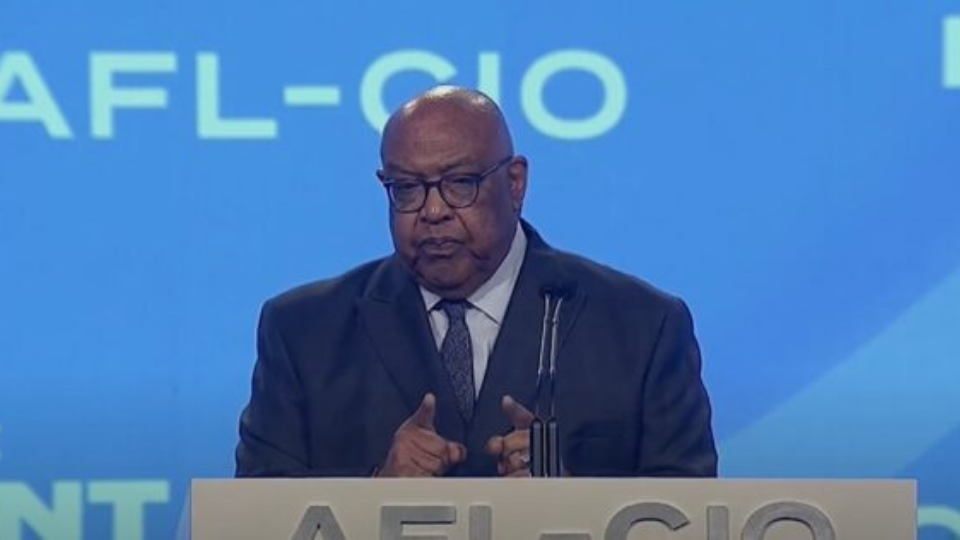
And Musk didn’t even work full-time on Tesla, federation Secretary-Treasurer Fred Redmond said in unveiling the report, based on corporate data sent to U.S. agencies.
Musk was busy running his other enterprises, notably SpaceX, or using his chainsaw as head of GOP President Donald Trump’s so-called Department of Government Efficiency (DOGE) “to bushwhack” much of the federal workforce.
Or spending $288 million—which Musk did the year before—to elect Trump to the Oval Office. Or spending $100 million this year to keep GOP (read “corporate”) control of the U.S. House of Representatives.
Or, though Redmond didn’t say so, joining with other megamillionaires in a federal lawsuit to get the National Labor Relations Act, and the NLRB which enforces it, declared unconstitutional. Musk, of course, is the world’s first trillionaire.
Without Musk, Redmond explained, CEOs of Fortune 500 firms had median pay and perks worth $22.8 million each, a record 21% jump in one year. The median is the point where half of the group is above and half below.
Such huge paychecks are dangerous to workers and to the economy, Redmond explained. That’s because they skew decision-making, prioritizing short-term gains, mostly through stock options, over long-term investment in factories—and in the workers whose productivity produces those gains. It also “contributes to growing economic inequality,” Paywatch adds.
The largesse to Musk “boggles the mind,” Redmond said. It also skewed the figures of the Paywatch report. It was so huge, Paywatch had to calculate all its ratios twice: Once with Musk and once without him. The entire report, by company, sectors and states, is at www.paywatch.org.
Tesla didn’t do too badly even when Musk wasn’t there, Redmond reported. Its profits totaled $5 billion. Its federal income taxes totaled zero.
Musk wasn’t the sole mogul to hit it big in 2025, Redmond said. Trump pocketed $635 million by “selling memes” and other enterprises. But the president’s investors in memes lost $600 million.
Trump’s total income in his first year back in the Oval Office: $2.2 billion. That includes money from memes, stock, cryptocurrency and his real estate. The ratio between his payola and the median paychecks of all U.S. workers: 43,154-1.
The catch to the Paywatch report, of course, is that while it covers the Standard & Poor’s 500 and another list of 5000 firms, all are publicly traded. Private firms such as the Trump Organization or so-called “venture capital” funds don’t file federal reports.
And all of this largesse to the richest of the richest of the rich occurred while half of working people under the age of 30, including married couples, are still living with their parents, said Redmond.
“Sixteen percent of adults cannot pay their bills in full, 26% skipped medical care due to cost, 37% do not have enough cash to cover a $400 emergency expense, and 23% of renters fell behind on their rent in the past year,” Redmond added. The result is “billions for the billionaire and rising prices for working people.”
“This is only part of the story about how the wealthy have rigged the economy.”
But when the CEOs “make 300 times what workers make” while telling workers they can’t afford pay hikes or covering increased health insurance premiums—as the CEOs of Cleveland Cliffs and U.S. Steel are telling Redmond’s old union, the Steelworkers—then “the playing field is not level” and the CEO pay “is exorbitant.”
Despite the large paychecks, “we’re not opposed to CEOs getting paid more” than median pay for workers, Redmond admitted. But those who deserve it are CEOs who are “getting paid on the basis of a return on investment and on creating jobs.”
Job creation is one output the CEOs are not achieving during the first year and a half of Trump’s second term. Bureau of Labor Statistics data show that in February 2025, the first full month of Trump’s second term, private firms employed 133.333 million people. In July 2026, they employed 136.536 million.
That’s an average gain of 177,994 jobs monthly—not enough to keep up with the monthly increase of 200,000- 250,000 people, entering the workforce. The private sector did better than federal workers, though. They fell victim to Musk and DOGE. In those same 18 months, 306,000 U.S. workers, out of 2.32 million total, lost their jobs.
There is a partial solution to this chasm between CEO pay and that of the rest of us, Redmond said. It’s this fall’s election. And the federation intends to put hundreds of thousands of people in the field in its most massive get-out-the-vote campaign ever—and 25,000 more to help ensure Trump doesn’t rig the balloting by arresting people, deporting them to prison camps, scaring them away from the polls or all of the above.
“We can restore the balance to our economy by electing the right people who can do so,” he concluded.
We hope you appreciated this article. At People’s World, we believe news and information should be free and accessible to all, but we need your help. Our journalism is free of corporate influence and paywalls because we are totally reader-supported. Only you, our readers and supporters, make this possible. If you enjoy reading People’s World and the stories we bring you, please support our work by donating or becoming a monthly sustainer today. Thank you!
CONTRIBUTOR